PyPI redesigns project pages to expose security signals for each package
The official Python package repository completed, in November, the overhaul announced in July: a dedicated security tab shows provenance, attestations, and warnings of possible compromise for each release.


- Reading
- 6 min
- Tables
- 1
The official Python package repository completed, in November, the overhaul announced in July: a dedicated security tab shows provenance, attestations, and warnings of possible compromise for each release.
Editor's note: two statements in this text, presented as coming directly from the source, are not supported by PyPI's official announcement: the quantification that 'No Provenance' would be 'the reality for most legacy packages in the ecosystem' (the source only says this is typical of old releases or projects without Trusted Publishing, without quantifying it) and the claim that the source recommends 'eliminating long-lived API tokens' (the source recommends considering Trusted Publishing, but does not use that wording). We kept the text because these are points of analysis and not central facts of the news, but readers should consider these two sentences as the editorial team's interpretation, not a direct quote from the source.
PyPI, the official Python package repository, announced on November 6 the completion of an interface overhaul promised in July of this year. The goal: to make visible, on the project's own page, security signals that were previously hidden in technical metadata or simply did not exist on screen.
The work was carried out with the consultancy Kabu Creative and funded by the Open Source Security Foundation (OpenSSF), following the recommendations of the OpenSSF Attestations Style Guide. The motivation declared by the PyPI team is that the growth of the Python ecosystem has turned the repository into an increasingly attractive target for supply chain attacks.
A single tab for security
The central change is the new "Security" tab on each project page. There, PyPI shows the provenance status of each release and details, file by file, which attestations (cryptographic proofs of origin) exist. Attestations were introduced by PyPI in 2024, but the old interface did little to explain their meaning or limitations.
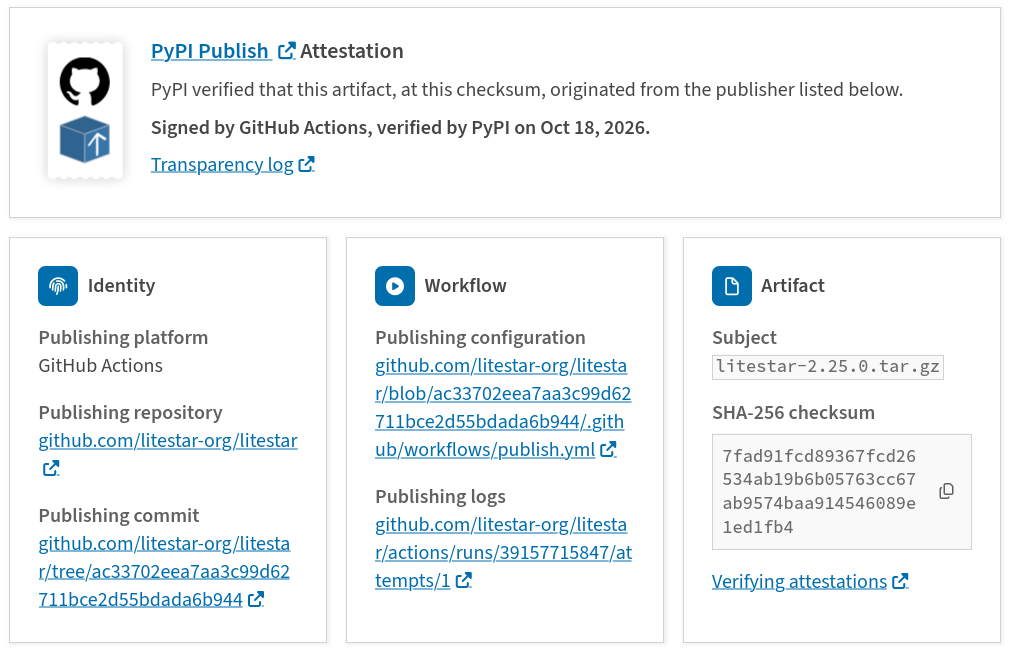
PyPI calculates the provenance of each release by checking whether every published file has an attestation. Two states are the most common:
- Full Provenance: 100% of the release's files carry at least one supported type of attestation.
- No Provenance: no file has an attestation, which is typical of old releases or projects that never configured Trusted Publishing. According to PyPI, this does not necessarily indicate malicious intent, only that the file's origin cannot be cryptographically verified.
Two types of attestation are supported, with different functions:
| Type | What it proves |
|---|---|
| PyPI Publish attestation | The file was published by a Trusted Publisher recognized by PyPI |
| SLSA Build Provenance attestation | The file is linked to the exact source commit, build platform, and instructions used |
Both can be inspected directly in the interface, with a link to the corresponding transparency log.
Four warnings worth checking before installing
Beyond the two basic states, PyPI now displays warnings when provenance metadata appears inconsistent with the project's history, which can indicate anything from a legitimate infrastructure migration to a compromised account. There are four:
- Incomplete Provenance: part of the release's files have attestation and part don't (for example, wheels published via Trusted Publishing, but the source code tarball uploaded with an API token).
- Inconsistent Provenance: files from the same release come from different build systems or source repositories.
- Change of Provenance: the files of the current release came from a different repository or workflow than the one used in the previous release.
- Loss of Provenance: a project that previously published with attestations has started publishing without them.
PyPI itself recommends proportional caution: for "Incomplete Provenance," check the release notes or open an issue with the maintainers; for "Inconsistent Provenance," the guidance is to check the attestation metadata to confirm whether all files came from sources controlled by the maintainers; for "Change of" and "Loss of," confirm through official channels whether a planned migration occurred before treating the warning with skepticism. When a project or release is in quarantine, that banner takes priority over any other warning.
The rest of the page changed too
The project details page was reorganized to highlight these signals. Provenance warnings now appear at the top, along with banners for yanked releases, archived projects, and pre-releases. In the sidebar, metadata is no longer grouped by verification status and is now ordered by usefulness, with "PyPI data" (data provided by the maintainer) or "Data verified by PyPI" (data verified by PyPI itself) labels.
The release files tab gained search and filtering for long lists, shows the provenance status of each file individually, and marks "late files" with an orange icon: files uploaded more than 14 days after the release's initial timestamp. This warning only appears on releases prior to July 2026, when PyPI began rejecting new files for a release after that 14-day window. The release history tab, meanwhile, now shows file count, provenance status, and status (quarantined, yanked, archived, or pre-release) for each published version.
What changes for those choosing dependencies here
For those developing in Python in Brazil, the practical change is having, for the first time in PyPI's own interface, a single place to evaluate whether a dependency is worth trusting before running pip install. Previously, checking provenance required understanding the concept of Trusted Publishing and reading raw metadata; now the information arrives ready-made, with labels and explanations.
This doesn't eliminate the need for judgment. "No Provenance" remains the reality for most legacy packages in the ecosystem, and PyPI itself advises using complementary signals, such as maintainer history, release patterns, and repository activity, when there is no attestation. For teams that maintain packages published on PyPI, the source's direct recommendation is to migrate to Trusted Publishing with a publisher that generates attestations before the next release, eliminating long-lived API tokens from the publishing flow.
It's worth reading the package security guide published alongside the redesign, which covers everything from integrity checking to how to report a suspicious package, as well as the OpenSSF Attestations Style Guide itself, where the PyPI team published a case study detailing the warning patterns created in this project, to help the broader open source ecosystem benefit from this work.
What remains open
The announcement itself treats the new security tab as a foundation for the future, not an endpoint: it was designed to accommodate new types of attestation and security warnings that don't exist yet. The work was led by Dustin Ingram and Zach Steindler, with participation from the OpenSSF Securing Software Repositories Working Group, and received design review from Mike Fiedler and Jacob Coffee, of the PyPI team.
What isn't clear from the source is a timeline for other Python ecosystem package indexes, such as corporate mirrors, to replicate the same signals, nor whether adoption of Trusted Publishing by smaller projects will accelerate given the new visibility.
Translated from the Brazilian Portuguese original · Read the original
Anthropic eyes $64 billion IPO, but order book diverges on its AI edge
Anthropic's roadshow set a record for institutional demand, outpacing even the early days of SpaceX's offering. But behind the oversubscribed book, banks and investors still don't agree on how much the company's AI lead is worth.