
Qualcomm releases native Linux preview for Snapdragon X2 laptops
Even before the first Snapdragon X2 laptops reach the market, Qualcomm has released a developer preview with upstream Linux kernel support, aimed at those who maintain distributions and toolchains, not the end user.

Qualcomm announced, during Snapdragon Summit 2026, an early developer preview of Linux running on upcoming Snapdragon X2 laptop processors. Unlike previous versions of the platform, the company is prioritizing an upstream-first approach: the target is not the end user who wants to install a ready-made distribution, but rather kernel contributors, toolchain maintainers, and those responsible for Linux distributions, according to a report by InfoQ.
The shift in approach has a concrete reason. The first generation of Snapdragon X Elite left a trail of fragmentation: out-of-tree kernel trees, broken display drivers, and incomplete power management. This time, Qualcomm wants to resolve that software friction before the laptops reach shelves, not after.
What the Preview Delivers Today
The preview establishes a functional reference environment based on Debian 13 ("Trixie"), which already validates boot paths, core system buses, the graphics stack, and the neural processing unit (NPU) on reference hardware. It is not an operating system ready for daily use, but rather a foundation for those who need to test whether their own code, driver, or package works on this architecture before the commercial hardware exists.
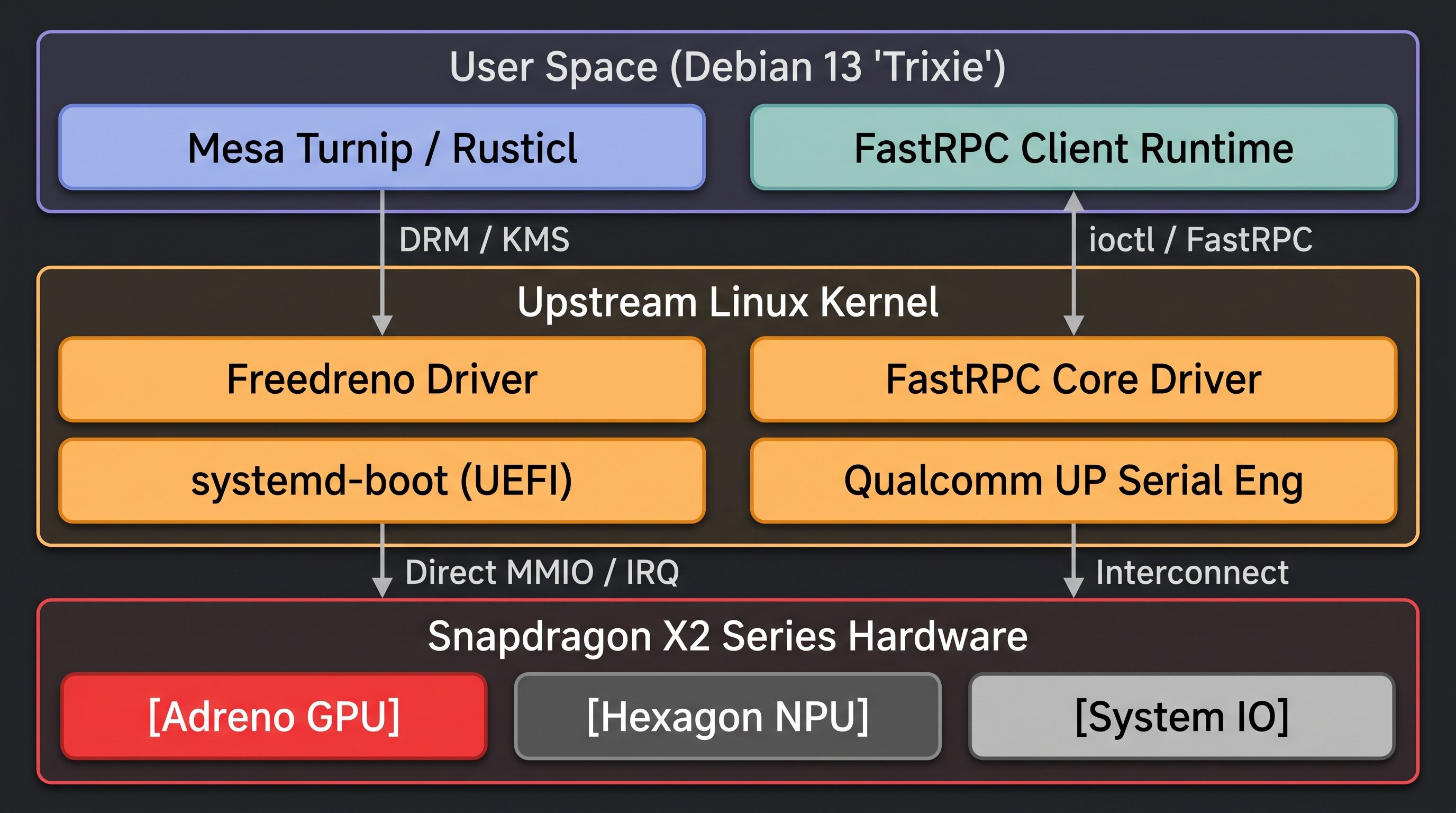
System boot uses standard UEFI handing control over to systemd-boot, avoiding the proprietary bootloader semantics that plagued the previous generation. This brings Snapdragon X2 closer to behavior already familiar from ARM servers and x86, reducing the learning curve for those who already work with these platforms.
How the Stack Handles Input, Output, and Acceleration
Qualcomm is upstreaming drivers for several layers of the system instead of relying on proprietary out-of-tree kernel modules:
- I/O peripherals: upstream drivers for the Qualcomm Universal Peripheral serial engines cover UART, I2C, and SPI, as well as PCI Express and high-speed USB.
- Graphics: Qualcomm collaborates with Mesa's open-source maintainers to integrate the display pipeline via Freedreno KMS (Kernel Mode Setting), Turnip for Vulkan, and Rusticl for OpenCL computing.
- Local AI inference: hardware-accelerated machine learning workloads go through the FastRPC driver subsystem, exposing the Hexagon NPU to user-space frameworks without requiring out-of-tree kernel modules.
This design matters because it is exactly the kind of integration that has historically been missing: without it, every kernel update risked breaking graphics or AI acceleration on ARM laptops.
Testing the Preview in Practice
For those who want to validate their own stack on this architecture, Qualcomm provides a build flow via the Qualcomm Linux repository, compiling device tree binaries and kernel sources into bootable media:
# Build reference kernel and device tree artifacts
export ARCH=arm64
export CROSS_COMPILE=aarch64-linux-gnu-
make snapdragon_x2_defconfig
make -j$(nproc) Image dtbs

# Deploy to UEFI boot partition running systemd-boot
bootctl install --path=/boot/efi
cp arch/arm64/boot/Image /boot/efi/vmlinuz-linux-snpg
cp arch/arm64/boot/dts/qcom/x2-reference.dtb /boot/efi/dtb/
The flow follows the pattern already familiar to those who compile kernels for ARM in other contexts (Raspberry Pi, ARM servers, embedded boards), which reduces friction for teams that already have this experience.
A Three-Phase Rollout
According to Qualcomm engineers Nagaraju Naik and Ramya Kanthi Polisetti, co-authors of the post accompanying the announcement, this preview is just the first stage of a three-phase plan. The company expects to close the main peripheral gaps by the end of November 2026, then move toward a production-ready quality milestone that meets upstream stability and distribution-integration criteria.
What Still Doesn't Work
The list of caveats is long and deserves attention from anyone considering early hardware adoption. In short: the preview targets laptops and leaves out much of the ecosystem, and even within scope there are quality gaps.
- The current preview targets laptop designs exclusively, excluding desktop variants, previous Snapdragon X platforms, and standalone development boards.
- Peripheral coverage is uneven across designs from different manufacturers, due to differences in ACPI tables, embedded controller implementations, and proprietary power rails.
- Audio routing configurations are missing, thermal throttling governors are still rudimentary, and sleep states are not optimized, which hurts battery life compared to equivalent Windows on Snapdragon builds.
- Acceptance into the mainline kernel, via Linux kernel mailing lists, has an uncertain timeline: subsystem maintainers typically require architectural revisions before accepting complex SoC patch series.
Partners and Timeline
Canonical confirmed a collaboration with Qualcomm to deliver officially certified Ubuntu distributions for Snapdragon X2 hardware, with release expected in the first half of 2027. Manufacturers such as HP, ASUS, and HUMAIN have signaled plans to support Linux on consumer and workstation Snapdragon X2 devices within the same period.
What Changes for Developers
For software architects and platform engineers, the preview offers a viable, upstream-aligned foundation to validate native ARM compiler toolchains, container runtimes, and local AI agent inference ahead of general market availability, according to InfoQ.
In practice, this means that those who maintain cross-platform CI/CD pipelines, multi-architecture builds, or projects that depend on local inference of small models gain a real window to test ARM compatibility before any large-scale purchasing decision. This is a very different scenario from what happened with the first generation Snapdragon X Elite, where Linux support arrived fragmented and late relative to hardware already on sale.
For the Brazilian market, where ARM laptops are still a niche and costly-to-import product, the immediate value lies less in the physical hardware and more in getting ahead: teams working with ARM builds for containers, edge computing, or on-device AI can follow the development of Linux support on Snapdragon X2 via Qualcomm's repository without needing the machine in hand, getting a head start on toolchain adjustments before the commercial hardware arrives here.
Translated from the Brazilian Portuguese original · Read the original

KiviDB claims to be up to 9 times faster than Redis while keeping full compatibility
KiviDB is an in-memory database written in Rust that speaks the Redis protocol, adds native vector search, and publishes its own benchmarks against Redis, Dragonfly, and KeyDB. The numbers show a real gain in pure caching, but the story is more contested in vector search.