Google releases EnvHarness, a framework that adapts training environments to each AI agent's weaknesses
The company open-sourced EnvHarness, a layer that reconfigures the training environment according to each agent's flaws, without touching the agent's code. In tests, the technique boosted performance on benchmarks like WebArena and SWE-bench Verified.

Google open-sourced EnvHarness, a framework that dynamically adapts the training environment of AI agents to the weaknesses identified in each one, without altering the agent, the original environment, or the evaluation system. The work was described in a technical paper by the company and reported by InfoQ on October 16, 2026. According to the researchers, the approach improves both the effectiveness and the efficiency of learning, helping agents overcome blind spots that static benchmarks can no longer expose.
The problem of an environment that stops teaching
Self-evolving agents typically improve by rewriting their own prompts and acquiring new skills, but they rarely adapt the environment in which they operate. This has a direct consequence: once the agent learns to solve the tasks of a fixed benchmark, there is nothing new left to learn there.
An agent that keeps improving against a frozen benchmark eventually stops learning from it. The start states, the rules and the feedback are the same for every learner at every stage, so once the agent can solve the tasks, the environment has nothing further to teach.
Google researchers, in the EnvHarness paper
Creating new environments for each training stage is costly: it requires domain-specific pipelines and often depends on expensive or unreliable verifiers. Even with that effort, the resulting environment remains static. It was to solve this equation that the team created EnvHarness.
Three pieces that don't touch the agent
EnvHarness works as a programmable layer of pluggable components that wraps a static environment, changing only the interface through which the agent interacts with it. The internal structure and the evaluation system of the original environment remain untouched.
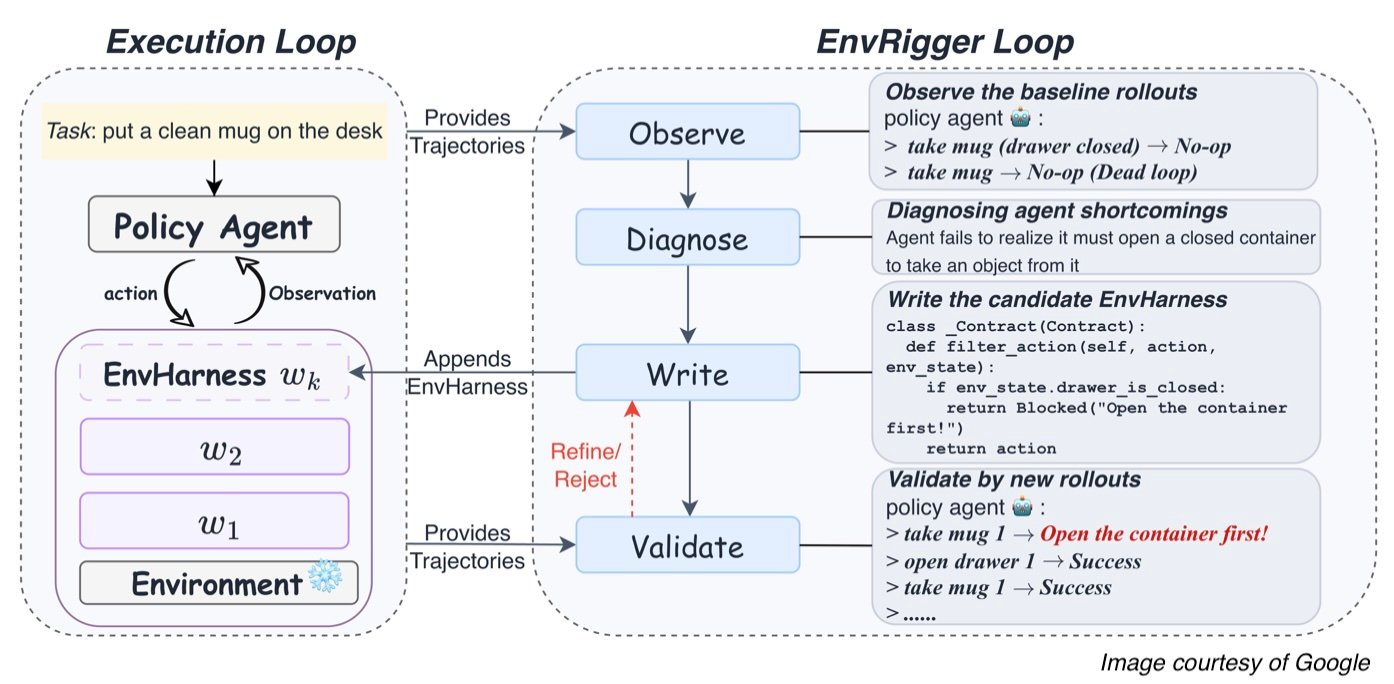
The framework encapsulates the environment using its standard reset() and step() interface and offers three types of combinable components:
- setup: customizes the environment's initial state;
- rule: restricts state transitions in response to the agent's actions;
- link: customizes the observation presented to the agent.
By combining these three blocks, whoever trains an agent can introduce mutations in the environment's behavior without rewriting the evaluation logic that already existed (and that, in many cases, took months to validate).
EnvRigger closes the loop
Beyond the wrapper layer, EnvHarness includes EnvRigger, a component that automatically determines how to adapt an environment to a specific agent. It does this by analyzing the agent's behavior, identifying recurring weaknesses, generating targeted modifications, and validating these changes with new interactions.
Running the EnvRigger loop repeatedly enables continuous coevolution between agent and environment, according to the researchers, with performance gains that accumulate as the number of customized tasks grows. In practice, this means the environment stops being a fixed snapshot of difficulty and starts reacting to the agent's history of errors.
Gains on the benchmarks
According to Google's paper, adding the EnvHarness layer improved agent performance on benchmarks such as WebArena, SWE-bench Verified, and ALFWorld, without modifying the core logic of any of them. The researchers tested four models:
- Gemini 3.1 Flash-Lite
- Qwen3.6 27B
- Gemini 3.5 Flash
- Claude Sonnet 4.6
All of them showed performance gains between 2.9 and 3.7 percentage points with the addition of EnvHarness, according to InfoQ. The researchers conclude that the framework delivers consistent gains where static environments cannot, generalizes across domains thanks to a domain-agnostic interface, and improves efficiency by correcting behaviors that waste the agent's attempts.
What early reactions to the announcement say
Commenting on the launch in a LinkedIn post, Asif Razzaq, founder and CEO of Marketechpost, pointed out that the technique preserves the human work already put into building the benchmarks:
wraps an existing environment through the standard reset/step interface, so the original tasks and human-built verifiers stay in place. An LLM designer writes the wrappers against flaws it finds in the agent's own rollouts.
Asif Razzaq, founder and CEO of Marketechpost, in a LinkedIn post
DevOps engineer Aniket Kumar, quoted in the same report, noted that the three components (which he calls Stage, Contract, and Chain) offer a clean abstraction that preserves benchmark verifiers, avoiding a common pitfall of other approaches to scaling training environments.
What changes for agent builders in Brazil
For Brazilian teams training or fine-tuning agents with reinforcement learning, EnvHarness's practical promise is reducing the cost of keeping training environments relevant. Today, teams that already use reset()/step()-style environments (the same model popularized by Gym-style libraries) often have to rewrite entire scenario-generation pipelines whenever the agent plateaus in performance.
With EnvHarness, the adaptation logic sits in a pluggable wrapper, which in theory makes it possible to reuse the same evaluation environment (and its already-validated verifiers) across multiple training cycles, simply swapping the setup, rule, and link components as the agent evolves. This could be especially relevant for those building agents for web navigation tasks, test automation, or assisted software engineering, the same domains covered by WebArena, SWE-bench Verified, and ALFWorld.
Based on the material available so far, the exact repository address and the open-source licensing terms remain unclear, as does computational cost data for the EnvRigger loop running at scale. The report also does not provide a direct comparison with competing frameworks for adaptive curriculum generation for agents, leaving it up to anyone testing it to validate whether the 2.9-to-3.7-percentage-point gains hold up outside the benchmarks used in the paper.
Translated from the Brazilian Portuguese original · Read the original

Black Forest Labs launches Flux 3 Image Klein, open weights image model with 5.6B parameters
Black Forest Labs released the weights of Flux 3 Image Klein, an image generation and editing model that runs on consumer GPUs with 8 GB of VRAM. For those paying for APIs in dollars, the math changes.