

UX and AI: Transforming Digital Experiences with Artificial Intelligence
At the intersection of User Experience (UX) and Artificial Intelligence (AI), we are living through a true revolution in how digital products and services


At the intersection of User Experience (UX) and Artificial Intelligence (AI), we are living through a true revolution in how digital products and services are designed and consumed. For us UX professionals, AI is not just a supporting technology, but a transformative tool that is reshaping the fundamentals of creating meaningful experiences.
The Integration of UX and AI
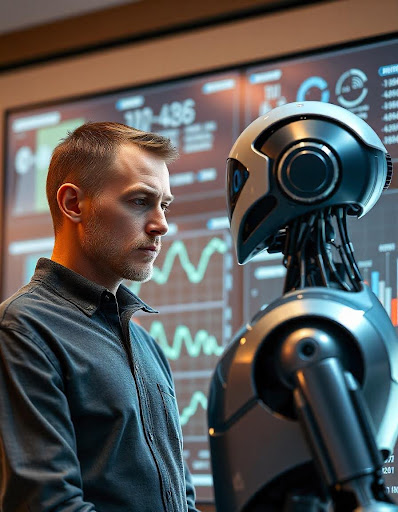
AI makes it possible to take user experience to new levels, offering personalization at scale, behavior prediction, and real-time solutions. Today, technologies such as machine learning and generative AI are being applied to transform interaction flows on e-commerce platforms, virtual assistants, healthcare applications, and more.
A clear example is the use of AI-powered chatbots. They not only automate customer service, but also learn and adapt to users' needs, creating more human and effective interactions. These advances make it clear that AI does not replace design work, but complements it by providing tools to create more intuitive experiences.
Impact on the User Journey
The integration of AI into UX allows for a complete redesign of user journeys:
- Relevant Personalization: AI algorithms can analyze real-time data to offer highly personalized content and products.
- Predicting Needs: AI identifies behavioral patterns, enabling the creation of proactive solutions.
- Continuous Improvement: Through continuous learning, AI optimizes experiences based on implicit and explicit feedback.
Challenges and Responsibilities
While AI offers enormous opportunities, it also presents ethical and technical challenges. One of the biggest is avoiding algorithmic bias, which can compromise the inclusiveness and fairness of digital solutions. As UX professionals, it is our responsibility to ensure that AI-based interactions are accessible, inclusive, and transparent.
Don Norman, one of the pioneers of human-centered design, says that “design is a balancing act between human needs and technological possibilities.” In this sense, the role of UX is crucial to aligning the potential of AI with users' real demands.

How to Prepare for the Future
To successfully integrate AI into UX, it is essential for professionals to develop new skills and an understanding of how emerging technologies work. Some suggestions include:
-
Understand how AI works: Familiarize yourself with concepts such as machine learning, neural networks, and natural language processing.
-
Collaborate with AI specialists: Work alongside data scientists and engineers to ensure AI models meet the needs of user-centered design.
-
Apply adapted usability testing: Assess how AI-based solutions are meeting users' goals.
Success Stories
The integration of Artificial Intelligence (AI) into User Experience (UX) has brought significant advances, resulting in measurable improvements for companies and users. Below, we present some success stories that illustrate these benefits:
-
Personalization in Online Retail
E-commerce companies have been using AI to offer personalized product recommendations. By analyzing users' browsing behavior and past purchases, AI suggests items that match individual preferences. This approach resulted in a 35% increase in sales, as reported by several e-commerce platforms.
Source: Elastic
-
Virtual Assistants in Customer Service
The implementation of AI-based virtual assistants has transformed customer service. These systems are able to resolve up to 80% of common inquiries without human intervention, improving efficiency and reducing operational costs. In addition, customer satisfaction increased by 25% due to the speed and accuracy of responses.
Source: Zendesk
-
Sentiment Analysis to Improve Products
Companies have been using AI to analyze user feedback on social media and review platforms. Automated semantic analysis identifies recurring themes and associated sentiments, enabling adjustments to products and services. This practice led to a 20% increase in customer satisfaction and a 15% reduction in churn rates.
Source: Diabolocom
-
Real-Time Fraud Detection
In the financial sector, AI has been used to monitor and detect fraudulent activity in real time. By identifying suspicious patterns, institutions are able to prevent fraud before it causes significant damage. This technology resulted in a 30% reduction in financial losses related to fraud.
Source: Elastic
-
Process Automation with Generative AI
Generative AI has been applied to automate complex processes, such as resolving customer complaints. By quickly collecting and analyzing relevant data, AI provides more accurate and faster solutions, increasing operational efficiency by 40% and improving the user experience.
Source: Automation Anywhere

Conclusion
The integration of UX and AI is an exciting journey that opens up a range of possibilities for creating smarter, more personalized experiences. However, it requires us to keep our focus on the human, ensuring that technologies not only impress, but also positively impact people's lives.
As a UX technical lead at Stefanini, I see every day how AI can revolutionize digital interactions, whenever applied with empathy and responsibility. The future of UX is in our hands, and it is built with technology, but guided by people.
Translated from the Brazilian Portuguese original · Read the original

Agents, voice and social capital: what comes after AI that responds
From iRTE 2026, in Beijing, Rodrigo Terron examines how AI agents transform task execution and the value of human connections. The article covers social capital, conversational AI, autonomy and trust, as well as infrastructure and opportunities for Brazilian entrepreneurs.