

The PACED framework helps decide when to disclose AI use in the product
Research from the Nielsen Norman Group shows that disclosing AI use doesn't always reduce trust, but it isn't neutral either: it all depends on who's reading, what was automated, and how much that matters to the person using the product.

Product teams that have adopted AI text generation (support replies, item descriptions, meeting summaries, email drafts) face a question that has no answer in the brand style guide: when should you tell the user that something was made, or assisted, by AI? An article published on September 25, 2026 by the Nielsen Norman Group (NN/G), written by Taylor Dykes, reviews the state of academic research on the topic and proposes a five-question framework, named PACED, to replace the pocket answer ("disclosure always erodes trust" or "never disclose") with a contextual decision.
The regulatory trigger is concrete: the European Union's AI Act, approved in 2024, now requires disclosure of AI-generated content in specific cases, with the transparency obligations taking effect in August 2026. In Brazil there is still no equivalent requirement (the AI regulation bill remains under discussion in Brazil's Congress), which leaves the decision of whether to disclose in the hands of whoever designs the product, without a clear legal anchor for most cases. That's precisely the vacuum PACED tries to fill.
The paradox that stalls decision-makers
The most uncomfortable finding in the review is what researchers Siavosh Sahebi, Paul Formosa, and Sarah Bankins call the "disclosure paradox": people say they want to be told when AI was used, but they rate disclosed content as less trustworthy, less authentic, and less useful than the same content without a disclosure. In this trio's study, texts attributed to AI were judged worse even when participants stated, in a separate question, that disclosure mattered to them.
A second study, by Jingchao Fang, Victoria Xiaohan Wen, and Mina Lee (presented at FAccT 2026), shows the asymmetry from the other side: when the same people are put in the role of authors, they consider disclosure far less necessary than when they're in the role of readers. In other words, everyone wants to know when someone else used AI, but no one finds it as urgent to disclose when it's their own use of AI that helped. For product designers, this means that user research asking "would you like to know if this was made by AI?" tends to overestimate real demand for transparency, and the response observed in behavior (rather than in stated attitude) usually diverges from what people say in interviews.
There is a pragmatic way out of this impasse, and it comes from another study cited in the article: Oliver Schilke and Martin Reimann tested proactive disclosure against third-party disclosure (the platform exposing the AI use after the fact) and found that being exposed by a third party produces the steepest drop in trust of all the conditions tested. Disclosing upfront, even if it stings a little in perception, is always better than letting the platform, a journalist, or another user make that revelation for you.
Not all disclosure weighs the same
NN/G points out that the effect of disclosure isn't uniform, and two factors explain most of the variation. The first is the role AI played. In the experiment by Zhuoyan Li and team, saying that AI generated the content lowered quality ratings for both argumentative essays and creative writing; saying that AI merely edited the text had a much narrower effect, hurting only the creative texts. Hiroki Nakano and colleagues found a similar pattern in a different study design: the higher the percentage of text attributed to AI, the worse the rating given to the author, in an almost linear relationship.
The second factor is content type. Interpersonal writing, the kind that depends on sincerity and human connection (a thank-you note, a personal letter, a condolence email), suffers the harshest penalty when AI is disclosed. In transactional or informational writing, like an appointment reminder, the negative reaction is much milder. A concrete example that speaks directly to anyone who manages a brand: in the study by Jasper David Brüns and Martin Meißner, participants couldn't visually distinguish an AI-generated fashion image from a real photo in a pilot stage; but when that same image, included in a brand's social media posts, was labeled as AI-generated, perceived brand authenticity, post credibility, and attitude toward the brand all dropped. The problem wasn't the image quality, it was the label.
The five PACED questions
The framework NN/G proposes organizes the decision into five axes, each with a practical question:
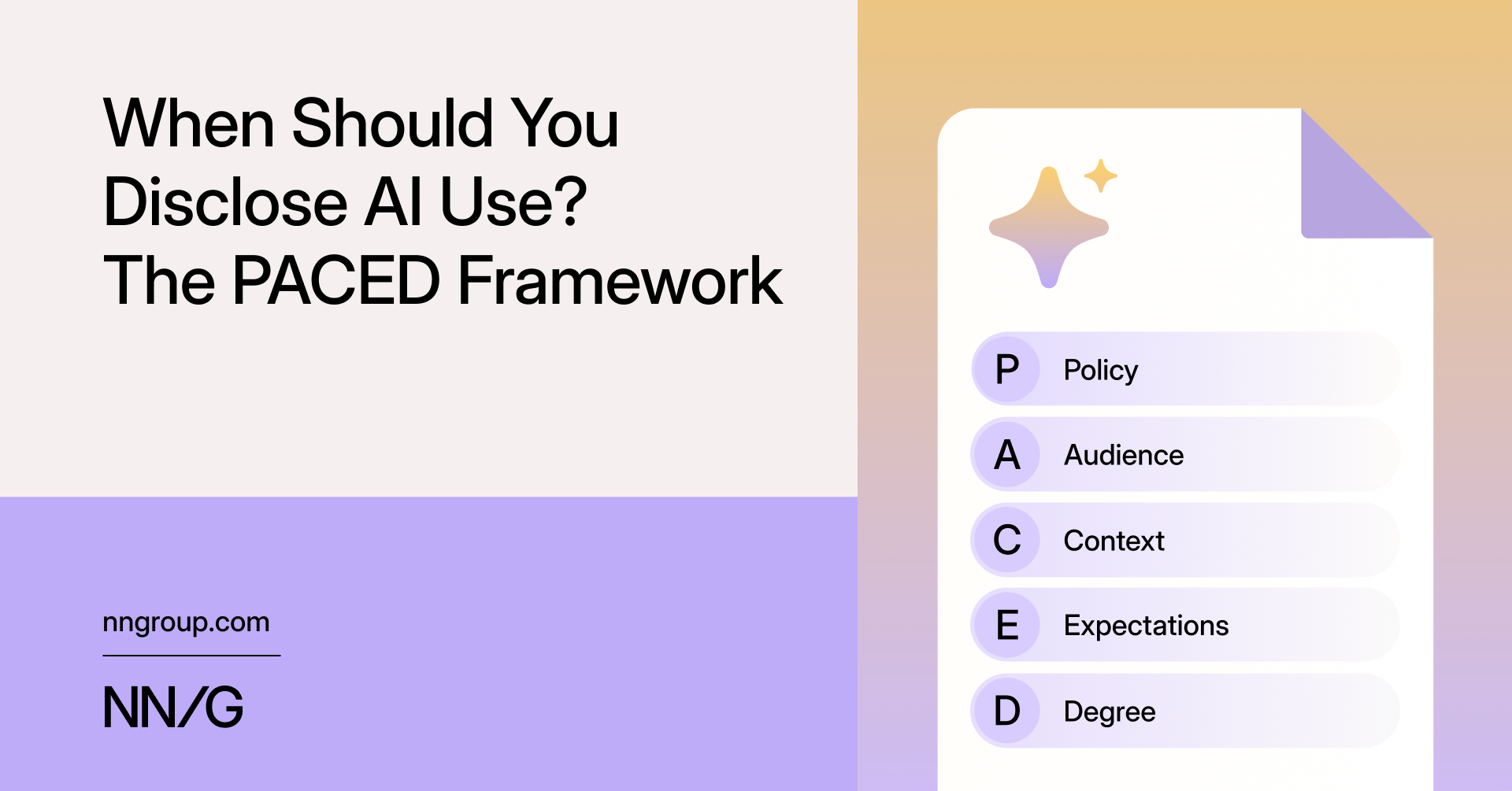
- Policy: is there a legal, platform, or internal policy requirement that already forces disclosure? If the content falls under a case covered by the EU AI Act, the answer is automatic. Beyond that, it's worth checking whether the platform itself applies an AI label based on technical signals, because, as shown above, being labeled by a third party is the worst-case scenario.
- Audience: what is your audience's prior attitude toward technology and AI? People who are more favorable toward technology tend to react with less penalty; users confident in their own writing ability tend to judge AI-assisted text more harshly.
- Context: how much does the interaction depend on qualities associated with a human author, such as sincerity, creativity, or personal judgment? A transactional message carries little weight; interpersonal or creative communication carries a lot.
- Expectations: do your users already assume they'll be told when AI is involved? The article recalls the principle that "you are not the user": the intuition of whoever builds the product about the need for disclosure frequently doesn't match the expectation of whoever consumes it.
- Degree: did AI merely tweak one paragraph, or generate the entire content? The more central AI's contribution, the greater the risk of misattributing credit to the human author if there's no disclosure, but also the greater the chance of a penalty if there is.
What this changes for those who design the product
For product and design teams in Brazil, PACED works less as a compliance checklist and more as a UX decision guide. One example of application: an e-commerce site that uses AI to generate product descriptions is in a low-risk zone (transactional Context, high Degree, but low Expectations: no one expects a spec sheet to be hand-written by a human); there, a discreet label reading "description generated with AI assistance" tends to cost little. A therapy or emotional-support app that uses AI to draft empathetic responses, on the other hand, sits at the opposite pole: a Context of very high dependence on human sincerity, where any disclosure risks eroding exactly the bond the product is selling.
The point NN/G leaves open, and that each product team must answer with its own user research, is that there's no market benchmark to copy: the effect of the same disclosure changes from app to app, from audience to audience. That pushes the disclosure decision inside the design process, alongside usability testing, rather than treating it as a legal footnote written after the product has already shipped. It's also worth documenting the decision: if a team decides today not to disclose because Degree is low and Context is transactional, that same decision needs to be revisited the day the feature grows in autonomy, because that's exactly where, as Nakano and team's research shows, user perception slips.
Translated from the Brazilian Portuguese original · Read the original
Material 3 Expressive changes motion and color tokens: what to review in Figma
Material Design's official documentation details how M3 Expressive's physics-based motion tokens, more vibrant palette, and new shapes affect accessibility and design system handoff in Figma.