IBM updates Granite Speech family with open-source transcription, translation, and speaker identification
IBM released version 5.0 of Granite Speech and updated two sibling models, covering everything from fast transcription to identifying who is speaking in recordings with multiple people, all under the Apache 2.0 license.

IBM released version 5.0 of Granite Speech and updated two sibling models, covering everything from fast transcription to identifying who is speaking in recordings with multiple people, all under the Apache 2.0 license.
IBM released version 5.0 of Granite Speech and updated two sibling models, covering everything from fast transcription to identifying who is speaking in recordings with multiple people, all under the Apache 2.0 license.
IBM published, on October 21, 2026, on the Hugging Face blog, the update to its family of speech models: the new granite-speech-5.0-2b and revised versions of granite-speech-5.0-470m-turboctc and granite-speech-4.1-2b-plus. The post, signed by IBM Research researchers such as George Saon and Brian Kingsbury, describes three models for three different problems: high-precision transcription and translation, ultra-fast transcription for on-device use, and recordings with multiple speakers where knowing who said what matters as much as the content.
For developers in Brazil, the key point isn't just accuracy: it's that all three models are released under the Apache 2.0 license, with native support in Transformers, and granite-speech-5.0-2b specifically also runs on vLLM, llama.cpp, and mlx-audio for Apple Silicon. This means running speech transcription and translation entirely on-premise or on your own laptop, without sending audio to a third-party API and without paying per processed voice token.
Three models, three use cases
IBM organized the family by use-case scenario, not by size. The table below summarizes what each model solves, according to the post itself:
| Model | Status | Recommended for |
|---|---|---|
granite-speech-5.0-2b | New | High-precision multilingual transcription and translation |
granite-speech-5.0-470m-turboctc | Updated | High-volume and on-device transcription |
granite-speech-4.1-2b-plus | Updated | Meetings, calls, and recordings with multiple speakers |
IBM's own recommendation is direct: if the priority is accuracy, translation, or keyword biasing, use 5.0-2b; if what matters is speed or running embedded, use Turbo CTC; if the audio has multiple voices and timestamps matter, use 4.1-2b-plus.
Granite Speech 5.0 2B: more precise, more multilingual
granite-speech-5.0-2b is the direct successor to granite-speech-4.1-2b, keeping the same 2 billion parameters. It transcribes English, French, German, Spanish, Portuguese, and Japanese, and translates between English and those languages, plus English to Italian and Mandarin. It was trained on 390,000 hours of public audio plus synthetic data created specifically for Japanese ASR, keyword biasing, and translation.
It's worth noting that the native language set is still modest compared to broader alternatives on the market: here the gain isn't wide coverage, it's depth in a smaller set that's more robust for Western corporate scenarios, with Portuguese included from the start.
Among the improvements over version 4.1, the post highlights:
- Language ID prompting: lets you specify the input language directly in the prompt to guide multilingual transcription.
- More stable long-form and conversational speech translation, not just in short, read sentences.
- Keyword lists with up to 2,000 terms, useful for biasing transcription toward product names, people, and acronyms in any supported language.
- Punctuation and capitalization on demand, with capitalization F1 between 89.7 and 99.5 on IBM's test sets.
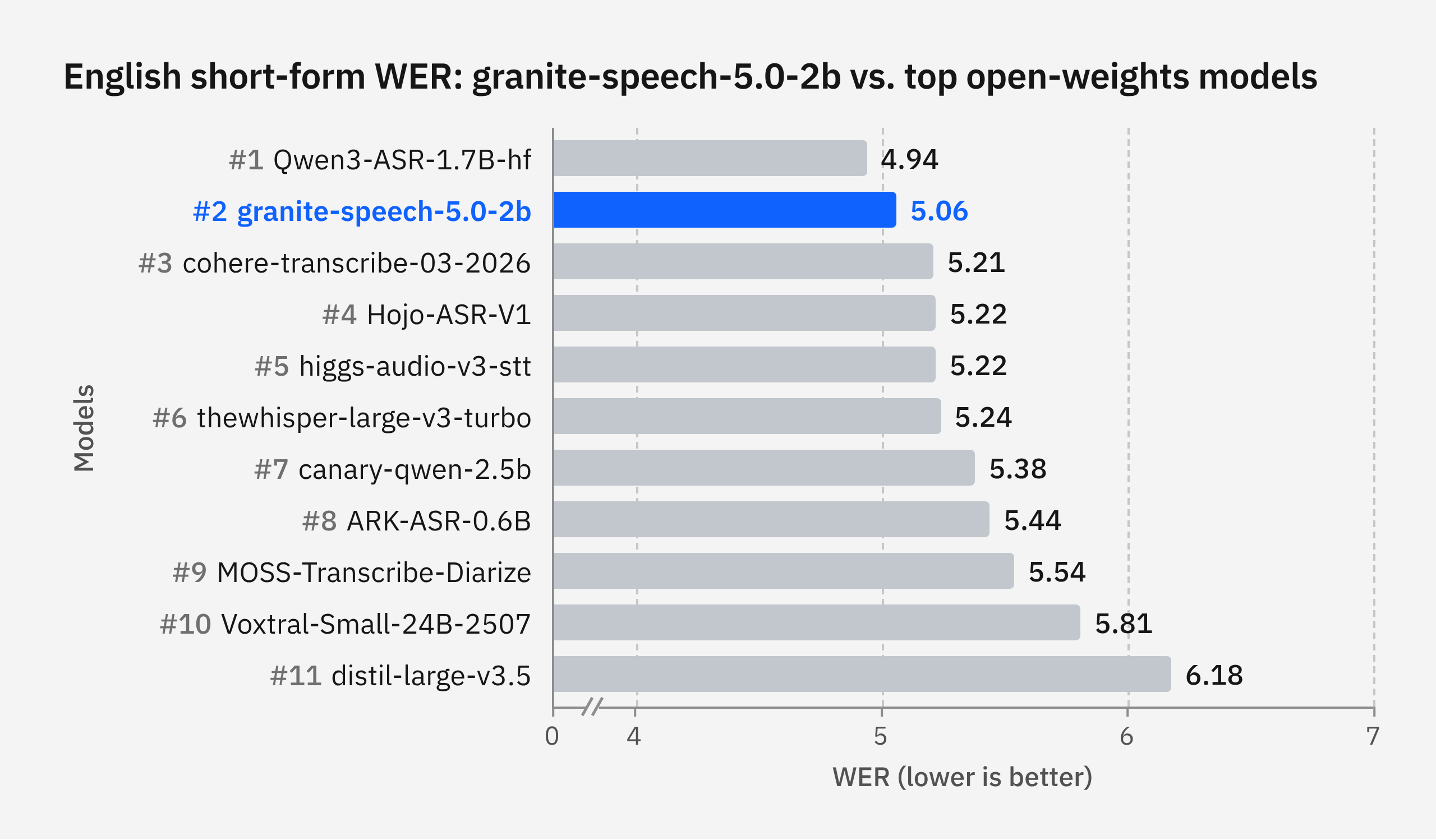
On the Open ASR Leaderboard, IBM reports that granite-speech-5.0-2b ranked second among open-weight models in average English WER (word error rate, lower is better), at 5.06%, in an unofficial measurement taken on October 15, 2026, on the leaderboard's public short-form English speech test sets.
Turbo CTC: from August's speed to October's multilingual support
Turbo CTC was introduced in August as a 470-million-parameter, English-only encoder built for speed. October's revision keeps the size and addresses three recurring community requests: support for English, Japanese, Spanish, German, French, Italian, and Portuguese; native punctuation and capitalization, without a separate truecasing step; and more robustness in difficult acoustics, with training focused specifically on reverberant audio and distant-microphone recordings.
The model also got faster. By compiling a single Conformer block and reusing its graph throughout the stack, IBM reduced warmup time and brought Turbo CTC to 19,870 RTFx on the Open ASR Leaderboard, up from around 12,600 RTFx at its August launch: a gain of roughly 1.6x in the same accuracy range. RTFx measures how many times faster than real time the model processes audio; the higher, the better for batch transcription or real-time transcription with resource headroom.
IBM provides a WebGPU streaming demo to test Turbo CTC directly in the browser, without installing anything locally.
4.1 2B Plus: identifying who's speaking, and when
granite-speech-4.1-2b-plus kept the 4.1 name because the architecture, prompt format, and API remain the same: it's a weight swap, not a code migration, which makes it easier to update for those already running the model in production. The improvements target exactly the kind of audio companies actually have: meetings, support calls, and long interviews with multiple participants.
The metrics table published by IBM shows the size of the gain:
| Capability | Metric | Previous version | Updated model |
|---|---|---|---|
| Timestamps, long-form speech | AAS (average timestamp deviation) | 210.86 | 98.54 |
| Timestamps, short-form speech | AAS | 29.27 | 26.20 |
| Keyword biasing | WER with 20-term list | 11.79 | 6.48 |
| Long-form speech | WER on long-form test sets | 13.53 | 10.22 |
| Speaker attribution | WDER | 4.40 | 4.10 |
| Transcription with speaker | cpWER | 30.50 | 28.48 |
All the metrics in the table are error rates, so lower is better. The standout is the long-form AAS, which dropped by more than half: in practice, this means more reliable timestamps for captions, in-recording search, and call review, a sensitive point in any compliance or customer service pipeline that needs to locate the exact portion of a conversation.
What changes for developers here
All three models are available on the Hugging Face Hub under the ibm-granite organization, with model cards detailing architecture, training data, and usage examples. IBM recommends pairing any of them with Granite Guardian in production deployments that require additional risk detection, something worth considering before exposing automatic transcription to sensitive customer data.
For a team that currently relies on a paid transcription API, the case is clear: compatibility with Transformers reduces integration friction, and the option of using llama.cpp or mlx-audio with granite-speech-5.0-2b opens the way to run transcription on an Apple Silicon laptop without a dedicated GPU. That said, granite-speech-5.0-2b, having 2 billion parameters, requires more memory and, likely, a GPU to run at acceptable latency in production.
It's worth considering all three models when the use case falls within the seven supported languages and the priority is not depending on an external voice service. It's not worth swapping out an already mature solution if the project needs languages outside that list, such as Asian languages beyond Japanese or African languages, in which case models with broader coverage, even if proprietary, remain the more straightforward option.
Translated from the Brazilian Portuguese original · Read the original

OpenAI uses thousands of AI agents to analyze brain data in 32 minutes
In partnership with PerturbAI and Scripps Research, OpenAI split the analysis of a genetic atlas of mouse brains among thousands of agents running in parallel. The result matters to anyone who designs agent systems, not just to biologists.