4 min read
Claude Ship, from Anthropic, lets AI agents approve pull requests on their own
 Redação iMastersNewsroom

- Reading
- 4 min
Agent package launched in beta promises to review, fix and even approve code changes automatically, tackling the bottleneck that emerges when teams start generating code in volume with AI.
Anthropic announced on Monday, November 23, the launch of Claude Ship, a set of AI agents to automate the review, fixing and approval of code changes. The company already had code review features in its tools before this. The new element is an agent capable of approving pull requests on its own, following policies defined by the development team itself.
The package arrives at a time when coding agents, such as Claude Code itself, generate ever-larger volumes of new code. This has pushed the bottleneck of the development cycle to after generation: reviewing and approving everything AI proposes. Claude Ship targets exactly this stage, delegating part of the approval authority to an agent.
The three agents in the package
Claude Ship is made up of three pieces at different stages of maturity:
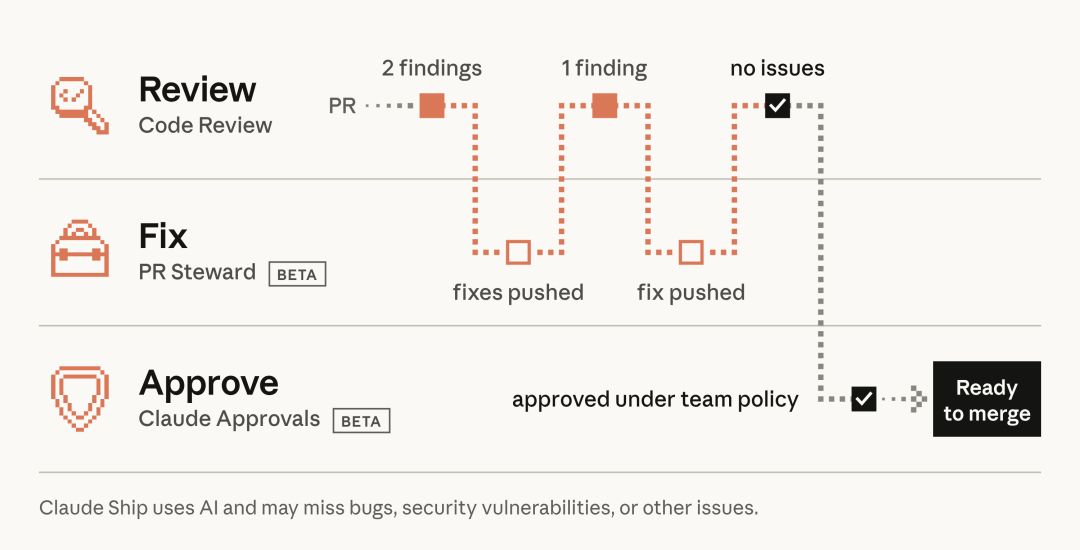
- Code Review: already generally available before the launch of the full package; identifies issues in the code proposed in a PR.
- PR Steward (beta): resolves pending issues such as failing CI checks, merge conflicts and Code Review findings; after each push, it comments on what changed and how to revert the change, if necessary.
- Claude Approvals (beta): applies an approval policy that the team writes as a versioned file in the repository, in natural language, combining signals such as Code Review findings or Anthropic's own classifiers.
In practice, PR Steward works like a junior developer on call, fixing whatever is blocking the merge, while Claude Approvals takes on the role that today belongs to a human reviewer giving the final word on the PR.
Why Anthropic is doing this now
The company's justification appears in the official post that accompanied the announcement: when people write every line of code, it's easy to keep a human approving every change. The problem is that this is no longer the reality for many teams.
Most teams want a person to approve every change, and that's easy to keep up with when people write every line. But a lot of developers build with agents now. On the Claude Code team, Claude writes most of our code, and we wanted everything after the PR to move that fast too.
Anthropic, official Claude Ship launch post
In other words: the very team that builds Claude Code already uses Claude to write most of its internal code, and identified that the human review process became the slowest link in the pipeline.
The guardrails for those testing in beta
Since PR Steward and Claude Approvals are still in beta, Anthropic explicitly recommends caution for anyone adopting the package:
- Run the approval feature first in observe-only mode, with no real merge power.
- Start with a single repository before expanding to the rest of the organization.
- Set monthly spending limits to control the cost of running the agents.
- Choose the review level per repository: Quick, Standard or Deep.
- Define which types of changes should be escalated for a human to decide.
These controls address an obvious concern: letting an AI approve the very code another AI generated raises the question of who audits this closed loop. Anthropic doesn't eliminate the human from the process, but shifts the default decision point from line-by-line review to defining the approval policy.
What changes for developers in Brazil
Brazilian teams that have already put Claude Code, GitHub Copilot or equivalent tools to work generating a good portion of a project's code know the symptom Anthropic describes well: the PR stalls not for lack of code, but for lack of people to review everything that comes in. Claude Ship proposes treating this bottleneck as an engineering problem, not a hiring one.
In practice, this means a repository's approval policy becomes a versioned artifact, auditable and reviewable like any other configuration file, no longer just a team convention. For those working in compliance or security, this also opens up a new line of work: deciding what kinds of changes can never go through without human eyes, documenting that in natural language so the agent interprets it correctly, and periodically auditing whether the policy is being followed as expected.
It's worth noting that the offering, for now, only runs on repositories hosted on GitHub, within Anthropic's Claude Team and Enterprise plans. Those who use GitLab, Bitbucket or host code on their own infrastructure are left out of the package for now. It also remains unclear how Claude Approvals behaves in repositories with stricter compliance rules, such as those subject to regulatory audit, something Anthropic itself acknowledges by recommending observe-only mode as a first step.
Translated from the Brazilian Portuguese original · Read the original

NariQ compresses Qwen3.8-27B into a 10 GB file with BF16 performance on agent tasks
Nari Labs released a quantization technique that shrinks the Qwen3.8-27B model from 53.8 GB to about 10 GB without losing performance on long-horizon agent tasks, but the gain comes with hardware and software requirements readers need to know before migrating.