6 min read
NariQ compresses Qwen3.8-27B into a 10 GB file with BF16 performance on agent tasks
 Redação iMastersNewsroom
- Reading
- 6 min
- Tables
- 1
- Code
- 2
Nari Labs released a quantization technique that shrinks the Qwen3.8-27B model from 53.8 GB to about 10 GB without losing performance on long-horizon agent tasks, but the gain comes with hardware and software requirements readers need to know before migrating.
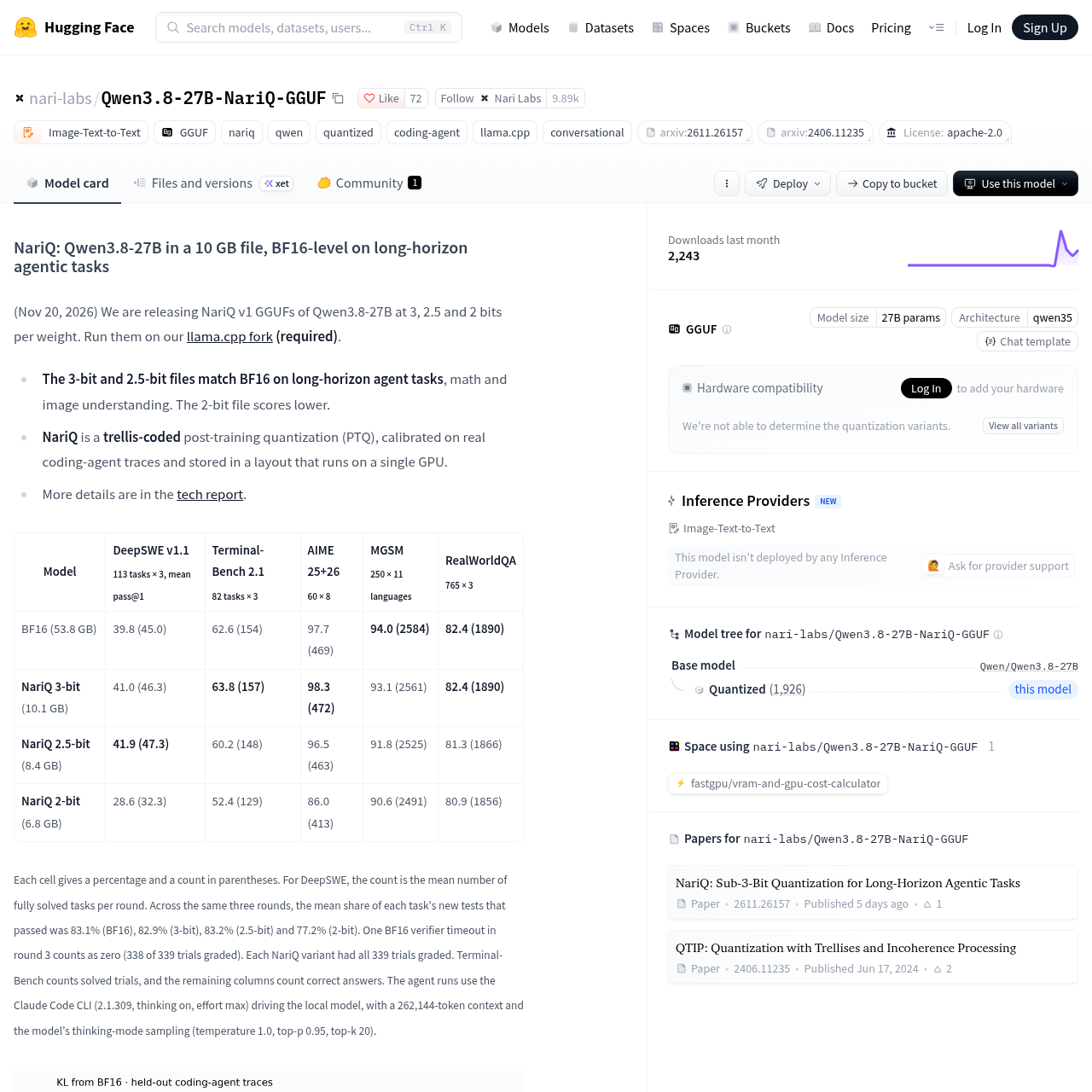
On November 20, 2026, Nari Labs published the NariQ v1 files for the Qwen3.8-27B model: quantized versions in GGUF format that reduce the model's weight from 53.8 GB (in BF16) to files of 10.12 GB, 8.44 GB, or 6.75 GB, depending on the chosen precision. According to Nari Labs itself, the 3-bit and 2.5-bit-per-weight versions match or exceed the original model on long-horizon agent tasks, math, and image understanding. The 2-bit version falls short.
Qwen3.8-27B is a dense 27-billion-parameter model released by the Qwen team in August 2026, with native image and video support, a 262,144-token context (extensible to 1 million via techniques like YaRN), and flexible reasoning-mode control. It's the kind of model that, run locally, demands a server-grade GPU: the BF16 checkpoint alone already exceeds 50 GB, not counting the space needed for context and activations.
How the compression works
The technique is called NariQ and is described as post-training quantization (PTQ) with trellis coding, calibrated on real code-agent traces instead of generic text. The idea, according to Nari Labs, is that calibrating specifically for agent usage patterns (tool calls, long reasoning, code) preserves quality better in that scenario than generic quantization. The method builds on QTIP, a trellis quantization technique published by Tseng et al. in 2024, and has its own technical report authored by Doyeob (Toby) Kim, on arXiv under identifier 2611.26157.
The released file package is this:
| File | Bits per weight | Size | Nari Labs guidance |
|---|---|---|---|
Qwen3.8-27B-NariQ-3.0bpw.gguf | 3.00 | 10.12 GB | default option |
Qwen3.8-27B-NariQ-2.5bpw.gguf | 2.50 | 8.44 GB | less memory, BF16-level performance on agent tasks |
Qwen3.8-27B-NariQ-2.0bpw.gguf | 2.00 | 6.75 GB | the smallest, weaker at math and agent tasks |
Qwen3.8-27B-NariQ-mmproj-BF16.gguf | 16 | 0.93 GB | vision projector, used by all three |
What the numbers show
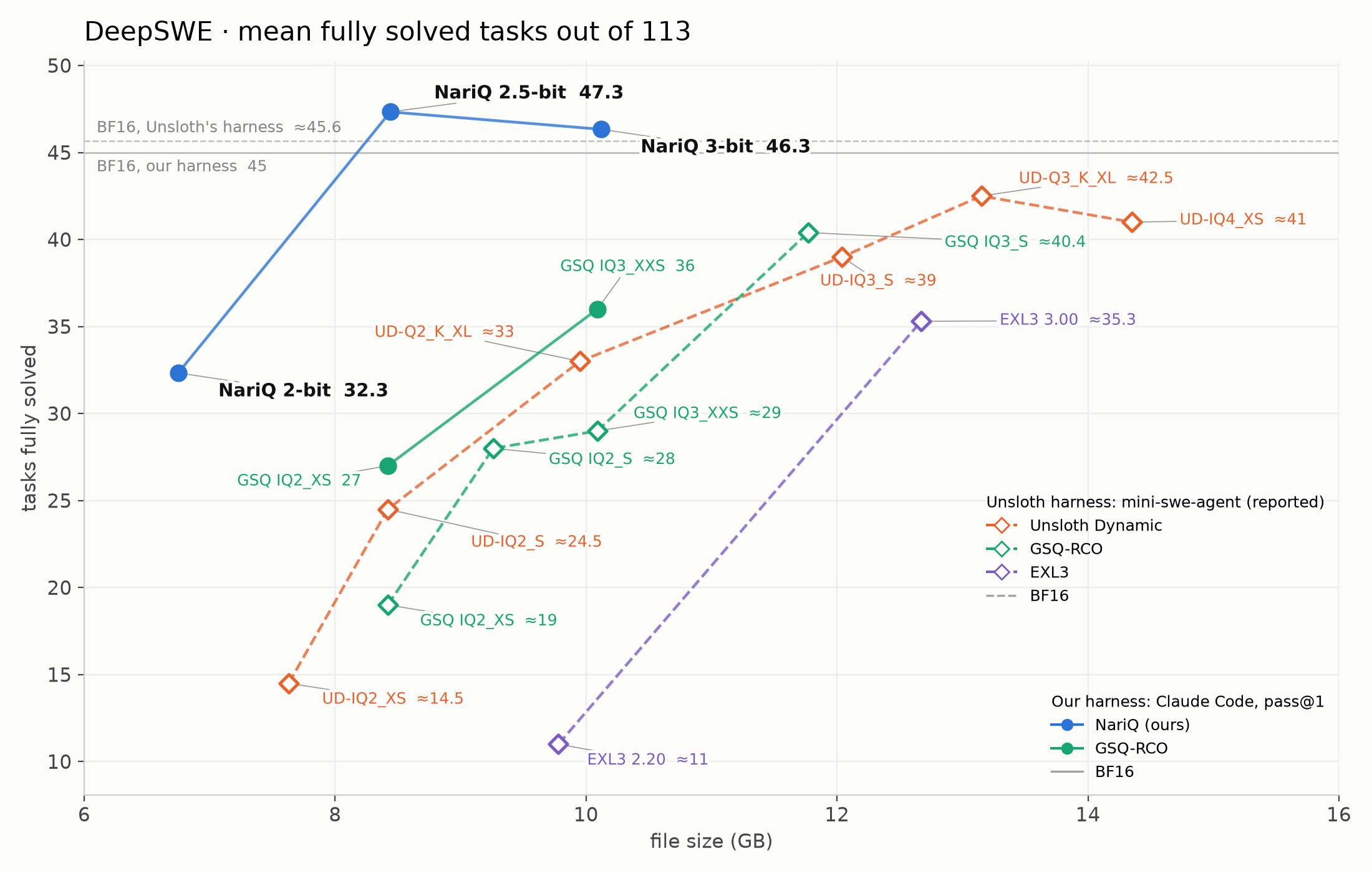
The tests used the Claude Code CLI (version 2.1.309, with reasoning enabled) driving the local model across four benchmarks: DeepSWE v1.1 (113 software engineering tasks, averaged over three runs), Terminal-Bench 2.1 (82 tasks), AIME 25+26 (math), and MGSM (multilingual). On the first two, which measure exactly the kind of long, multi-step task that a code agent performs, the 3-bit and 2.5-bit versions beat the original BF16 model: 41.0% and 41.9% on DeepSWE, versus 39.8% for BF16; 63.8% and 60.2% on Terminal-Bench, versus 62.6%.
The 2-bit version, however, drops much more sharply: 28.6% on DeepSWE and 52.4% on Terminal-Bench, a fall of more than ten percentage points compared to BF16. Nari Labs is direct about this on the model's own page: it recommends the 2.5-bit or 3-bit version for anyone who needs overall performance, reserving the 2-bit version for cases where disk space is the deciding factor.
In short: the real gain isn't just "fitting in less space," it's that, in the 3-bit and 2.5-bit versions, the compression didn't cost any measurable performance on the tasks that matter most to anyone using the model as the engine of a code agent.
How to run it (and the first important caveat)
NariQ files don't work on standard llama.cpp, Ollama, or LM Studio: Nari Labs uses new tensor types that, for now, only the project's own fork, nari-llama.cpp, knows how to interpret. The team itself says it hopes to upstream support into mainline llama.cpp, but that hasn't happened yet.
For those who just want to try it out, the quickest path is a script that downloads binaries and files and adjusts the context automatically:
curl -fsSLO https://github.com/nari-labs/nari-llama.cpp/releases/download/b12431-nariv0/run.sh
bash run.sh 3.0 # or 2.5, 2.0
For those who prefer to download and start the server manually:
hf download nari-labs/Qwen3.8-27B-NariQ-GGUF \
  Qwen3.8-27B-NariQ-3.0bpw.gguf Qwen3.8-27B-NariQ-mmproj-BF16.gguf --local-dir .
llama-server -m Qwen3.8-27B-NariQ-3.0bpw.gguf --mmproj Qwen3.8-27B-NariQ-mmproj-BF16.gguf \
  -ngl 99 -c 131072 --jinja --port 8080 \
  --temp 1.0 --top-p 0.95 --top-k 20 --min-p 0
The sampling flags (--temp 1.0 --top-p 0.95 --top-k 20) are the same ones used in the benchmarks, with reasoning mode enabled. The value -c 131072 covers half the model's native context and fits on a 24 GB GPU with little headroom; for the full 262,144-token context, Nari Labs recommends a GPU with 32 GB or more.
What changes (and what still doesn't) for developers
It's worth tempering the "cost-free GPU" angle here: Nari Labs' test suite ran on RTX PRO 6000 (Blackwell), H100, L4, and A10, all server-class cards, and the team hasn't tested GeForce yet. The requirement is NVIDIA driver 570 or newer; AMD and Intel aren't supported. The current fork also focuses performance on the SM120 architecture (the one in the RTX PRO 6000): on Ampere, Ada, and Hopper, performance is below expectations, according to the documentation itself.
Even so, the leap is real: running Qwen3.8-27B in BF16 requires more than 53 GB just for the weights, which usually means parallelism across GPUs or a single 80 GB card. With the NariQ files, 10 GB (or less) fits on a single 16 GB to 24 GB GPU, the range of cards that smaller teams already have in inference servers or can rent by the hour for far less than an 80 GB VRAM instance. That's what makes prototyping and testing agents outside the cloud possible, even without a data-center budget.
Anyone with only a Mac, though, shouldn't expect miracles: on an 18 GB M3 Pro, decoding with the 3-bit file runs at about 3.8 tokens per second, well below what's seen on a CUDA GPU and unworkable for interactive use. Nari Labs recommends compiling from source for Metal and notes that other Macs remain untested.
What's still missing
Three loose ends are made explicit in the project's own announcement:
- The vision tower remains in BF16: only the language model was quantized, so the space savings don't extend to the multimodal part.
- The Qwen3.8-27B multi-token prediction (MTP) module hasn't been quantized yet.
- KV cache and activations remain in BF16; quantizing them is the next step cited by the team, and it's what would determine whether long contexts fit on consumer 16 GB GPUs, currently out of reach.
Nari Labs describes the work on the llama.cpp fork as a "solo effort" and is asking for open source contributions to expand hardware support. For anyone already running Qwen3.8-27B in production or considering swapping cloud inference for their own server, NariQ is a concrete sign of where large-model quantization is headed, but the dependency on Nari Labs' own fork is the detail that separates "testing it over the weekend" from "putting it into production tomorrow."
Translated from the Brazilian Portuguese original · Read the original

Ladybird launches public alpha on macOS and Linux, first browser engine built from scratch in years
After more than four years of development, Ladybird moves off the drawing board with an alpha release for macOS and Linux, bringing the first entirely new rendering engine since Blink arrived in 2013.