4 min read
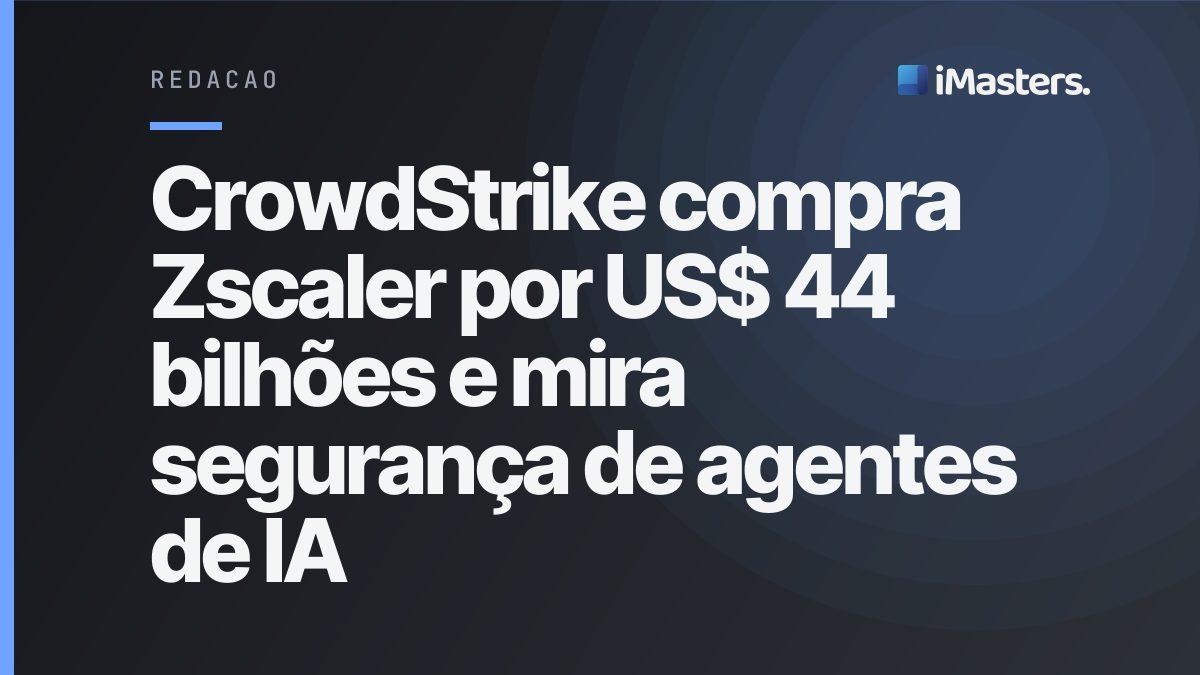
CrowdStrike Buys Zscaler for $44 Billion, Targets AI Agent Security
 Redação iMastersNewsroom
- Reading
- 4 min
The all-stock deal values Zscaler at $260.41 per share and creates a company with more than $10 billion in recurring revenue. For those running Falcon and Zero Trust Exchange in production, the merger doesn't change anything in the code yet, but it raises signals worth monitoring.
The deal: $44 billion in stock
CrowdStrike announced on November 23, 2026, the acquisition of Zscaler for $44 billion, in a transaction paid entirely in stock. Under the terms, each Zscaler share converts into 1.135 CrowdStrike shares, implying a price of about $260.41 per share and a 34% premium over the closing price before the announcement.
According to both companies, combined annual recurring revenue should exceed $10 billion once the deal closes. The market reaction was mixed: Zscaler shares rose 12% in pre-market trading, while CrowdStrike shares fell about 10%, a sign that some investors have doubts about the price paid and the execution risk of the integration.
The security race for the age of AI agents
The merger brings together two historically separate pieces of the corporate security stack: CrowdStrike, with Falcon, is a benchmark in endpoint protection (computers, servers and cloud workloads). Zscaler built its position on top of zero trust architecture, which controls user and service access to the network without automatically trusting anything inside the perimeter.
The timing is no accident. In November alone, CrowdStrike had already paid $495 million for two startups specialized in protecting AI environments, reinforcing a strategy of monitoring and containing autonomous agents that now access corporate data and systems as if they were users. Experts cited in the original reporting also note that AI is being used to find previously unknown vulnerabilities in software and languages that underpin much of the web infrastructure, such as PHP and Java, which changes the pace at which once-obscure flaws turn into active exploits.
Before, security meant keeping the adversary out. Today, security is needed to let AI in. The network used to connect people to places; now, it connects agents to data.
George Kurtz, CEO of CrowdStrike
What already works today between Falcon and Zero Trust Exchange
CrowdStrike and Zscaler aren't starting from scratch: the two already share more than 2,000 customers through an existing strategic partnership. The companies haven't publicly detailed the technical mechanisms of this current partnership, such as any telemetry exchange between Falcon and Zero Trust Exchange.
Both companies have signaled an intention to deepen this partnership once the deal closes, but have not publicly detailed, so far, what that means in technical terms or what the integration timeline would be. There is no official announcement about a unified console, event correlation between the products, or consolidation of the agents into one; any such hypothesis is a possible reading of the move, not a commitment made by the companies.
For security and infrastructure teams that currently keep the two tools separate, the realistic short-term expectation is zero changes to APIs, policies, or agents; any deeper integration, if it comes, is a medium- to long-term project with no date set yet.
The risk of concentrating everything in one vendor
It's worth remembering that CrowdStrike itself has already proven, in practice, what can go wrong when a single vendor concentrates low-level access across millions of machines. In 2024, a faulty Falcon update took down about 8.5 million Windows devices worldwide, causing flight cancellations, hospital disruptions, and impact on banks.
That history is especially relevant now that the company is expanding its reach into the network layer via Zscaler. For those designing security architecture, the practical reading is that consolidating vendors reduces operational complexity and licensing cost, but it also recreates, at a larger scale, the same single point of failure that already caused a global incident. It's a trade-off worth revisiting in any contract renewal with either brand, now or after the deal closes.
What hasn't been settled yet
The deal has been announced but not yet closed, and the companies haven't disclosed a closing timeline or a technical roadmap for integrating the products. That means, for now, squads running Falcon, ZIA, or ZPA in production don't need to change anything: no API changes, no contract changes, no agent disappears.
What does change is the planning horizon. Anyone evaluating a switch of EDR or Zero Trust tooling, or about to renew a contract with either company, gains a new factor in the decision: potential stack simplification down the road, but also greater dependence on a single vendor, right as the attack surface, supercharged by AI, is growing faster than most security teams can keep up with.
Translated from the Brazilian Portuguese original · Read the original
JDK 28 takes ZGC memory preparation off the startup path
JEP 545 moves ZGC's heap allocation and warmup to dedicated concurrent threads, cutting startup time by 38% and warmup from 80 to 10 seconds in the official test case.