5 min read
Ladybird launches public alpha with a browser engine built from scratch
 Redação iMastersNewsroom

- Reading
- 5 min
After years in development, Ladybird has moved past the build-from-source stage and become a download for macOS and Linux, with its own engine that does not derive from Chromium, WebKit or Gecko.
The launch
The Ladybird project announced on November 23, 2026 that its browser has entered alpha, with builds available for direct download on macOS and Linux. Until then, you had to compile the browser from source to try it out. Anyone who wants to test it no longer has to go through that: just download the installer published by the project itself.
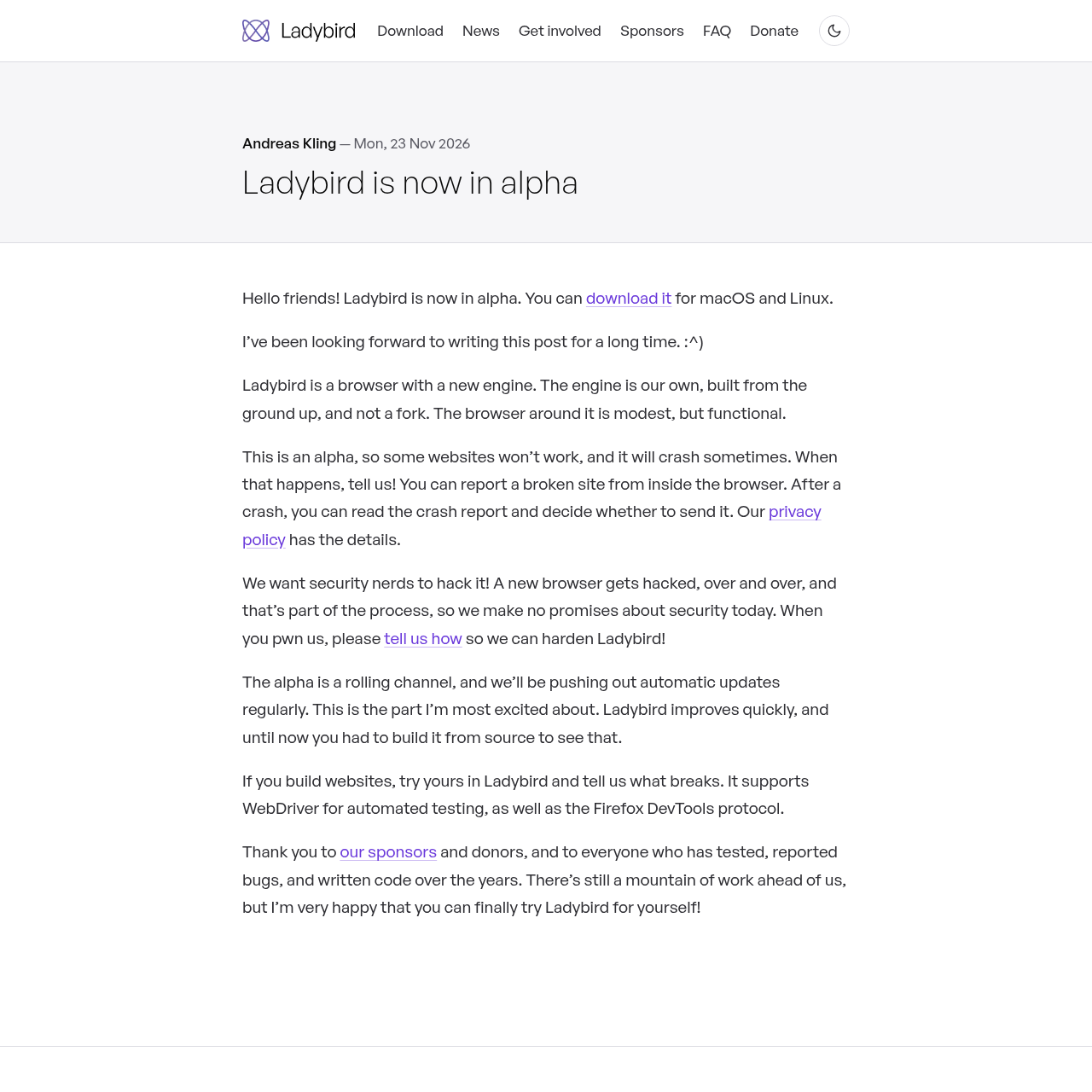
The announcement was signed by Andreas Kling, creator of Ladybird, in a short post on the project's official site. He describes the alpha as a "modest but functional" version, and makes it clear that the technical differentiator is not the interface, but the engine behind it.
An engine that is not a fork of anything
The central point of the announcement is this: Ladybird runs on its own rendering engine, written from scratch by the project's team, and it is not a fork of Blink (Chromium), WebKit (Safari) or Gecko (Firefox). That places it in a rare category in today's browser market, dominated by derivations of an ever smaller number of independent engines.
For people who develop for the web, this distinction matters more than it seems at first glance. Today, the overwhelming majority of browsers in use, including Chrome, Edge, Opera, Brave and a good share of Android browsers, use Chromium's Blink. That means that, in practice, much of the front-end testing and validation ecosystem revolves around a single engine. A fourth truly independent engine, with its own implementation of HTML, CSS and JavaScript, is real testing material for anyone who wants to know whether a site respects the specification or only works because Chrome accepts it.
What already works for testers
Ladybird's alpha does not arrive empty of tools designed for developers. According to the announcement, the browser already supports:
- WebDriver, the standard protocol for browser test automation, used by tools such as Selenium and Playwright;
- The Firefox DevTools protocol, which makes it possible to inspect and debug pages in Ladybird using Firefox's developer tools;
- Reporting broken sites from inside the browser, without having to open an issue manually;
- Integrated crash reporting, which shows the contents of the report before asking whether the user wants to send it.
This combination of WebDriver and Firefox DevTools is the most practical part of the announcement for anyone maintaining a compatibility test suite. You can point an existing CI pipeline that already speaks WebDriver at Ladybird, without rewriting the automation from scratch.
A real alpha, with the risks of an alpha
Kling does not gloss over the product's stage. In the announcement itself, he warns that "some websites won't work" and that the browser "will crash sometimes". This is not the rhetoric of a cautious launch: it is the very definition of what alpha means, and the text treats that as expected, not as an excuse.
The same goes for security. The project is direct in inviting researchers to attack Ladybird, without promising any hardening for now.
A new browser gets hacked, over and over, and that's part of the process, so we make no promises about security today.
Andreas Kling, creator of Ladybird
In practice, this means that using Ladybird to browse sites with sensitive data, or using it as your main browser, is still not recommended by the project itself. The invitation is to test, report and contribute, not to replace your day-to-day browser.
Continuous updates instead of closed releases
Another detail of the announcement that affects those following the project closely: the alpha runs on a rolling channel, with frequent automatic updates. Kling describes this part as the one that excites him the most, because, until now, only those who compiled Ladybird from source could keep up with the engine's real pace of evolution.
This changes the rhythm for anyone who will test sites against Ladybird on a recurring basis: a rendering bug reported today may already be fixed in the next automatic update, without the user having to download a new installer manually.
What is missing and what still cannot be done
The announcement leaves some gaps evident:
- No Windows build for now, only macOS and Linux;
- No security guarantees, as already mentioned;
- Kling sums up the project's general state as "a mountain of work ahead", acknowledging that the alpha is a milestone, not an arrival.
What this changes for developers in Brazil
For Brazilian front-end teams, the most immediate practical effect is having a fourth real browser engine to include in the compatibility testing matrix, something that today is rare outside the Chromium, WebKit and Gecko trio. Projects that take conformance with web specifications seriously (and not just "it works in Chrome") gain an additional environment, free and open source, to validate whether the CSS, the JavaScript or the APIs they use really follow the standard or merely coincide with the behavior of a dominant engine.
There is also the contribution door: a browser engine written from scratch, at the alpha stage, is fertile ground for anyone who wants to learn the internals of parsing, rendering and JavaScript engines in practice, contributing code, tests or simply reporting Brazilian sites that break in Ladybird. The announcement itself asks for exactly that: "if you build websites, test yours in Ladybird and tell us what breaks".
Anyone who decides to test should remember the framing: it is alpha, no Windows, no security guarantees and with instability expected. The value here is not using Ladybird as a production browser, but as a validation tool and as a project open to contribution, in an area, browser engines, where very few teams in the world, and even fewer in Brazil, get the chance to get their hands dirty.
Translated from the Brazilian Portuguese original · Read the original

CrowdStrike Buys Zscaler for $44 Billion, Targets AI Agent Security
The all-stock deal values Zscaler at $260.41 per share and creates a company with more than $10 billion in recurring revenue. For those running Falcon and Zero Trust Exchange in production, the merger doesn't change anything in the code yet, but it raises signals worth monitoring.