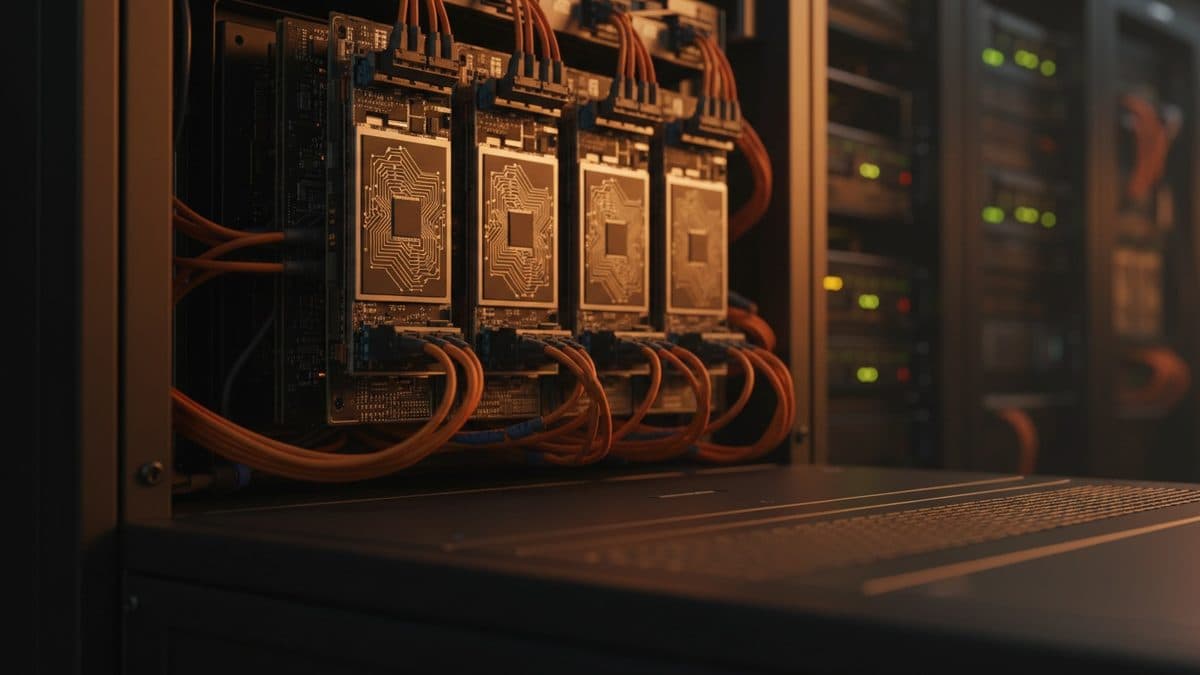
DeepSeek may train V5 model on Huawei's Ascend chips, Chinese newspaper says

- Reading
- 4 min
A report by the Chinese newspaper STAR Market Daily, published on November 3, says DeepSeek is considering using Huawei's Ascend processors to train the V5 model, not just to run inference as it does today.
DeepSeek is reportedly planning to train its next model, V5, using Huawei's Ascend chips, according to a report by the Chinese newspaper STAR Market Daily published on November 3, 2026. The information, attributed to unidentified industry sources and republished by the site TechNode, has not yet been officially confirmed by either DeepSeek or Huawei.
If confirmed, the move would expand the role of Ascend chips within DeepSeek's ecosystem. Until now, according to the report, Huawei's hardware had mainly been used for inference, that is, to run already-trained models and respond to user queries. Training a model from scratch is a far more computationally demanding step, and this would be the first time Ascend took on that central role in developing a DeepSeek model.
From inference to training: why the leap matters
Inference and training place very different demands on a chip. Running a finished model requires processing inputs and generating outputs efficiently, but at a relatively predictable scale. Training a cutting-edge model like V5 involves months of distributed processing across thousands of accelerators, with far stricter requirements for throughput, memory, and inter-chip interconnection.
The software stack also carries more weight. For large-scale training, frameworks like PyTorch rely on deeply optimized libraries, historically built on top of Nvidia's CUDA. Migrating that process to Ascend means using CANN, Huawei's software layer equivalent to CUDA, which is technically riskier and less mature in terms of tooling, debugging, and community support.
In short: the report describes an extension of use, not a simple hardware swap. It's the kind of decision that usually comes with months of infrastructure adaptation work, something the STAR Market Daily article itself acknowledges by mentioning that DeepSeek had already been adjusting its software infrastructure for domestic processors before this step.
The backdrop: sanctions, CUDA, and the race for alternatives
DeepSeek became globally known in 2025 after releasing V3 and R1, open models that drew attention for the relatively low training cost reported by the company itself and for their rapid adoption by developers outside China. These models were originally trained on Nvidia GPUs, the same architecture that dominates AI training worldwide via CUDA.
The problem is that Chinese AI companies face United States export restrictions on Nvidia's most advanced chips, which pushes the Chinese sector toward domestic alternatives. Huawei is the strongest contender in this race, with its Ascend line aiming to occupy the space that Nvidia can no longer freely fill in the Chinese market.
This move is neither new nor exclusive to DeepSeek: it's part of a broader strategy of Chinese technological self-sufficiency in AI semiconductors. What the STAR Market Daily report signals is that this strategy would be advancing from a safer stage (inference) to a more critical and risky one (training a new model).
What's still unknown
It's worth separating fact from informed speculation. The source of the news is a Chinese newspaper citing anonymous industry sources, with no official statement from DeepSeek or Huawei confirming the plan. As of this article's publication, there is no timeline, number of chips involved, or technical details on how the training pipeline adaptation would be carried out.
It's also unclear whether training would be done entirely on Ascend or through a hybrid scheme, combining Chinese hardware with Nvidia GPUs still available in the Chinese market. The difference between the two approaches matters: a 100% Ascend training run would be a much bolder proof of concept than a mixed scheme, which would reduce technical risk.
What this means for AI developers in Brazil
For those training or fine-tuning models here, the case is less about Chinese geopolitics and more about a practical reminder: dependence on the CUDA ecosystem is a choice, not a law of physics. If Ascend proves viable for training a model the size of V5, it strengthens the argument that PyTorch and other frameworks can run well outside the Nvidia stack, something also being tested by other backends such as AMD's ROCm.
In practice, this means watching, over the coming months, whether DeepSeek publishes technical papers or releases V5's weights with details about the infrastructure used, as it did with V3 and R1. Historically, DeepSeek has documented its engineering choices in open papers, and it's that material, once released, that will answer whether training on Ascend worked, and how efficiently.
For infrastructure teams in Brazil weighing whether to diversify AI hardware suppliers, the episode also serves as a gauge: the more major providers that demonstrate production training outside Nvidia, the greater the pressure for portability tools across hardware stacks, reducing the lock-in that today concentrates nearly all serious large-model training on a single architecture.
Translated from the Brazilian Portuguese original · Read the original

Raspberry Pi 5 Price Rises for the Fourth Time in 2026, Now Triple Its Launch Price
Raspberry Pi Holdings has raised prices four times in 2026 alone. The 16 GB Raspberry Pi 5, which cost $120 in 2023, now reaches $385 in the United States.