DeepSeek opens up search and page reading via API for AI agents
The Chinese company behind the DeepSeek model released two APIs, Search and Fetch, that let AI agents search the web and read entire pages without relying on Google, Bing, or Western search providers.

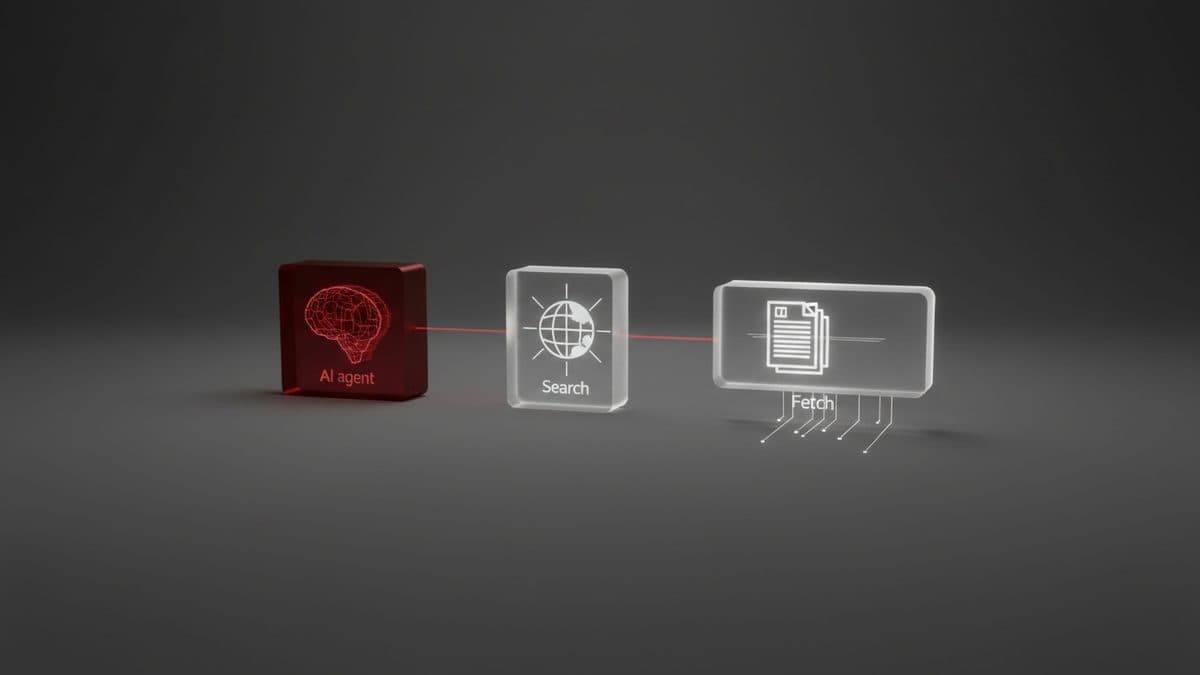
DeepSeek, the Chinese lab known for its R1 and V3 models, announced on October 19, 2026 the launch of two APIs aimed at people building AI agents: Search and Fetch. According to TechNode, the original announcement came in a post by DeepSeek itself, in Chinese.
Until now, anyone who needed to give a DeepSeek-based agent access to the web had to integrate a separate search provider, usually a Western one, such as Google, Bing, or third-party services built for LLMs. With the new APIs, search now comes from the same vendor as the model, using the same credentials as the DeepSeek API.
How Search and Fetch work
The two APIs address different steps in the workflow of an agent that needs up-to-date information from the web:
- Search returns structured search results, in a format an agent can process directly without having to parse the HTML of a results page;
- Fetch takes a URL and returns the page's title and content already converted to Markdown, ready to go into a model's context.
This combination is the standard pattern that agent frameworks usually implement with third-party tools: first search, then open the relevant link and extract the clean text. The difference here is that both ends come from DeepSeek's own proprietary search engine, not from a generic scraper or a separately paid search API.
Pricing, and a free window for people already using Claude Code and Codex
Both services cost RMB 5 (about five yuan) per 1,000 successful requests. Calls that fail, return an empty search, or time out are not charged, which reduces the risk of paying for a network error or a page that no longer exists.
One detail stands out in the source: server-side search and fetch calls made through tools such as DeepSeek Harness, Claude Code, and Codex are, for now, free of charge. That changes starting November 1 at midnight Beijing time, when normal billing starts to apply to those channels as well.
The mention of Claude Code (from Anthropic) and Codex (from OpenAI) is relevant: these are coding agents from direct competitors of DeepSeek in the model market, and yet the company is letting its search run on them for free until early November. In practice, it's a short window to test the API at no cost inside tools that a large share of developers already use day to day.
Why this matters for people building agents
For people building AI agent pipelines in Brazil, the main change isn't the price itself, it's the reduction of a dependency. Today, setting up an agent with web access usually means contracting a separate search API (the most commonly used options come from American providers) in addition to the language model API. That adds another contract, another API key, another billing dashboard, and, in some scenarios, another layer of compliance risk when the data passes through yet another foreign vendor.
With Search and Fetch, anyone already using the DeepSeek API for inference gets search and page extraction without leaving the same credential ecosystem. This is particularly relevant for two scenarios mentioned in this story's angle: agents running in environments with restricted access to Western services, and teams that already chose DeepSeek for its lower inference cost and can now also consolidate the search layer with the same provider.
The counterpoint is worth noting: unifying model and search under a single provider also concentrates risk. If DeepSeek changes the price, rate limit, or usage policy of the search API, whoever built their entire agent on top of it feels the impact on two fronts at once, not just in text generation.
What's still unclear
The source does not provide detailed technical documentation in English, per-minute rate limits, geographic coverage of search results, or a quality comparison with Google and Bing. There is also no indication of when (or whether) DeepSeek will publish official SDKs for languages beyond those already supported by the main API.
It also remains open how teams outside China will deal with the question of where search data is processed and stored, a sensitive point for projects that handle sensitive user data and that already weigh this when choosing DeepSeek as a model provider. Anyone testing the new APIs before November 1 has the advantage of running them at no cost via Claude Code, Codex, or DeepSeek Harness, but needs to monitor their own usage so as not to be caught off guard when normal billing kicks in.
Translated from the Brazilian Portuguese original · Read the original

Buildkite releases scoped secrets and MCP tools for AI in CI/CD
The CI/CD provider released secrets restricted by pipeline and a more complete MCP server, letting coding agents check YAML, compare builds, and fix webhooks before touching the commit.