DeepSeek updates V4.1 Flash and opens inference framework to cut AI costs
The Chinese company released V4.1 Flash-1017 with gains in coding benchmarks and opened DeepInfer, the inference framework that powers its production services.

V4.1 Flash-1017: what DeepSeek fixed in the benchmarks
On October 17, DeepSeek released V4.1-Flash-1017, an update to its V4.1 Flash model focused on completing tasks faster and generating shorter responses. According to TechNode, benchmarks published by the company itself show gains in coding and agentic tasks.
Two numbers sum up the leap:
| Benchmark | Previous version | V4.1 Flash-1017 |
|---|---|---|
| Terminal-Bench 4.0 | 31.2 | 42.3 |
| DeepSWE v1.1 | 74.2 | 77.0 |
The update was optimized to run in agent frameworks such as DeepSeek Harness, Tencent CodeBuddy, and WorkBuddy. It's worth stressing: these are the manufacturer's own numbers, measured with specific frameworks and evaluation setups, which doesn't guarantee equivalent performance in any real-world application.
How much it costs to run this intelligence
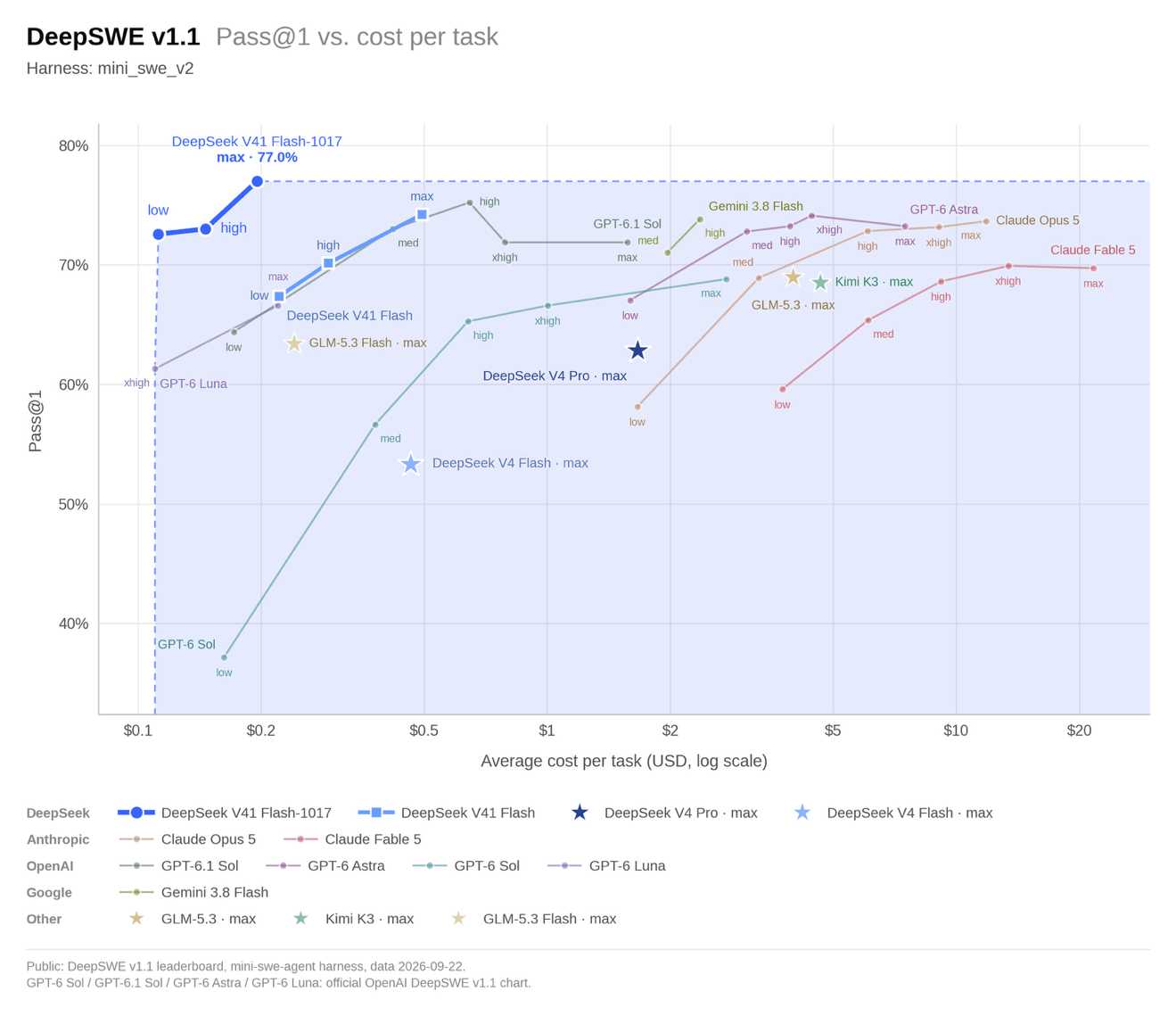
The central point of the announcement isn't just accuracy, it's cost per task. A cost-benefit chart released by DeepSeek for the DeepSWE v1.1 benchmark shows V4.1 Flash-1017 reaching 77% Pass@1 while spending about $0.20 per task, outperforming competing models that cost much more to run. In more economical setups, from $0.11 to $0.14 per task, the model still delivers between 72% and 73%.
An independent signal came from Agent Arena, the Arena leaderboard. According to an ITHome report published on October 20 and cited by TechNode, the updated model ranked first among open-weight models and 11th overall, based on 7,498 real-world usage sessions. The median cost per task was close to $0.18, with different leaderboard pages showing values between $0.18 and $0.19.
In summary: DeepSeek is fighting the cost-per-token battle on two fronts at once, the model becomes more efficient and the infrastructure that serves it does too.
DeepInfer: opening the inference black box
On October 20, three days after the model's launch, DeepSeek released DeepInfer, the internal framework that, according to the company, runs its large-scale production services. Along with it came deepseek-recipe, a library for processing API requests, preparing prompts, and parsing outputs.
Inference frameworks are the least visible part of the AI bill, but they decide latency, throughput, and the hardware needed to serve users. According to the project's README and deployment documentation, DeepInfer includes:
- optimized compute kernels;
- asynchronous request scheduling;
- support for distributed inference and speculative decoding.
Hardware support today covers Nvidia SM100 GPUs and Huawei Ascend 950 NPUs, with DeepSeek V4.1 Flash listed as a supported model. It's a detail that matters: Ascend is still much harder to access outside China, so those outside that ecosystem depend essentially on Nvidia compatibility.
DeepSeek's own documentation is honest about what's missing: a complete KV-cache system, prefill-decode disaggregation, and load balancing across parallel data replicas aren't fully covered by the release yet, although most of the disaggregation functionality is already implemented. In other words, it's not an inference stack ready to point and run: it's DeepSeek's production base, open, but requiring additional engineering to become a complete service.
The efficiency package that's been coming since September
DeepSeek's cost math didn't start now. At the launch of V4.1 Flash in September, the company already reported having cut KV-cache memory requirements to a quarter and SSD storage usage to an eighth of the previous generation. The API also offers off-peak rates at half the price of peak hours.
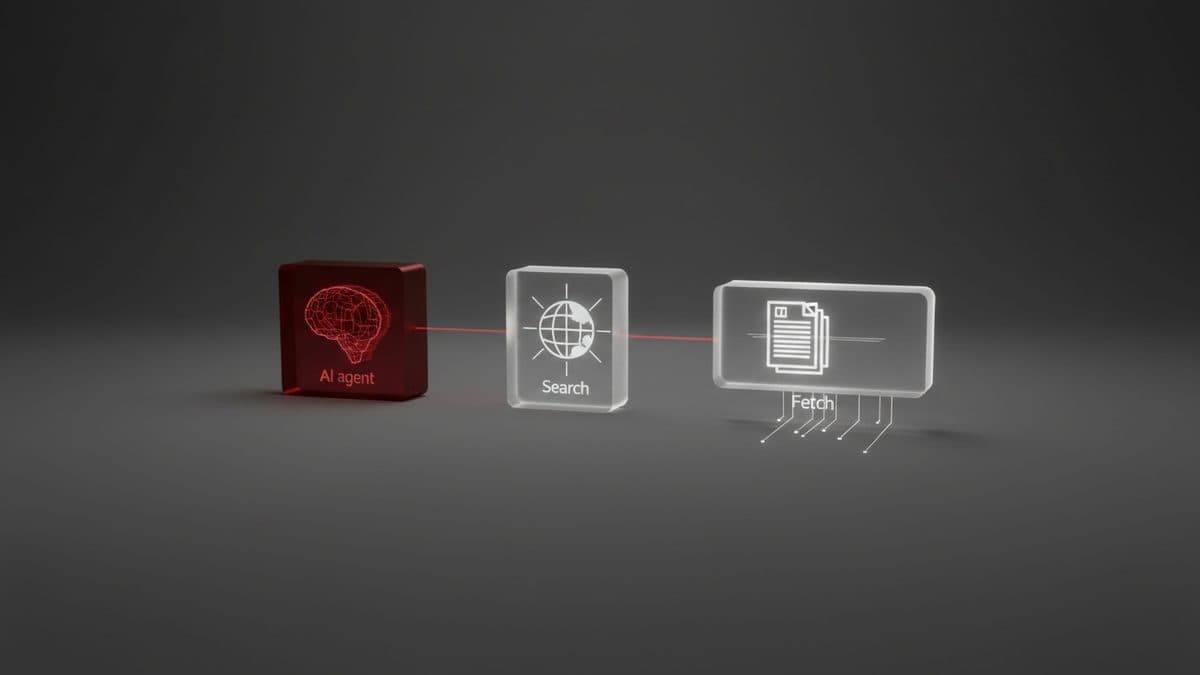
In October, DeepSeek opened its Search and Fetch APIs to developers, charging 5 yuan per thousand successful requests. Calls made through DeepSeek API integrations with Claude Code and Codex are temporarily free, with per-request billing scheduled to begin on November 1.
What changes for those running models in production in Brazil
For those who evaluate inference cost in dollars and convert it to reais, this combination of a cheaper per-task model and an open serving framework is the kind of announcement worth testing before committing infrastructure budget. The gains in Terminal-Bench and DeepSWE directly matter to those using code agents in production, but the number that really moves the spreadsheet is cost per task, not the isolated score.
DeepInfer doesn't solve everything on its own. Teams already running their own serving with tools like vLLM or SGLang will look at the optimized kernels and speculative decoding as pieces to evaluate, not as an immediate substitute for their current stack, since complete KV-cache and ready load balancing are still missing. Dependence on Nvidia SM100 GPUs also limits those running older hardware or a mix of cloud providers.
What remains open is exactly what TechNode points out: the numbers come from DeepSeek itself, with frameworks and configurations chosen by the company. Whether the efficiency gain holds up in real workloads, with deployment and maintenance by third-party teams, is something only production adoption will answer in the coming months.
Translated from the Brazilian Portuguese original · Read the original
How to run distributed Spring Batch without a message broker, using only a database
An article published on InfoQ describes a pattern for distributing Spring Batch jobs across multiple nodes using only the relational database the framework already requires, swapping the message queue for heartbeats and conditional updates in SQL. The idea doesn't replace classic remote partitioning, but it avoids spinning up a Kafka or RabbitMQ just for that.