Google DeepMind launches Genie 4, a world model with audio and real-time editing
Google DeepMind launched Genie 4 this week: a model that generates interactive worlds in real time, with synchronized audio and editing via text commands. The company's bet is to use it as a simulator to test agents and robots before running them in the real world.

- Reading
- 5 min
- Tables
- 1
Google DeepMind launched Genie 4 this week: a model that generates interactive worlds in real time, with synchronized audio and editing via text commands. The company's bet is to use it as a simulator to test agents and robots before running them in the real world.
A simulator that responds to commands in real time
Google DeepMind released Genie 4 as a research preview on Tuesday, October 27, 2026. It's the fourth generation of the company's world model, capable of generating interactive, photorealistic scenarios from text or image, with one key difference from its predecessors: you can type a new command in the middle of the simulation and change the scene on the spot, without restarting anything.
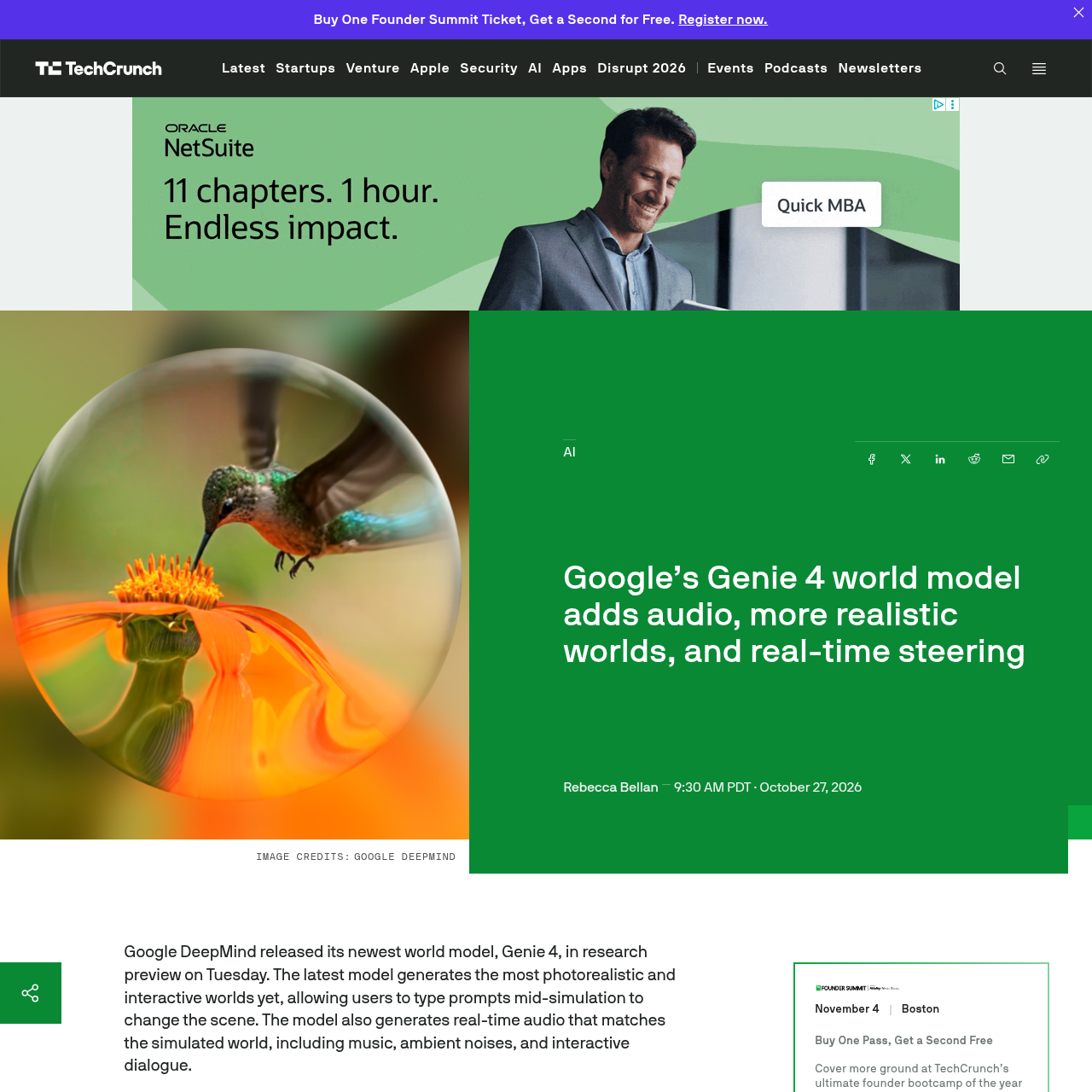
The model also generates real-time audio synced with what's happening on screen: music, ambient noise, and interactive dialogue between characters. This is new compared to Genie 3, which didn't generate audio, according to the original TechCrunch report.
The leap from Genie 3
Genie 3 had been launched as a research preview a little over a year earlier, in mid-2025. The difference in capability between the two versions is large enough that DeepMind treats Genie 4 as a generational leap, not an incremental update.
| Feature | Genie 3 | Genie 4 |
|---|---|---|
| Audio | Did not generate | Music, ambient sound, interactive dialogue |
| Real-time editing | Limited | Weather, camera angle, insert people and objects via text |
| Consistent scene duration | Up to 1 minute | Up to 2 minutes |
| Physics and characters | Baseline | More realistic, more human-like characters |
Consistent scene duration doubled, from about one minute to up to two minutes without losing visual coherence, according to the company.
Gemini as the simulation's director
The most relevant point for software builders isn't the visuals: it's the tighter integration between Genie 4 and Gemini. In this setup, Gemini acts as director, planning the steps of a task and checking the generated frames, while Genie handles rendering the world itself.
What we'll increasingly see in the future are these hybrid world models, where you have a combination of Gemini writing code and text, and Genie ingesting that in real time and simulating reality at different levels of abstraction.
Tejas Kulkarni, director of research at Google
This integration has already been tested in a research experiment tied to Gemini Robotics: a Gemini 4 Argon model broke tasks down into steps, and Genie 4 simulated each step in real time. It's one possible path for testing robot scenarios in simulation before running them physically.
Why this matters for people building agents and robots
For teams developing autonomous agents or robotics systems, the Gemini Robotics experiment points to a specific workflow: plan the task in a language model, simulate execution in a world model, and only then bring the validated behavior to real hardware or into production.
This reduces the cost of iterating on scenarios that are expensive or risky to test physically, such as object manipulation by a robotic arm or navigation by an autonomous vehicle. That said, DeepMind itself treats the experiment as research, not a finished product: throughout the presentation, the team stressed that these are still Genie 4's early days and that it's unclear what the end-to-end product experience will look like.
Initial access also limits who can actually test this today: for now it's a research preview for trusted testers, with gradual rollout via the Gemini API and Google AI Studio in the coming weeks.
A use nobody expected: film pre-production
Besides gaming, interactive learning, and robotics, uses already anticipated for world models like this one, the team cites as a speculative example of interactive learning stepping into a historical painting and talking with the figures depicted about the event portrayed. In a use DeepMind hadn't planned as a primary case, however, testers pointed to film prototyping.
The real time aspect becomes most valuable in the areas where keeping a state of flow in the creativity space becomes incredibly useful. For example, in the ideation phase, in the storyboarding phase, anytime you're kind of in need of rapid ideation.
Google already has Veo, a video generation model with synchronized audio from text, image, or video, which has been gaining traction among filmmakers. According to Rivas, the future idea is for prototypes generated in Genie 4 to be turned into final assets by Gemini Omni, a multimodal model that generates video from image, audio, and text, but he's clear that these capabilities are still far from ready.
What still doesn't work
The team itself acknowledges flaws that limit production use today:
- Details and objects can drift the longer the simulation runs;
- The accuracy of the generated audio still isn't guaranteed;
- Text inside the simulated world isn't always legible.
Rivas insists it's too early to define what the end-to-end product experience will look like. This comes on top of a world-model market that's consolidating fast: World Labs, founded by Fei-Fei Li, is being acquired by AMD, Amazon is negotiating the purchase of Decart, and automaker Rivian just acquired Third Dimension to bring autonomous-driving test simulation in-house. Two months before Genie 4, AI video startup Runway had already launched its own model, GWM Worlds 2, also playable and with audio generation.
How to access it
Genie 4 is currently available only as a research preview for trusted testers. In the coming weeks, access is expected to expand to Google AI Ultra subscribers within Project Genie, Google's tool for generating interactive worlds from text or image, and to early-access partners of the Gemini API and Google AI Studio. As of now, no date or price has been announced for general availability via API.
Translated from the Brazilian Portuguese original · Read the original
PHP fixes two critical RCE flaws that were already under attack
On October 21, the PHP project released emergency updates for two critical remote code execution vulnerabilities, after Amazon detected exploitation attempts four days before the patch existed.