Google opens Gemini and Search to third-party apps with the Connected Apps Platform

- Reading
- 4 min
- Tables
- 1
The new Connected Apps Platform lets any developer register an app to be triggered inside Gemini and, soon, Google Search. The flow runs through an MCP server, AppFunctions, and a monitoring console, currently in beta only for the United States.
Google announced on Wednesday (10/28) the Connected Apps Platform, a self-service path for any company or developer to register their app to be used inside Gemini and, soon, Google Search. The announcement formalizes a feature that has existed since early 2026, the so-called "connected apps," which let the user link a third-party service and perform actions directly through Google's AI interface, without opening the original app. The difference now is that this access stops being curated only through closed partnerships and gets an open submission pipeline, according to TechCrunch.
What Changes in Practice
Before, only partners selected by Google appeared as connected apps in Gemini. These included cases like asking the AI to build a playlist on YouTube Music or design a flyer in Canva, triggering the third-party service behind a natural-language command. With the Connected Apps Platform, any developer can submit their own app to enter this flow, test it, and track usage metrics after it's published.
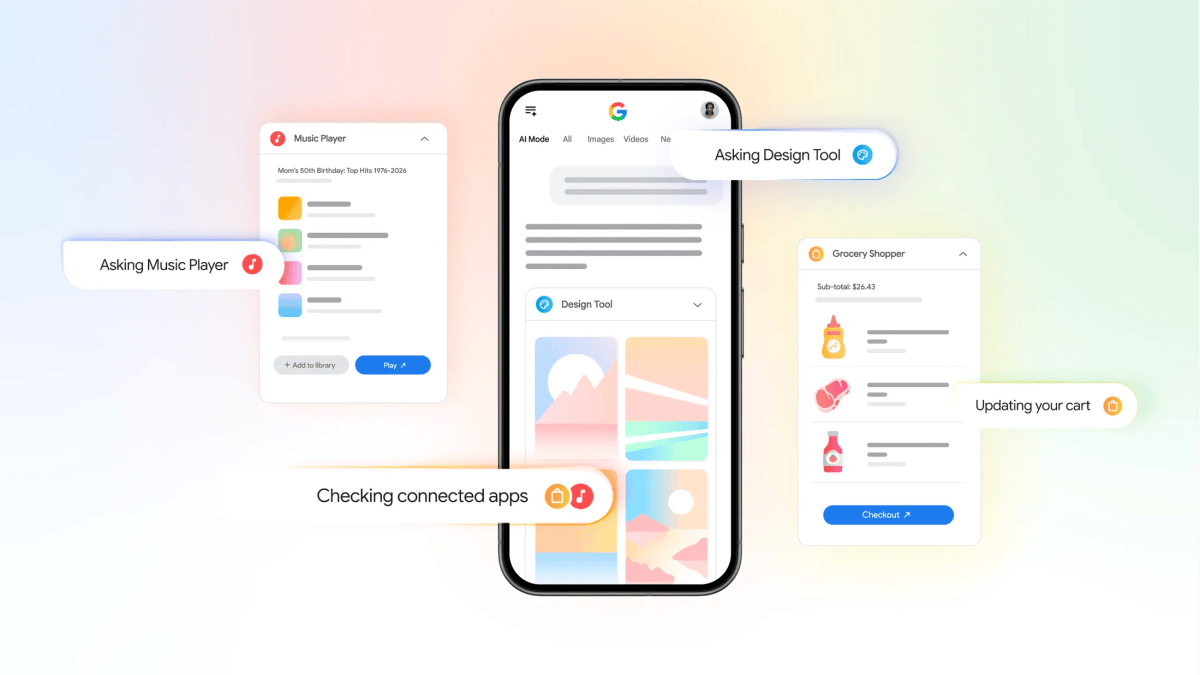
In short: Google is turning what used to be a closed list of integrations into an open distribution channel, similar to what an app store does for mobile, but for AI agents.
What the Technical Integration Flow Looks Like
To join the platform, the developer needs to expose their app through a cloud-hosted MCP server, or through MCP on Android using the AppFunctions APIs. After that, the app is registered, tested, and submitted for review through the Google Connected Console, the management tool cited by Google in the source.
The Model Context Protocol (MCP) is the open protocol that has become the de facto standard for connecting language models to external tools and data, and Google's adoption of it here follows the same path other AI providers have already been taking. In practice, this means a backend already set up to expose functions via MCP, something common in stacks that already integrate agents like Claude or GPT, can reuse much of its integration work for this Google flow.
Once approved, the developer chooses where the app appears:
- Gemini only;
- Google Search only;
- Or both at the same time.
Once live, Google provides dashboards for traffic, latency, and error rate, along with control over brand identity, such as a verified logo and an authenticated account, as described in the source.
Who's Already In, and the Brazilian Detail
Gemini already has more than 50 connected apps in production, including partners such as Adobe, Experian, Peloton, and Brazil's Localiza, alongside Google's own services, such as Workspace, Google Photos, YouTube Music, and Google Home, according to TechCrunch. Search, for now, has a much smaller set: Instacart, Canva, YouTube Music, and Yahoo Fantasy Football are the examples cited in the report.
These apps that already exist in Gemini will also start appearing in Search "in the coming weeks," according to Google. The meditation app Calm was announced as a new partner, with a simultaneous launch planned for both Gemini and Search.
Localiza's presence on Gemini's partner list is the most direct data point for anyone working in product in Brazil: it shows that the closed partnership program already included at least one Brazilian company even before submissions opened to any developer.
The Parallel with SEO, and Why It Matters for Product Builders
TechCrunch itself draws the parallel: just as SEO defined for decades how a site appeared in search results, submitting a connected app could become one of the first visibility rituals in the "agentic web," a term that describes an internet where AI agents perform tasks on the user's behalf instead of just returning links.
For product builders, this raises a concrete question: if a user never opens the app again and only interacts with it through Gemini or Search, what part of the experience and the brand survives that mediation? Google promises control over the logo and the authenticated account, but the usage interface, the screen flow, the app itself, stops being the main point of contact.
What's Still Open
Some relevant points still have no answer, according to the source itself:
| Open Question | Current Status |
|---|---|
| Geographic availability | Beta restricted to developers in the United States |
| Full availability date | Google gave no timeline |
| Channel monetization model | Not mentioned by the company |
| App approval criteria | Not publicly detailed |
For Brazilian teams that already expose functionality via MCP to other agents, it's worth getting in line: the platform is in public preview with a waitlist, even with no timeline for opening outside the US. Whoever already has an MCP-compatible backend has a head start, because the bottleneck Google has cited so far isn't technical, it's geographic rollout.
The episode also reinforces a broader trend: ChatGPT and Meta's Muse are already experimenting with similar connected-app formats, according to the report. The competition is no longer just over search rankings, it's over which AI assistant becomes the default hub from which the user triggers the services they use day to day, and that changes the distribution architecture product and engineering teams will need to plan for in upcoming releases.
Translated from the Brazilian Portuguese original · Read the original

Git on macOS still trusts eMudhra's compromised certificates
More than ten days after the alert, Apple hasn't fixed git, curl, and python3 on macOS: the tools still accept compromised eMudhra TLS certificates, and the system's latest update undid the manual fix developers had applied.