5 min read
Netflix builds Quasar to measure the real impact of API changes in internal libraries
 Redação iMastersNewsroom

- Reading
- 5 min
Netflix's internal tool cross-references semantic code indexing with usage history to show, before a merge, which repositories and teams will be affected by an API change.
A Netflix construiu uma ferramenta interna chamada Quasar para responder a uma pergunta que qualquer time que mantém uma biblioteca compartilhada conhece bem: se eu remover ou mudar este método, quem quebra?
Netflix built an internal tool called Quasar to answer a question that any team maintaining a shared library knows well: if I remove or change this method, who breaks? The announcement was detailed in a post on Netflix's engineering blog and reported by InfoQ on November 27, 2026. The tool combines semantic code indexing with API comparison to identify, repository by repository, who consumes a symbol before the change is published.
The problem compatibility tools don't solve
Compatibility-checking tools (such as Revapi, which Netflix already used) can point out that a method was removed or that a signature changed. What they don't do is say which applications actually call that method.
Netflix's post, according to InfoQ, points out three limitations of traditional methods for tracking API usage:
- Dependency graphs show declared relationships (what's in the build manifest), not actual usage in the code.
- Simple text search misses references that go through inheritance, method overloading (overloads), and auto-generated code.
- Compiling every downstream consumer to validate a change is expensive at scale, especially when there are hundreds of repositories.
This is the space where Quasar comes in: not to replace compatibility checking, but to complement it with real usage evidence.
How Quasar works under the hood
The architecture starts from the SCIP Code Intelligence Protocol, an open format for representing relationships between code (symbol definitions and references). Language-specific indexers run during continuous integration builds and feed Quasar with that data.
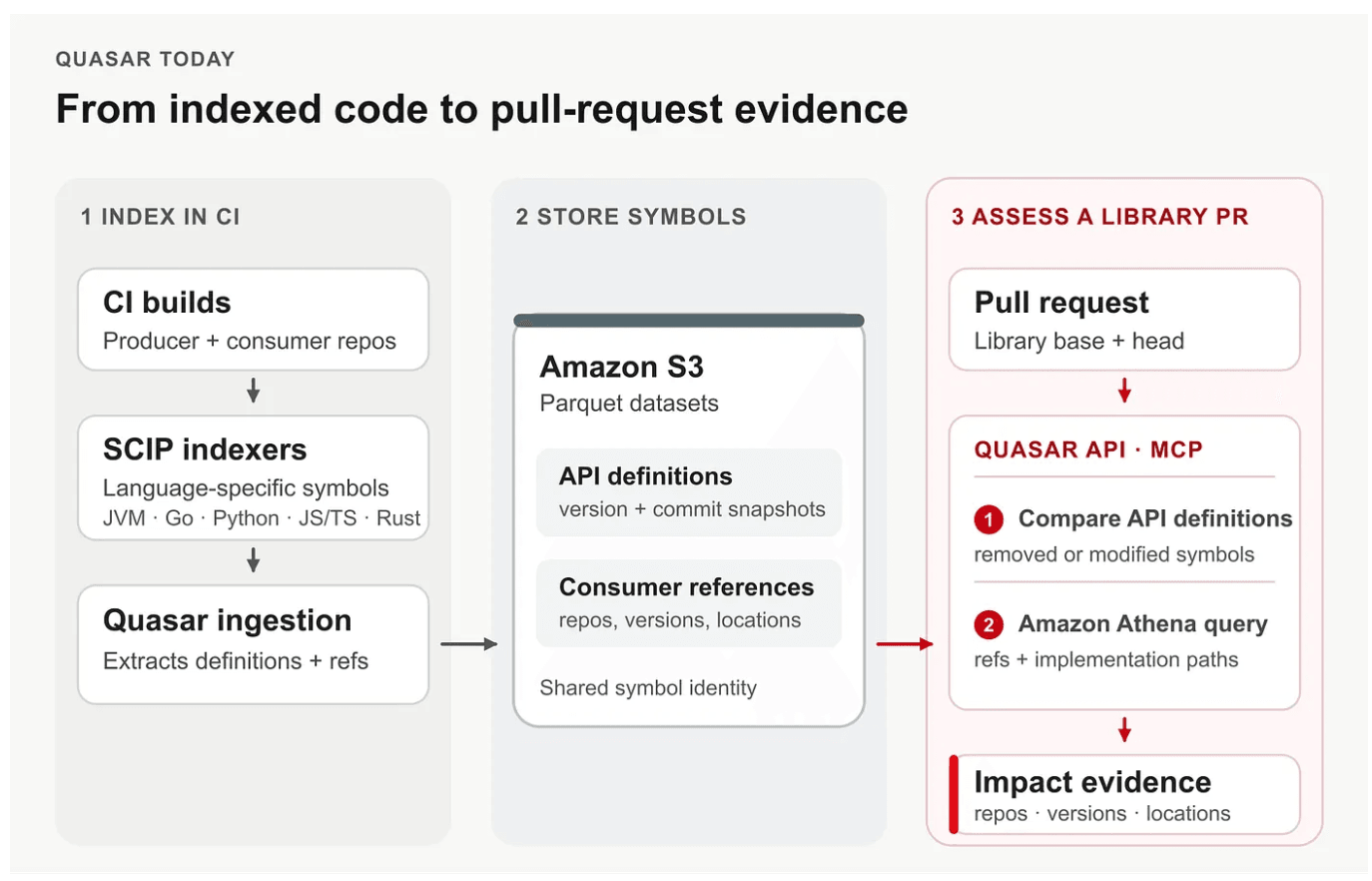
O fluxo de armazenamento e consulta é relativamente simples:
The storage and query flow is relatively simple:
- Indexed data is stored in Amazon S3 in Parquet format.
- Queries are made via Amazon Athena.
- During the analysis of a pull request, Quasar compares API definitions between commits and identifies symbols that were added, removed, or modified.
- It then queries the indexed references to locate affected repositories, dependency versions in use, and the exact points in the source code where the call happens.
Support for usage queries covers Java, Go, Python, JavaScript/TypeScript, and Rust via SCIP. Compatibility analysis (what actually changed in a signature), however, is restricted to JVM APIs and to Protobuf changes tracked through the generated Java code.
A concrete example: 137 repositories across three versions
The case cited by Netflix and reproduced by InfoQ gives a sense of scale to the problem: the removal of a deprecated method in an internal library affected 137 repositories, spread across three different versions of the dependency. Without a tool like Quasar, discovering this manually would mean hunting down that usage repository by repository, or simply removing the method and waiting for builds to break in production.
Quasar also exposes these findings in three ways: a REST API, a GraphQL API, and an MCP (Model Context Protocol) server. The choice of MCP is not accidental: Netflix wants coding agents to query this data directly, not just human developers browsing a dashboard.
The limits Netflix itself acknowledges
No static indexing captures everything, and the team behind Quasar was direct about that. Antonio J. del Águila, founder of Knaisoma, commented on the limitation in a LinkedIn discussion about the tool:
Observed usage has a blind spot for reflection and for code on rare paths, like a quarterly batch job, since those calls may never show up in the window that was sampled.
Antonio J. del Águila, founder of Knaisoma
Roberto Pérez Alcolea, a member of Netflix's Java Platform team and author of the original post, confirmed the point and previewed the next step:
Reflection and incomplete indexing remain blind spots, and we're also investing in runtime analysis to complement the static evidence. Together, those signals help inform removal decisions, without guaranteeing that an API is safe to delete.
Roberto Pérez Alcolea, Java Platform Team, Netflix
In other words: the absence of an indexed reference is not proof that an API is unused. Reflection, dynamic loading, outdated indexes, and incomplete indexer coverage remain reasons why Quasar doesn't see every existing consumer.
Where Quasar fits alongside other tools
Netflix already used Revapi for API compatibility comparison and Kythe for code navigation. Quasar doesn't replace either one: it connects the API change identified by Revapi with the actual usage identified via symbol indexing, something neither Revapi nor Kythe does on its own.
The next step, according to Netflix, is to push this analysis earlier in the workflow: even before a pull request is opened, coding agents could identify that a public API change is being proposed and already bring up the list of affected consumers, helping prepare migration changes. The decision about the API and the release, however, remains with the team that produces the library, not with the agent.
What this means for teams maintaining internal libraries
Platform teams that maintain shared libraries in large monorepos (or in multi-repository ecosystems) face a smaller version of the same problem: knowing who uses a function before deprecating it. The combination Netflix describes, semantic indexing via SCIP plus SQL-queryable Parquet storage, doesn't depend on infrastructure exclusive to the company; it's a pattern replicable with open tools.
For those building this kind of automation at a smaller scale, the most direct message isn't technical, it's about process: no static impact tool solves the problem alone. Netflix itself treats Quasar as input for human decision-making (or human-guided agent decision-making), not as an automatic "safe to remove" signal. That holds whether you run five repositories or five hundred.
Translated from the Brazilian Portuguese original · Read the original
New VPS: the security checklist that locks down the server before the bots find it
A Russian developer documented on Habr the 15-to-20-minute routine he applies to every new VPS before putting any site online. The account shows where most people get it wrong: thinking that hiding a port is the same as closing it.