OpenSSH on Alpine Linux has flaw that allows passwordless login, already being exploited


- Reading
- 6 min
The flaw dubbed *sshole (CVE-2026-123158) lets accounts that should be unreachable by password accept any sufficiently long password on musl-based Linux systems without PAM. Attacks have already been confirmed across several parts of the world.
The bug that turns absence of a password into full access
A vulnerability disclosed on November 5, 2026 allows an attacker with no credentials to log into accounts that, in theory, should not accept any password at all. The issue was dubbed *sshole, received the identifier CVE-2026-123158, and affects Linux systems running OpenSSH together with the musl library, without using PAM for authentication. According to InfoQ, security researchers already confirm active exploitation in real-world environments.
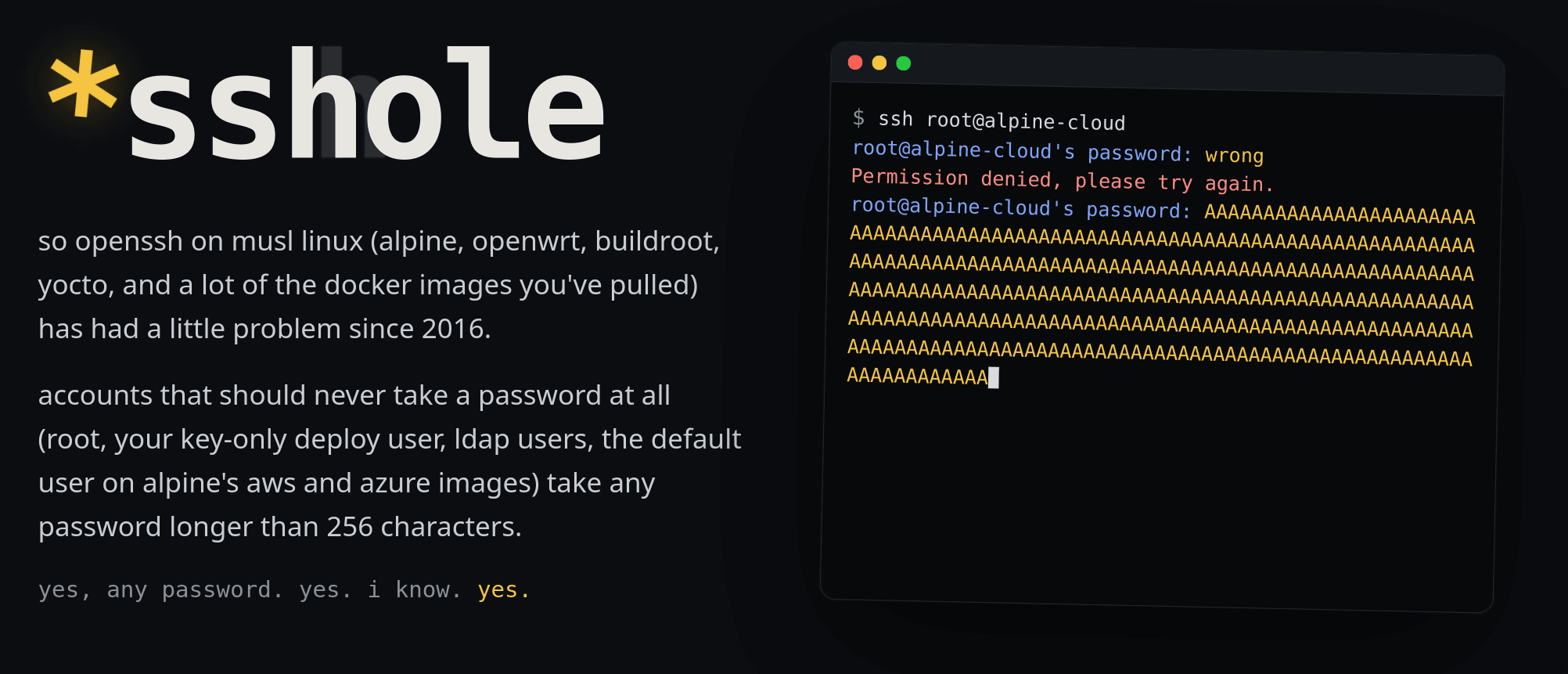
The cause is an interaction between two implementations. When musl processes a crypt() call with a password longer than 256 bytes, it returns an error value represented by an asterisk (*). That is the same character Linux uses in /etc/shadow to mark an account as having no usable password. OpenSSH, upon receiving that asterisk as the return value of crypt(), treats it as if it were a valid match and grants access.
In practice, any password between 257 and 1,024 characters can authenticate against an account marked as passwordless, as long as the server runs a version of OpenSSH earlier than 10.6p2, is compiled against musl (not glibc), does not use PAM, and has at least one account with an active SHA-256 or SHA-512 hash alongside another marked with an asterisk in /etc/shadow.
Accounts that should never take a password at all (root, your key-only deploy user, ldap users, the default user on alpine's aws and azure images) take any password longer than 256 characters.
Ozgun Kultekin, security researcher at Wakefield
Ten years of two flaws that only just met
Ozgun Kultekin, author of the technical disclosure on the *sshole website, traced the origin back to two changes made to musl in 2012: the first replaced crypt()'s NULL error return with an asterisk; the second imposed a 256-byte limit on SHA-512 hashing, causing longer inputs to return an error. Combined, they produced a value easy to mistake for a valid hash.
On OpenSSH's side, the behavior comes from a 2016 fix for CVE-2016-6210, a timing attack that revealed whether a username existed or not. To equalize response time between valid and invalid users, OpenSSH started borrowing the salt from another account and hashing the password anyway. That adjustment ended up also applying to real accounts whose shadow field contained an asterisk.
Kultekin says the issue went unnoticed for about a decade because the vulnerable combination was rare in testing: OpenSSH is tested on OpenBSD and glibc-based systems, and most Linux distributions delegate authentication to PAM, which doesn't call crypt() the same way for asterisk inputs. The flaw only surfaced after he compiled OpenSSH across multiple configurations and tested around 17,600 non-standard login attempts.
Who is exposed (and who isn't)
Alpine Linux is the most affected distribution, because it uses musl and its default OpenSSH configuration does not enable PAM. Other musl-based environments, such as OpenWrt, Buildroot, and Yocto, can also be vulnerable wherever the same configuration applies.
- Affected: Alpine Linux, OpenWrt, Buildroot, Yocto (whenever they combine musl, pre-10.6p2 OpenSSH, and the absence of PAM).
- Not affected: systems with glibc, distributions that use PAM, servers running Dropbear instead of OpenSSH, and OpenBSD systems.
The risk is particularly high in Alpine's official AWS and Azure images: the default alpine user comes marked as passwordless and also has access to doas without a password, which amounts to root.
On alpine's official aws and azure images that's the default
Ozgun Kultekin, security researcher at Wakefieldalpineuser, and it has passwordlessdoas. so it's root
Red Hat has already stated that its products are not affected, since they don't combine musl with the absence of PAM. Amazon made the same statement about Amazon Linux 2 and Amazon Linux 2023. This doesn't eliminate the risk for teams running Alpine-based containers, embedded devices, or custom builds with musl.
Exploitation confirmed on multiple fronts
InfoQ, citing reporting by Dan Goodin at Ars Technica, reports that the flaw can grant unauthenticated access to high-privilege accounts within seconds on affected systems. GreyNoise reported honeypots in Southeast Asia being attacked by a group tracked as GT10, which is said to be installing a backdoor with support for shell commands, reconnaissance, and persistence.
watchTowr linked the activity to botnets and cryptocurrency operations, while Previdian recorded 20 exploitation attempts coming from 13 IP addresses in nine countries. The US agency CISA (Cybersecurity and Infrastructure Security Agency) added CVE-2026-123158 to its Known Exploited Vulnerabilities (KEV) catalog on November 9, according to Hackread.
What changes for those running Alpine in Brazil
Alpine tends to be the preferred base image in container pipelines because of its small size: node:alpine, python:alpine, and nginx:alpine are common choices among Brazilian startups and fintechs optimizing registry costs and build time. If your project's Dockerfile starts from one of these images and exposes SSH for debugging or management, it's worth checking the bundled OpenSSH version.
Outside of containers, the risk shows up in edge infrastructure: routers running OpenWrt and industrial devices built with Buildroot or Yocto are common in telecom and automation operations in Brazil, and typically don't use PAM. Teams that maintain firmware or appliances based on these platforms need to treat this as a patch priority, not a routine update.
How to fix it now
- Update OpenSSH to version 10.6p2 or later, which already contains the fix.
- While that isn't possible, set
PasswordAuthentication noin the SSH server's configuration file and restartsshd. - Review
/etc/shadowfor accounts marked with an asterisk alongside accounts with an active SHA-256 or SHA-512 hash. - Check authentication logs for evidence that a passwordless account accepted a long password.
- Confirm whether the OpenSSH binary in use was compiled against musl and whether PAM is actually disabled, since that specific combination is what makes the system vulnerable.
Kultekin published a detection repository and technical context along with the original disclosure, aimed at teams that need to confirm exposure before applying the patch.
What remains open
InfoQ does not provide an official CVSS score for CVE-2026-123158, and the exploitation condition remains narrow: it requires the exact combination of musl, the absence of PAM, and asterisk-marked accounts coexisting with real-hash accounts. That limits the universe of vulnerable systems, but doesn't make it small, given how widely Alpine is used as a container base and how OpenWrt dominates home and small-operation routers.
What isn't clear from the available coverage is the real number of unpatched instances still running in production, nor how long Alpine-derived distributions will take to push OpenSSH 10.6p2 as the default in their official images. For those maintaining infrastructure based on this ecosystem, the practical recommendation while this remains unresolved is to treat any internet-exposed SSH server as a candidate for immediate verification.
Translated from the Brazilian Portuguese original · Read the original

Uber creates framework to decide whether an AI agent's action is appropriate in context
The company detailed a framework that goes beyond identity and API permissions to assess whether an autonomous agent's action makes sense in context, covering the agent's entire lifecycle.