Opera adds ChatGPT, Claude, and other AI agents integration
Opera, a browser and agentic AI company, announced on Tuesday, the 31st, the launch of MCP Connector for Opera Neon, its browser with agentic AI.

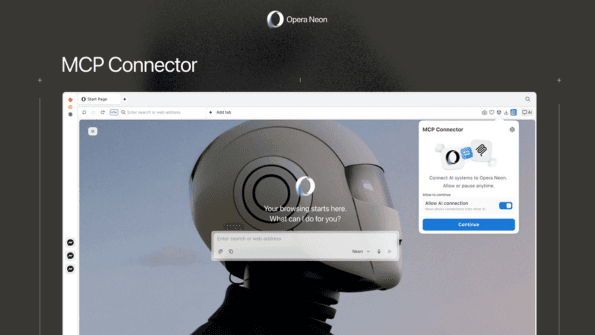
Opera, a browser and agentic AI company, announced on Tuesday, the 31st, the launch of MCP Connector for Opera Neon, its browser with agentic AI. MCP Connector is a technology based on the Model Context Protocol (MCP) that allows different AI tools to connect directly to the software, access real-time web context, and execute actions within it, without the need to switch between platforms.
With the update, Opera turns the browser into a true artificial intelligence execution layer. In practice, this eliminates the need to bring information to the AI: now, the AI integrates into the environment where the work is already happening.
Opera Neon now supports third-party AI agents through MCP Connector, which allows tools like ChatGPT, Claude, Lovable, OpenClaw, and n8n to operate directly within the user's active session. Unlike other solutions that work in simulated environments, Opera Neon allows the technology to act within the software's real session, with access to open tabs, page content, and authenticated sessions.
“Last year, we launched Browser Operator as a first step toward an agentic browser. Now we are opening these capabilities to external AI clients through MCP, so they can act directly within the browser, not outside it,” says Monika Kurczyńska, Director of Browser AI R&D at Opera.
The integration addresses one of the main current challenges of using AI: the disconnect between tools and the work environment. Today, internet users still need to copy content between tabs, re-explain contexts, and restart workflows when switching between platforms. With MCP Connector, AI clients can now access and act directly within the browser, making processes more fluid and efficient.
By exposing an endpoint based on the Model Context Protocol (MCP), Opera Neon gives connected clients access to the browser's real-time context. Possible actions include navigating pages, extracting information, capturing screenshots, filling out forms, opening new tabs, and performing searches.

The new feature significantly expands Opera Neon's ecosystem, which now connects with a variety of MCP-compatible clients, creating an open platform for AI innovation applied to browsing.
Use cases are diverse and include development, prototyping, and automation. Developers already use tools like Claude Code to test applications in real browsing environments, while platforms like Lovable enable the creation of interfaces from live pages. Solutions like n8n and assistants like ChatGPT can incorporate browser-based actions into automated workflows.
“The browser is where workflows live, but AI was disconnected from it. With Opera Neon, we connect popular AI clients directly to an agentic browser, allowing them to operate where users already work, without needing to recreate context,” Kurczyńska adds.
The connector builds on Opera Neon's existing capabilities to execute tasks directly in the browser, now extended to external clients. To ensure security and stability, Opera implemented authentication via a secure MCP server URL, along with a persistent proxy layer that keeps the connection active and reports when the browser is unavailable.
MCP Connector is now available to all Opera Neon subscribers. Opera also plans to release a simplified version of the connector in its Opera One and Opera GX browsers, expanding access to the feature across its entire portfolio.

Translated from the Brazilian Portuguese original · Read the original
WordPress Backup: What to Save Before Migrating Your Site
Making a WordPress backup seems simple until it's time to restore the site on another host. Downloading a folder of images or exporting just the…