US orders removal of DeepSeek from federal agencies over data risk
An order from the Department of Homeland Security requires US civilian agencies to stop buying and remove products based on DeepSeek, extending a restriction that already applied to intelligence systems.

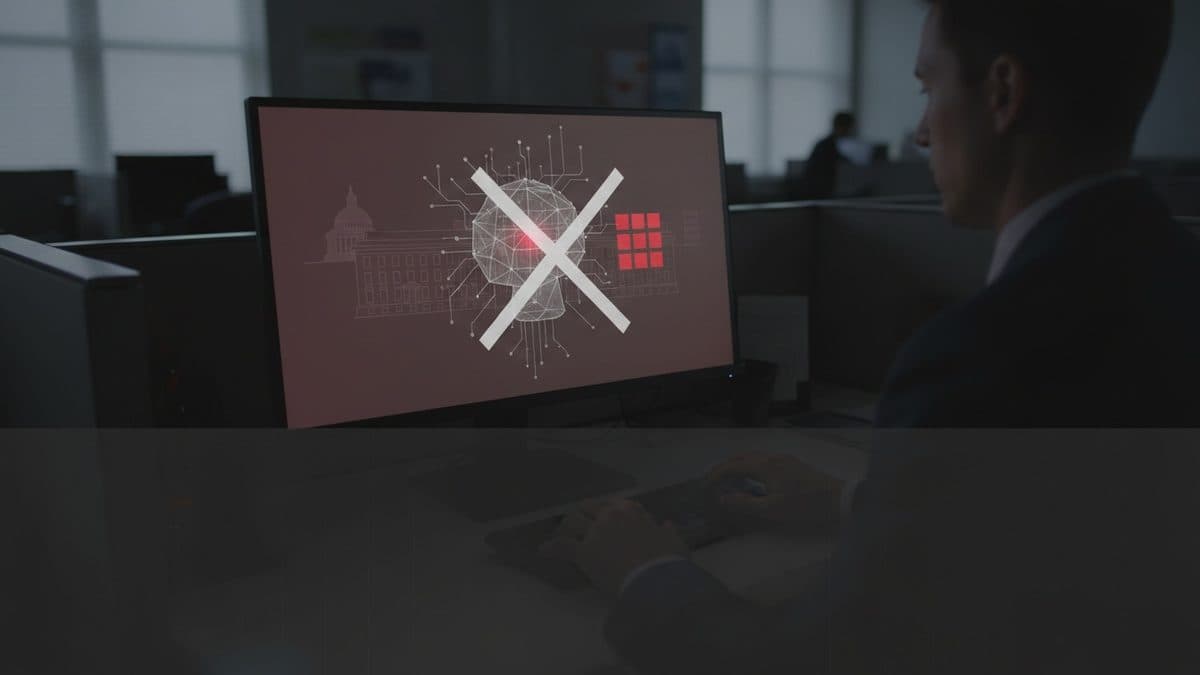
The US Department of Homeland Security (DHS) ordered federal civilian agencies to stop purchasing products and services built by DeepSeek and to remove what is already in use in government IT systems. The move, reported on October 20, 2026 according to TechCrunch, cites national security concerns tied to the Chinese startup's operations.
The order isn't limited to DeepSeek's own product. It also covers third-party products and services built on the company's technology, which extends the restriction's reach to any tool that uses DeepSeek's models under the hood. Agencies can request exceptions, but the general rule is clear: get DeepSeek out of the federal pipeline.
The argument is about data, not about the model itself
The DHS argues that sensitive data from US government users could become accessible to Chinese authorities under China's legislation, which requires companies in the country to cooperate with state intelligence requests. It isn't a criticism of the model's technical quality: it's a structural distrust about where and how data processed by DeepSeek could end up.
This matters to developers because it separates two problems that are often treated as one. Running an open-weight model locally, without calling an API hosted in China, exposes no data to third parties. Using DeepSeek's hosted service, or a third-party product that passes data along to the company's infrastructure, is another story. The DHS order targets the second situation, but the line between the two isn't always obvious to someone integrating an API into their code.
An escalation, not a first move
Today's order extends a restriction that already existed. A law passed in December 2025 had banned the use of DeepSeek in national security systems tied to the US intelligence community. What's new in October 2026 is extending that barrier to civilian agencies, covering both new purchases and IT systems already in operation.
The backdrop is DeepSeek's technical rise since the launch of its R1 reasoning model in January 2025, which sent Nvidia's stock tumbling at the time by showing it was possible to compete with OpenAI and Meta using open, lower-cost models. Since then, the Chinese company has been under growing scrutiny from governments and regulators around the world.
The model distillation accusations
According to a September report cited by TechCrunch, the US accused DeepSeek and five other Chinese AI companies, including Alibaba and Moonshot AI, of using large-scale distillation to extract information from American AI systems. Distillation is the technique of training a new model using the outputs of an existing one, a common shortcut to speed up development without repeating the full cost of training from scratch.
OpenAI and Anthropic independently raised the same suspicion. OpenAI told US lawmakers it had observed suspicious attempts by DeepSeek to distill its models; Anthropic said it had identified unauthorized attempts by DeepSeek and other Chinese labs to collect Claude's outputs. For developers, the episode is a reminder that an open model isn't synonymous with a transparent provenance chain: knowing where the training of a model you're putting into production came from has become part of technical due diligence.
Beijing's response and the bigger picture
China's Ministry of Foreign Affairs spokesperson, Mao Ning, responded to the American order at an official briefing on the Tuesday before TechCrunch's report.
We oppose overstretching the concept of national security and politicizing technology and trade issues. We will resolutely safeguard the legitimate rights and interests of Chinese enterprises.
Mao Ning, spokesperson for China's Ministry of Foreign Affairs
The dispute isn't one-sided. Bloomberg reported in the week before the DHS order that China is considering export restrictions on 23 AI-related technologies, including chip designs and certain advanced models, citing the need to contain security risks and misuse. In other words: while the US closes the door to DeepSeek inside government, China is studying how to close the exit door for technology that could equip competitors outside the country.
What changes for those choosing a model in Brazil
No American law directly applies to a Brazilian company choosing to run DeepSeek-V3 or R1 on its own server. But the move has practical effects on three fronts worth the attention of anyone designing AI architecture here.
- Procurement under contracts with the US government or multinationals: companies that sell to the US public sector, or that supply suppliers of the American government, may be pressured to document that they don't use DeepSeek components in products delivered to that market.
- Trust in the open-model supply chain: the distillation accusations, not publicly proven but raised by OpenAI and Anthropic, reinforce that published open weights don't guarantee clean training. Anyone who audits a model before putting it into critical production gains one more argument for doing so.
- Risk of access to future technology: if China does restrict exports of advanced models and chip designs, the next generation of open Chinese models may arrive later, or in a more limited version, for those outside China.
What remains open is how far American regulatory pressure will spread beyond the federal government. Today the order applies only to US civilian agencies; as of TechCrunch's report, there's no sign it will become a requirement for American private companies, or for trade partners outside the US. For those in Brazil already running DeepSeek in production, today's news is a sign to pay attention, not an immediate obligation.
Translated from the Brazilian Portuguese original · Read the original
GitHub Actions Runner Controller 0.15.0 reduces Kubernetes load and makes upgrades more predictable
Released on October 1, ARC version 0.15.0 swaps full updates for patches, moves status to metrics, and gives more control over the controller's reconciliation and shutdown.