5 min read
Huawei tallies 100 million Qiankun parts in cars, but still hasn't built a single one
 Lucas CardosoAuthor
- Reading
- 5 min
- Tables
- 1
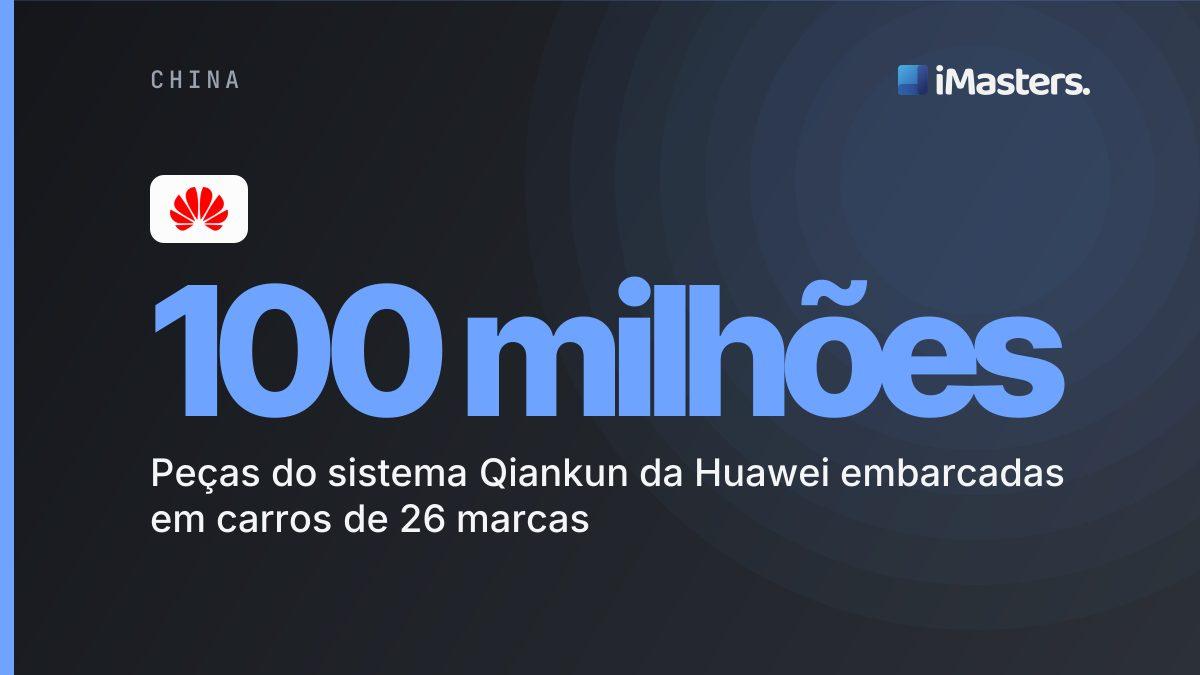
The company says it has shipped more than 100 million Qiankun parts to 26 brands and over 60 models. The number counts components, not cars sold, and reveals Huawei's strategy of becoming the supplier of the car's intelligence without entering manufacturing.
The announcement, in context
Huawei reported that, as of November 25, 2026, parts from its Qiankun intelligent automotive solution surpassed 100 million units shipped, covering 26 vehicle brands and more than 60 models. The information was disclosed by the company itself and republished by the Chinese outlets IT Home and 36Kr, which are the factual basis of this text: Pandaily, the original source of this coverage, had not yet found a dedicated press release on Huawei's automotive official website at the time of reporting.
The detail that changes how the number should be read: 100 million is a count of parts, not of cars sold or of complete assisted-driving packages installed. A single vehicle can carry dozens of Huawei components at once, so the total does not equate to 100 million cars running with the company's technology. For anyone reading this type of announcement to size up a market or evaluate a partner, this distinction is the first filter to apply.
What Qiankun actually is
Qiankun is not a car, it's a shelf of products that Huawei sells to automakers. According to the official definition passed along by 36Kr and confirmed by IT Home, the umbrella covers five fronts:
- Qiankun intelligent driving, also sold under the HUAWEI ADS (assisted driving system) brand;
- HarmonySpace digital cockpit, built on top of HarmonyOS;
- intelligent vehicle control, linked to the HUAWEI XMC digital chassis engine;
- intelligent automotive optics, which includes head-up displays and lighting systems;
- cloud services for intelligent vehicles.
In this material, Huawei describes itself as a supplier of "components and incremental solutions," not as a car manufacturer. It's a deliberate positioning choice: instead of competing with traditional Chinese and global automakers, the company inserts itself into the chain as an intelligence layer, repeating in cars the role that Qualcomm and Android play in phones, but with deeper integration between chip, operating system, driving software, and cloud.

Expert views
What people are saying about it.
A Stanford study shows a real decline in youth employment in roles exposed to AI. For the Brazilian founder, the question isn't whether AI replaces the intern, it's what the company loses when it stops training today's junior, who would be tomorrow's senior.
Search Central guide, updated since December 2025, reinforces that there is no special markup to appear in AI Overviews: what counts is solid basic SEO, measured through Search Console.
The AI infrastructure fintech raised $6 million led by NXTP after quadrupling its enterprise client portfolio in 2026, going from two to eight contracts. The bet behind the round says more about verticalized models than about the check itself.
From 23 million to 100 million in 19 months
The jump becomes clearer when compared to an older number. Huawei automotive's own institutional website still carried, at the time Pandaily checked the page, an outdated marketing statistic: more than 23 million intelligent components shipped as of April 2025. If the new total of 100 million really refers to November 2026, growth was more than fourfold in just under two years.
This pace says something about the Chinese electric and assisted-driving car market, which keeps absorbing automotive software volume at a speed with no direct parallel in Brazil. It also says something about Huawei's own communications: the official page was not updated on the same day as the announcement, which is a practical reminder for anyone evaluating Chinese suppliers through press releases: the most recent number usually circulates first in local trade press, before reaching institutional material in English.
Two different metrics, the same risk of confusion
Qiankun's history of announcements shows how easy it is to mix up similar-looking indicators without noticing. In August 2026, a separate official statement, about a user-trust milestone, said the company was working with 25 automaker brands and more than 60 cooperative models (brand and model numbers nearly identical to the current ones, but tied to a distinct metric: usage trust, not parts volume). English-language reports about "one million vehicles installed" describe yet another measurement, from another date.
| Metric | What it measures | When |
|---|---|---|
| 100 million parts | Qiankun components shipped (hardware + software) | As of 11/25/2026 |
| 25 brands, 60+ models | User-trust milestone | August 2026 |
| 1 million vehicles | Vehicles with Qiankun installed | Earlier date, unspecified |
| 23 million components | Statistic still on the institutional website | April 2025 |
This soup of numbers isn't unique to Huawei: it's how large technology suppliers usually communicate traction, picking whichever metric sounds biggest at any given moment. For anyone negotiating a partnership, due diligence, or investment with Chinese automotive hardware and software suppliers, the exercise of separating "part" from "vehicle" and "installation" from "stated trust" is worth as much as the number itself.
What this teaches the Brazilian founder
The Qiankun case matters less for its volume and more for the business architecture behind it. Huawei lost smartphone market share to US sanctions and redirected much of its chip, operating system, and computer vision engineering toward the car, without taking on the industrial risk of manufacturing a vehicle. It sells the intelligence and leaves the automaker to handle sheet metal, engine, and distribution.
In short: it's a "picks and shovels" strategy applied to a capital-intensive sector, where the infrastructure supplier grows alongside every competitor in the end market, instead of betting on a single brand. For Brazilian founders in mobility, logistics, or embedded fintech, the parallel isn't to build a car: it's to identify which layer of the stack can be turned into a horizontal supply, instead of competing directly with whoever already has manufacturing or distribution scale.
Huawei also disclosed, in an earlier Pandaily report, that Qiankun ADS had accumulated 17.3 billion kilometers in assisted-driving mode and 6.91 million collisions avoided, according to the company itself. If the figure holds up, it's the kind of real-world road data volume that feeds perception and planning models far faster than any limited pilot program could generate on its own (a data network effect that few companies outside China have the scale to replicate today).
Where the Brazilian yardstick still falls short
In Brazil, there is no vertical supplier today equivalent to Qiankun: the connected-vehicle chain here is fragmented across fleet telemetry, pay-per-kilometer insurance, and automakers that import ready-made assisted-driving stacks from abroad, case by case. There is no domestic player offering, in the same package, chip, cockpit operating system, assisted driving, chassis control, and cloud for multiple brands at once.
This isn't just a market gap, it's also an open strategic question: if global automakers operating in Brazil start importing cars with the Huawei stack already built in, Brazilian developers and integrators will need to learn to work with HarmonyOS and with the HarmonySpace cockpit APIs just as much as they learn Android Automotive today. The 100-million-parts announcement doesn't change that tomorrow, but it does mark the speed at which this software layer is consolidating around a single supplier, on the other side of the world.
Translated from the Brazilian Portuguese original · Read the original
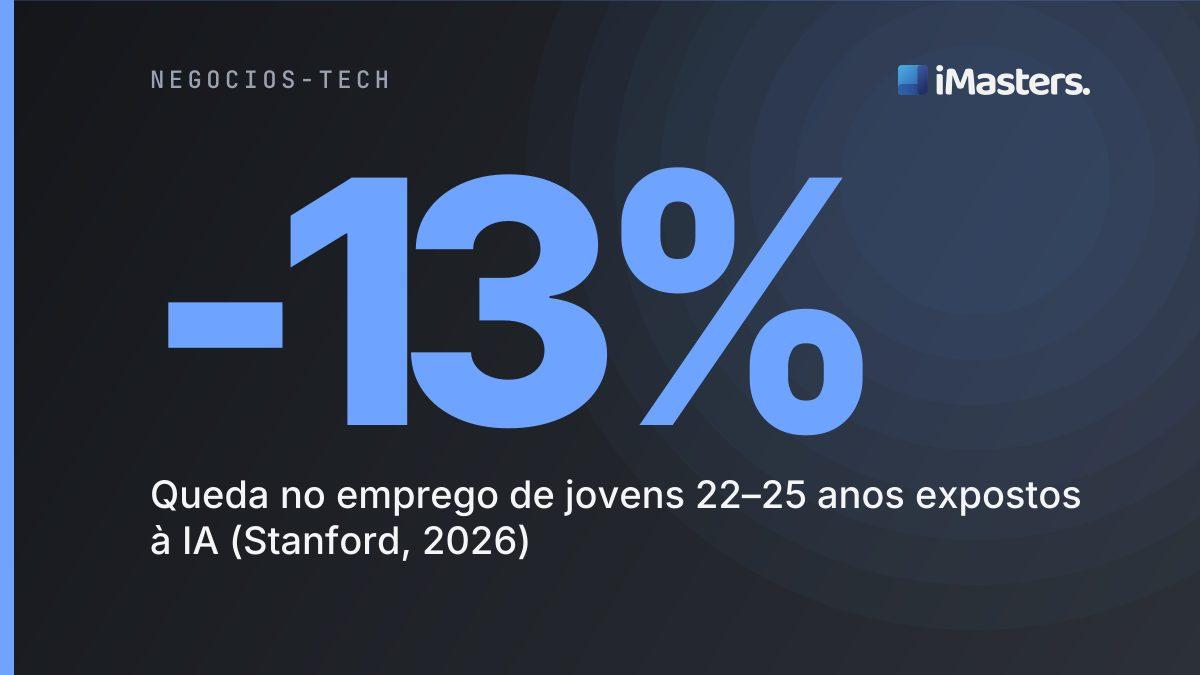
Interns in the AI era: the cost cut that can become a tacit knowledge gap
A Stanford study shows a real decline in youth employment in roles exposed to AI. For the Brazilian founder, the question isn't whether AI replaces the intern, it's what the company loses when it stops training today's junior, who would be tomorrow's senior.