2 min read
Google explains how sites appear in AI Overviews and AI Mode without extra technical requirements
Search Central guide, updated since December 2025, reinforces that there is no special markup to appear in AI Overviews: what counts is solid basic SEO, measured through Search Console.
 Sabrina SantosAuthor
- Reading
- 2 min
Search Central guide, updated since December 2025, reinforces that there is no special markup to appear in AI Overviews: what counts is solid basic SEO, measured through Search Console.
Editor's note: this article cites the update date in the footer of the 'AI features and your website' page as '2025-12-31 UTC'. The source consulted by the editorial team shows '2025-12-10 UTC' in the footer. It was not possible to confirm which date is correct at the time of publication; readers should check directly on the official Google Search Central page before using this date as a reference.
The AI features and your website page, from Google Search Central, shows in its footer the official update notice: 'Last updated: 2025-12-31 UTC' (December 31, 2025). It doesn't announce any new feature: it consolidates, in a single document, how AI Overviews and AI Mode decide which pages to cite and what a site can (or can't) do about it. For those working in technical SEO, the most important point in the text is precisely what it denies: there isn't a separate, exclusive set of rules to appear in AI-generated responses.
How Google decides what goes into the response
Both AI Overviews and AI Mode can use a technique Google calls query fan-out: instead of answering a single search, the system fires off several related searches, covering different subtopics and data sources, to build the final response. That's why the list of supporting links in an AI response tends to be broader and more diverse than the classic ten blue links: the system is, in practice, running several internal searches before displaying a single answer.
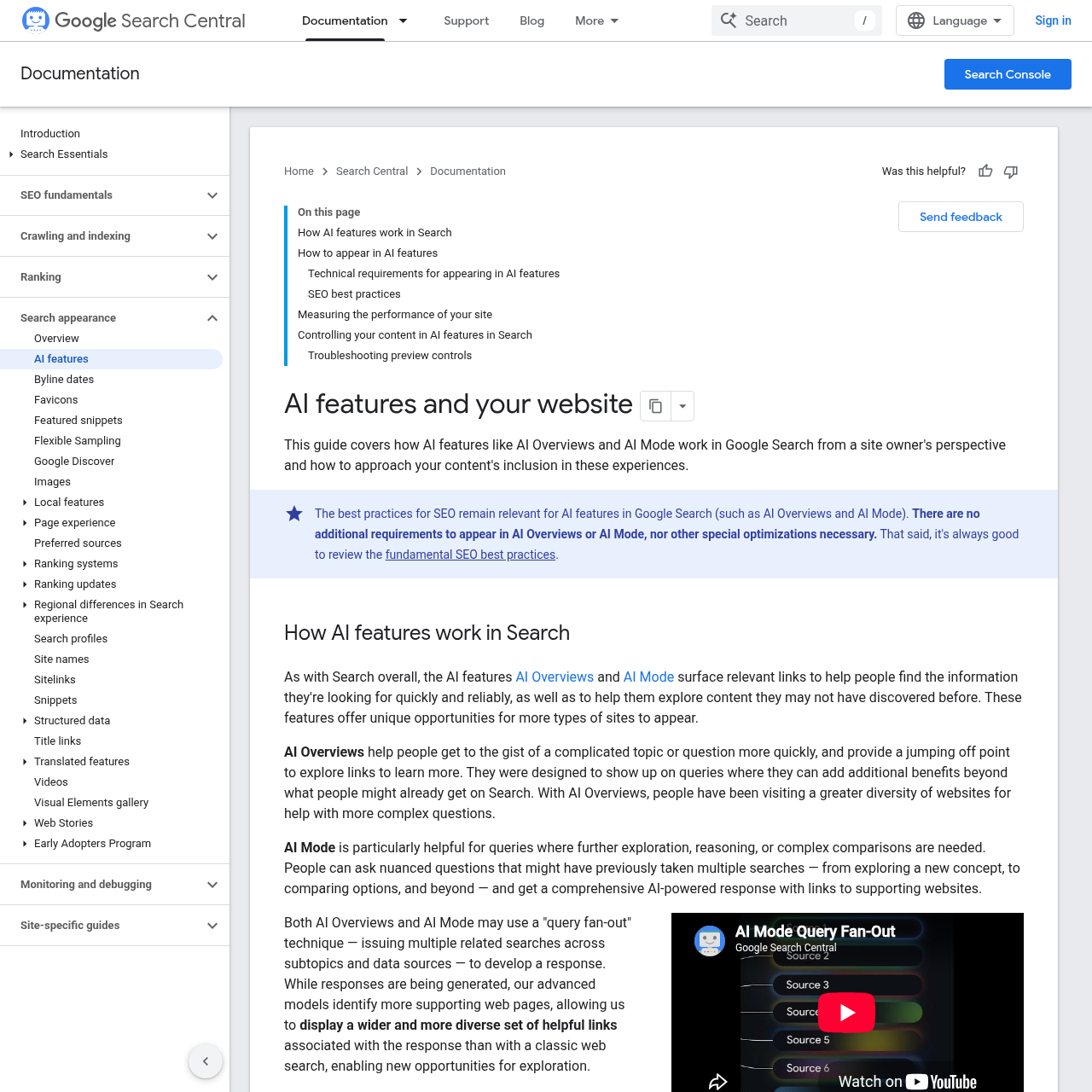
The documentation also separates the two features by purpose. AI Overviews targets complex questions where a summary helps the user decide whether to dig deeper, and it only appears when Google's system determines it adds something beyond the traditional search result, which explains why it doesn't trigger on every query. AI Mode, in turn, is designed for questions that would require several successive searches, such as product comparisons or exploring a new concept, condensed into a single response with supporting links.

Expert views
What people are saying about it.
The World Economic Forum ranks analytical thinking as the most in-demand skill among companies worldwide. For founders and leaders in Brazil, this has stopped being an HR trend and become a criterion for staying in the job.
The AI infrastructure fintech raised $6 million led by NXTP after quadrupling its enterprise client portfolio in 2026, going from two to eight contracts. The bet behind the round says more about verticalized models than about the check itself.
At an intellectual property event in Beijing, Huawei and supplier Phlexing Technology announced advances in EDA software tied to the Tau Scaling Law, a central piece of China's bet on closing the chip production cycle without relying on US tools.
There is no exclusive technical requirement for AI
The guide's most direct passage settles a recurring doubt among SEO practitioners: to be eligible as a supporting link in AI Overviews or AI Mode, a page only needs to be indexed and eligible to appear in Search with a snippet, meeting Google Search's standard technical requirements. The document is explicit: **
Translated from the Brazilian Portuguese original · Read the original

The official llms.txt guide to getting your site read by generative AI
The llms.txt specification reached version 2 after two years of real-world adoption. See the checklist of required fields and how to measure whether it worked on your site.