Google details technical requirements to appear in Search's AI Overviews and AI Mode
Updated Google Search Central documentation reinforces that there is no special SEO checklist for AI features in Search: the rules are the same as traditional technical SEO.
- Reading
- 7 min
- Tables
- 1
Google details technical requirements to appear in Search's AI Overviews and AI Mode
Updated Google Search Central documentation reinforces that there is no special SEO checklist for AI features in Search: the rules are the same as traditional technical SEO.
Editor's note: this article states that the guide was updated on December 31, 2025, but the original source (Google Search Central) records the update date as December 10, 2025. In addition, two claims in the technical checklist (the mention of Core Web Vitals in the page experience section and the explanation that generative AI tends to cite structured data directly) are elaborations in the text that do not appear literally in Google's official document. Keep these caveats in mind when using the article as a reference.
Google Search Central updated the AI features and your website guide and made it clear: there is no special optimization for generative AI, just solid SEO fundamentals applied well.
Google Search Central updated the AI features and your website guide and made it clear: there is no special optimization for generative AI, just solid SEO fundamentals applied well.
What the documentation actually says
On December 31, 2025, Google Search Central updated the AI features and your website guide, which explains how AI Overviews and AI Mode choose the pages that appear as supporting sources in AI-generated answers in Search. The document has existed for longer, but this revision consolidated the point that matters most to SEO practitioners: there is no parallel checklist for generative AI. The rules are the same as traditional Search, just applied more rigorously.
This matters because, since AI Overviews started appearing at scale in Brazil, an informal market for "AI optimization" has grown, selling tactics supposedly specific to the technology, such as extra markup or text formats exclusive to language models. Google itself dismisses this idea in the official text: to appear as a supporting link in an AI Overview or in an AI Mode answer, a page only needs to be indexed, be displayable with a normal snippet, and meet Search's standard technical requirements. There is nothing beyond that.
How the answer is put together behind the scenes
The guide describes the query fan-out technique (branching query distribution): instead of running a single search, the system fires off several related queries covering different subtopics and data sources to assemble the final answer. That is why an AI Overview or an AI Mode answer tends to link to a more diverse set of pages than a conventional search would bring.
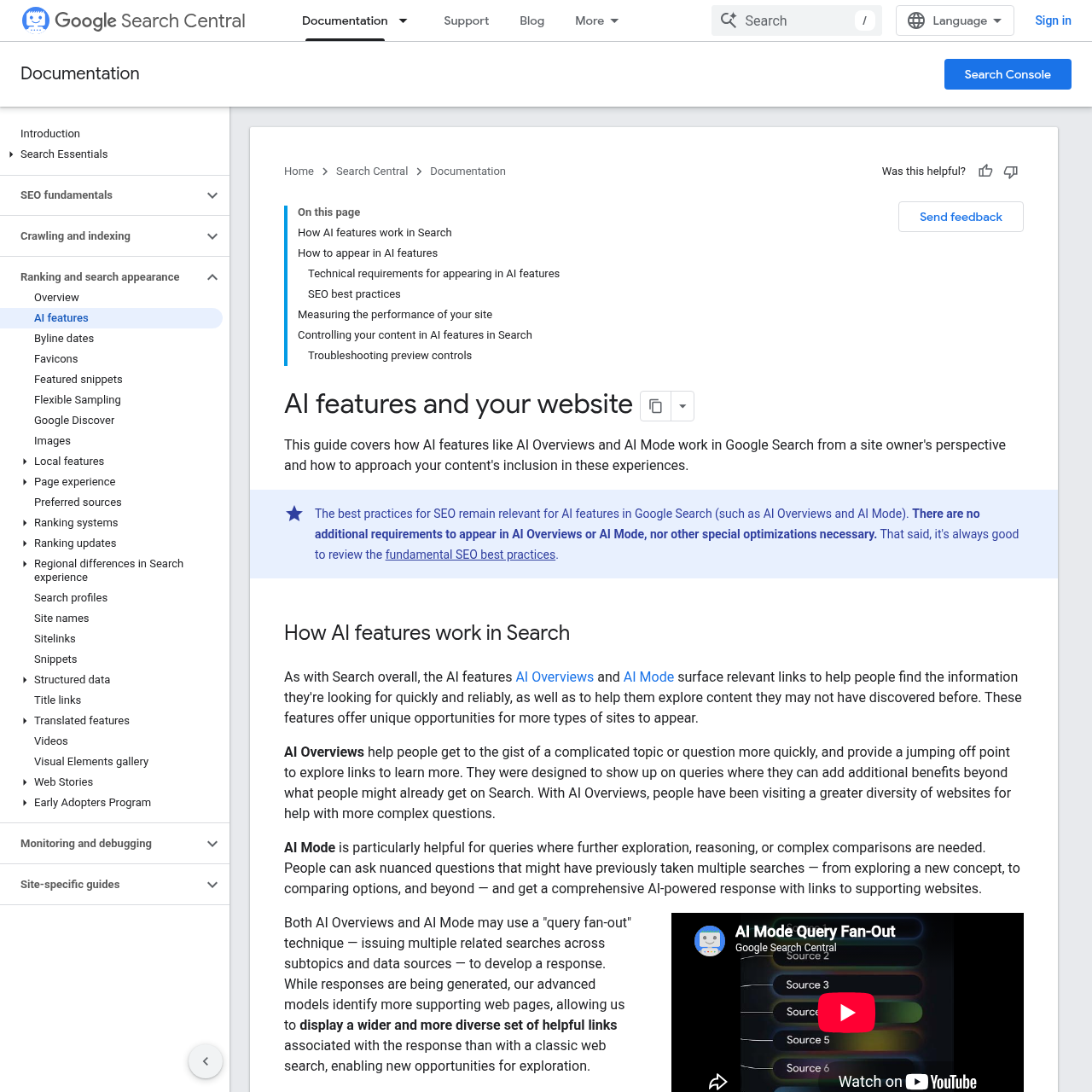
AI Overviews and AI Mode are not the same thing and use different models, which explains why the set of links changes between one and the other:
| Feature | When it appears | How the answer is assembled |
|---|---|---|
| AI Overviews | In queries where it adds value beyond the traditional result (and therefore doesn't appear in every search) | Summary generated from multiple relevant pages |
| AI Mode | In queries that require comparison, reasoning, or in-depth research | Query fan-out: parallel searches across several subtopics before consolidating the answer |
The technical checklist, straight from the source
Google lists the best practices that already applied to traditional SEO and reaffirms that they remain the entry point for AI experiences. For anyone running a site, the practical checklist is:
- Make sure crawling is allowed in
robots.txtand in any CDN or hosting infrastructure in front of the site. - Make content accessible through internal links on the site.
- Deliver a solid page experience (the same page experience and Core Web Vitals signals that already matter for regular ranking).
- Make sure important content is available in text format, not just as an image or video.
- Pair the text with quality images and videos, when it makes sense for the subject.
- Check that structured data matches exactly the visible text on the page, because generative AI tends to cite that data directly.
- Keep Merchant Center and business profile information up to date, for e-commerce and local businesses.
- Validate the site in Search Console to catch technical issues before they block indexing.
None of these items is new to anyone who already works with technical SEO. The point is that, according to Google, there is no shortcut through some trick specific to AI models: the entry door is the same, and ignoring it takes a site out of the running both in Search and in AI-generated answers.
How to control whether your page appears (or not)
Since AI is integrated into Search, the same robots.txt directives for Googlebot still apply to control what gets into AI Overviews and AI Mode. To limit what is shown from a page, the guide points to four directives: nosnippet, data-nosnippet, max-snippet, and noindex. All of them prevent the corresponding excerpt from becoming source text for a generated answer.
There is also a separate layer for those who want to limit the use of content in training and in other Google AI systems beyond Search: the Google-Extended directive, documented separately. It's worth noting that it does not control appearance in AI Overviews or AI Mode, only the use of content in the company's other AI products.
When the directive doesn't work in practice
The guide offers a diagnostic roadmap for when a page keeps appearing in an AI Overview even after a blocking directive has been implemented:
- Confirm that the directive is correct and visible to Googlebot using the URL Inspection tool, which shows the HTML exactly as the crawler received it on the last crawl.
- Give Google time to crawl the content again: the guide is explicit that this can take anywhere from a few days to months, depending on how often the system decides to revisit that page.
- If something changed recently, request a new crawl instead of waiting for the natural cycle.
- If the problem persists after these steps, the official recommendation is to open a thread in the Search Central help community.
This detail matters because it's common to confuse crawling latency with a directive failure, and end up rewriting markup that was already correct.
How to measure the impact in practice
For anyone tracking metrics, Search Console doesn't separate AI Overviews and AI Mode into their own report: both fall under general search traffic, within the "Web" search type in the performance report. This means a change in clicks for that search type could reflect the effect of AI experiences, even without a specific label for it.
The document also includes a data point on engagement quality worth quoting directly:
Google found that when users click on search results pages that include AI Overviews, those clicks tend to be of better quality, meaning people spend more time on the site.
(loose translation from English) Google Search Central, official documentation
To validate this on your own site, the way to do it is to cross-reference the Search Console performance report with session time and conversion events in Analytics, looking specifically at the period when a page started appearing as a source in AI answers. Without that cross-reference, it's hard to separate the AI Overview effect from a normal variation in organic traffic.
What remains open
The guide doesn't say how much traffic from generative AI currently represents for sites outside the United States, nor does it detail how to separately measure clicks coming from AI Mode. There's also no guarantee of display frequency: as the text itself states, AI Overviews only appear when the system decides they add value over a traditional search, which in practice means a good portion of queries won't trigger this feature at all. This reinforces that treating GEO as a discipline separate from traditional technical SEO is, at least according to Google itself, a misplaced focus.
Translated from the Brazilian Portuguese original · Read the original


FBI links SEO poisoning to US$28 million in ransomware payments
An FBI alert cited by Barry Schwartz of Search Engine Roundtable points out that SEO poisoning techniques have already generated US$28 million in ransomware payments. For those who handle marketing and search, this means the brand's own ranking has become an attack vector.