Google documentation confirms: no extra technical requirement to appear in AI Overviews
- Reading
- 5 min
Google Search Central guide, updated in December 2025, reinforces that eligibility for AI Overviews and AI Mode depends on the same technical indexing fundamentals as Search, with no additional criteria.
What Google Search Central actually changed
Google Search Central maintains a guide called "AI features and your website," which explains how AI Overviews and AI Mode work from the perspective of whoever publishes a site. The current version of the document was updated on December 10, 2025, nearly a year ago, and remains the company's official reference on the subject. It doesn't bring a new list of rules: it clearly reinforces that eligibility for these features follows the same technical basis as traditional Search.
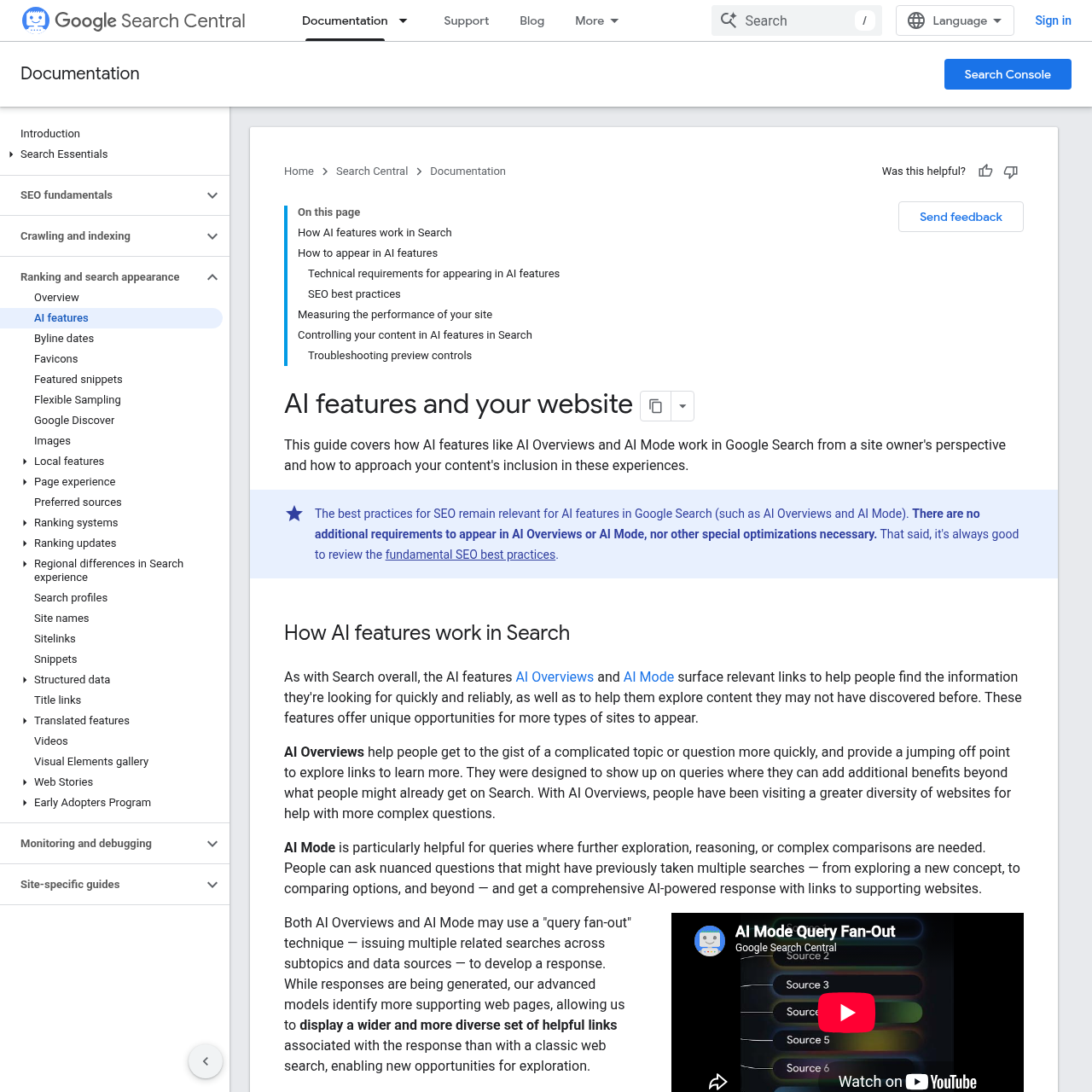
The document explains that AI Overviews and AI Mode use a technique called "query fan-out": the system fires off multiple searches related to subtopics and different data sources to put together the response. While the response is being generated, Google's models identify additional supporting pages, which allows for a broader and more diverse set of links to be shown than in a classic search. This is what explains a page appearing as a source in an AI Overview even without being at the top of the traditional organic ranking for that query.
The eligibility bar hasn't changed
To be eligible to be shown as a supporting link in AI Overviews or AI Mode, a page must be indexed and eligible to be shown in Google Search with a snippet, fulfilling the Search technical requirements. There are no additional technical requirements.
Google Search Central, "AI features and your website" documentation
In practice, this means there's no "AI optimization seal" or new markup format to implement. Whoever already meets the standard Search technical requirements is already eligible to be cited as a source in an AI response, should the system decide that this adds value. The document itself notes that AI Overviews only appear when Google's systems assess that the response adds something beyond what classic search would already deliver: that's why, according to the company, the feature is frequently not triggered, regardless of the site's optimization.
The checklist of best practices Google lists
Despite there being no extra requirement, the document lists eight SEO practices that remain valid even without specific optimization for AI:
- Allow crawling in
robots.txtand in any CDN or hosting infrastructure - Make content easy to find via internal links
- Ensure a good page experience
- Make important content available in text format
- Support the text with quality images and videos, when it makes sense
- Ensure structured data matches the visible text on the page
- Keep Merchant Center and Business Profile updated
- Verify the site in Search Console to quickly diagnose technical issues
For those who work with technical SEO, no item on the list is unfamiliar. The point is different: Google is saying, in writing, that this is the same list that applies to appearing in AI Overviews. There's no second "for AI" checklist running in parallel.
Structured data: the item that trips up the most pages
Among the eight points, the one that most often catches real sites off guard is the requirement that structured data (schema.org, JSON-LD) match the visible text on the page. If the schema declares a price, a rating, or a date that doesn't appear (or doesn't match) in the rendered content, the page risks losing eligibility for a snippet and, by extension, for appearing as a source in an AI response.
It's worth auditing the markup with the Rich Results Test and cross-checking it against the HTML that Googlebot actually receives via the URL Inspection tool, since a mismatch between what the crawler sees and what the user sees is the most common error on this point.
How to measure before and after in Search Console
There is, today, no separate report for AI Overviews or AI Mode traffic. The documentation confirms that this traffic falls into the same bucket as the rest of search: it appears in the Performance report, under the "Web" search type, alongside classic results. In practice, SEO teams can't isolate, within Search Console, how many clicks came specifically from an AI Overview.
The possible path is indirect: segment by landing page and by query pattern (long, comparative, exploratory questions) and observe variations in CTR and impressions after adjustments to structured data or crawling. This is what the documentation itself suggests by pointing to guides on how to analyze traffic changes and how to combine Search Console data with Analytics.
We've seen that when people click from search results pages with AI Overviews, these clicks are higher quality (meaning, users are more likely to spend more time on the site).
This suggests tracking session time and conversion in Google Analytics, segmented by the pages most likely to appear as a source in AI Overviews (informational, comparative, how-to content), comparing this group with the rest of organic traffic before and after technical adjustments.
Controlling what appears (and what doesn't)
The main access control remains the robots.txt directives for Googlebot, since AI is integrated into Search and uses the same crawler. To limit what's shown as a snippet, including within an AI Overview, the tools are the same as always: nosnippet, data-nosnippet, max-snippet, or noindex. To restrict the use of content in training other Google systems, outside of Search, the documentation points to Google-Extended, the usage-control user-agent for generative AI maintained by the company.
When preview control doesn't work as expected, the guide suggests a diagnostic routine:
- Confirm that the directive is visible to Googlebot via the URL Inspection tool
- Remember that recrawling can take anywhere from days to months, depending on the crawl frequency Google assigns to the page
- Request a new crawl when the change is recent
- If nothing resolves it, open a thread in the Google Search Central help community
What still remains open
The documentation makes clear what's required, but it doesn't detail what makes a page actually get chosen among the eligible ones: that depends on the models and on "query fan-out," which Google doesn't disclose in detail. For growth teams in Brazil, the practical path is to treat AI Overviews as a consequence of well-executed technical SEO, not as a separate front: auditing structured data, ensuring clean crawling, and measuring CTR by query pattern is what can be done today, without waiting for a dedicated dashboard that Google itself still doesn't offer.
Translated from the Brazilian Portuguese original · Read the original

Google details what Google-Extended, GoogleOther, and Googlebot control in robots.txt
Google Search Central's documentation, updated on October 30, 2026, clearly separates what each crawler user-agent does. The most common confusion, between Googlebot and Google-Extended, can cost dearly anyone who configures robots.txt without understanding the difference.