Anthropic's IPO doesn't prove a new AI playbook, it proves there's only one
Anthropic debuts on the Nasdaq valued at up to $1.4 trillion thanks to API and subscription revenue among programmers. But the $121.3 billion contract with Google reveals that the IPO's real risk is the same one that looms over OpenAI: compute bought before demand is proven.
- Reading
- 6 min
- Tables
- 1
Anthropic debuts on the Nasdaq valued at up to $1.4 trillion thanks to API and subscription revenue among programmers. But the $121.3 billion contract with Google reveals that the IPO's real risk is the same one that looms over OpenAI: compute bought before demand is proven.
The narrative Anthropic tells about itself is seductive: a group of researchers left OpenAI in 2021 because they wanted to understand the behavior of large models before selling them, raised $124 million for that, and, five years later, debuts on the Nasdaq valued at up to $1.4 trillion without ever having sold itself as a consumer phenomenon. It's a nice story. It's also incomplete, and the missing part matters more to anyone founding an AI startup in Brazil than the part the company tells in its prospectus.
Research that turned into $17 billion in one quarter
Dario Amodei, now CEO, and his sister Daniela, the company's president, founded Anthropic with five more people, some of whom came from OpenAI. The stated focus in 2021 was research into what happens when a model grows: it learns tasks nobody programmed directly, and it becomes harder to predict when it will go off course. That question gave rise to constitutional AI, a method in which the model itself evaluates and rewrites responses in light of a written set of principles.
Claude only reached the public in March 2023, nearly two years after the company's founding. Today, according to the offering's prospectus, revenue totaled $33.2 billion in the first nine months of 2026, up from $2.5 billion in the same period of 2025. The third quarter of this year alone brought in $17 billion. No research company grows like that: a product company grows like that.
Where the playbook truly diverges: the programmer's terminal
OpenAI built its user base with a consumer app, ChatGPT. Anthropic took the opposite path, and this is the point where the comparison with its rival is worth praising. In February 2025, the company unveiled Claude Code in preview: a tool that examines a project's files, proposes changes, and runs tests inside the very terminal where the developer already works.
The distribution difference isn't cosmetic. A consumer assistant competes for attention; a tool embedded in an engineering team's workflow generates recurring queries, each with its own compute consumption billed through subscription, enterprise contract, or API. It was this bet, not the safety discourse, that pulled revenue from $2.5 billion to $33.2 billion in a year.
Where the playbook is identical: financing compute with those who sell compute
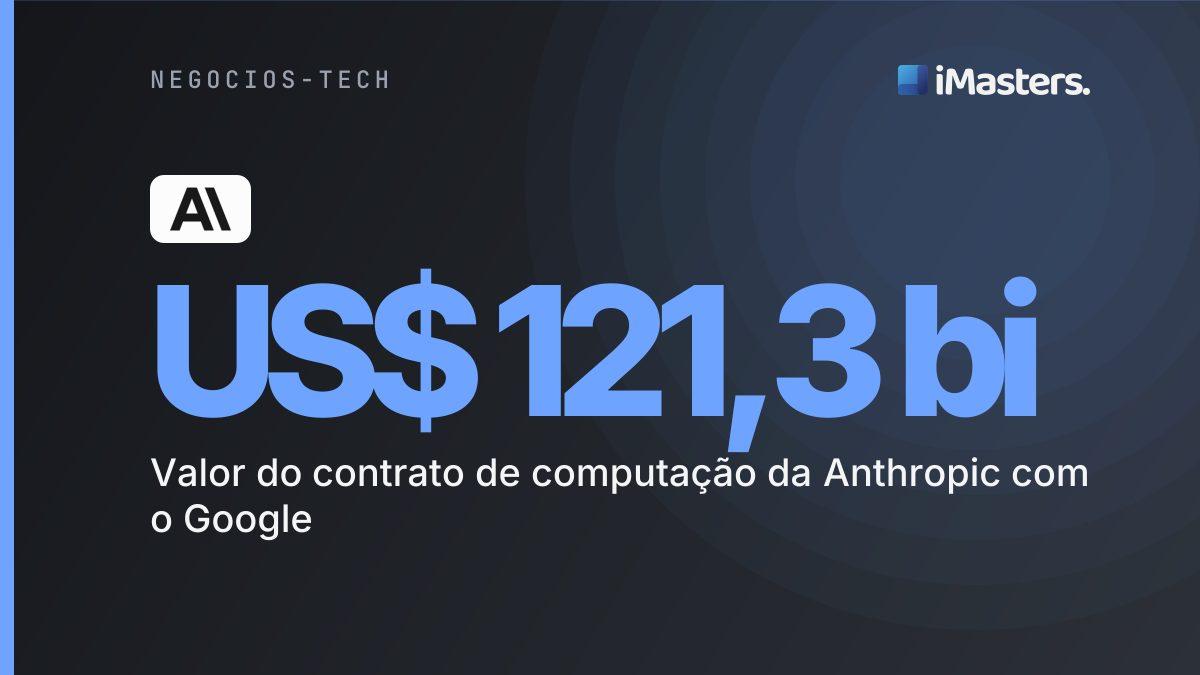
Here the story stops being exclusive to Anthropic. Alongside the IPO, the company is closing a $26 billion private placement with seven infrastructure suppliers: Google and Nvidia each put in about $10 billion, with AMD, Broadcom, Micron, Microsoft, and TSMC rounding out the group. The prospectus also records a commitment to spend at least $121.3 billion on Google compute between April 2026 and July 2033, regardless of actual usage.
This is the same financial architecture the market already questions in the relationship between OpenAI and its cloud and chip suppliers: whoever sells the infrastructure also becomes a partner or investor in the company that buys it, and future revenue has to justify spending that's already committed. The difference between Anthropic and OpenAI isn't in the financial engineering, it's in the discourse that accompanies it.
| Initial distribution | Compute financing | |
|---|---|---|
| Anthropic | Developer-first (Claude Code, API, Amazon Bedrock) | $121.3B commitment with Google through 2033 + $26B private placement with suppliers |
| OpenAI | Consumer-first (ChatGPT) | Long-term infrastructure commitments with cloud and chip suppliers |
Two valuations for the same stock: the cap table lesson
In short: the $1.4 trillion figure making headlines is an estimate on a fully diluted basis, which adds to outstanding shares the rights and securities that could become shares in the future. Applied only to the roughly 13.1 billion shares expected after the offering and the private placement, the same $78 price results in something close to $1.02 trillion.
For anyone building a startup in Brazil and negotiating valuation with a venture capital fund, this $380 billion gap between the two figures is the practical lesson: option pools, convertible SAFEs, and debt instruments that convert into equity always inflate the headline number relative to what each shareholder actually owns. Anthropic also reserves for its seven founders a class F share with 50.1% of the voting power on matters submitted to the shareholder meeting, which means whoever buys into the offering gains economic participation, not control.
The strongest counterargument: safety became a commercial advantage
It would be unfair to reduce Anthropic to a copy of OpenAI with different marketing. The bet on constitutional AI didn't stay just in the discourse: in practice, it seems to have helped shape a safety reputation that's reflected in revenue concentrated in API and enterprise contracts, not in end-consumer subscriptions. It's a revenue mix that looks more like software infrastructure than a viral app, and that has real value for anyone assessing concentration risk.
But that advantage isn't permanent, and the proof arrived fast. At Ignite this year, Microsoft unveiled MAI Code 2, rolled straight into GitHub Copilot, with a cost comparison that uses a 50% promotional discount to compete on price directly with Claude Code and with OpenAI itself. The moat that its safety reputation opened for Anthropic among developers doesn't stop a deeper-pocketed competitor from attacking on price as soon as the product proves the market exists.
What this changes for anyone founding an AI startup in Brazil
The question worth bringing to your own board isn't whether Anthropic deserves $1.4 trillion. It's what decision criteria this IPO suggests for any founder selling AI as a product:
- Concentrated revenue from whom? API and enterprise contracts grow faster and are more predictable than consumer subscriptions, but they also depend on a smaller number of large customers.
- How much of the infrastructure is already contracted and non-cancellable? A long-term commitment with a cloud supplier reduces capacity risk, but shifts onto the company the risk of paying for idle compute.
- Which valuation number is being used in the conversation? Fully diluted basis and outstanding-shares basis tell different stories, and the gap usually favors whoever is selling the round.
- Does the differentiation narrative survive a competitor with deeper pockets entering the market? Safety, brand, and research culture open doors, but they don't lock in price once Microsoft decides to compete on discount.
Anthropic took five years to turn a research question into $17 billion in quarterly revenue, and that's a real feat. But the IPO doesn't reveal an alternative path to OpenAI's: it reveals that, at this moment in the AI market, there's only one viable financial path, and it runs through buying compute before knowing how much of it will be used. The difference between the two companies lies in who tells that story better, not in who takes on less risk.
Translated from the Brazilian Portuguese original · Read the original

OpenAI completed conversion to public benefit corporation in October 2025
Since October 2025, OpenAI Foundation, a nonprofit entity, formally controls OpenAI Group PBC, owner of the API that powers thousands of products. This changes the risk calculus for anyone who built a business on top of it.