Nvidia doubles data center revenue with Vera Rubin debut, but signals GPU will stay expensive
- Reading
- 5 min
- Tables
- 1
In its first earnings report since Jensen Huang's departure, Nvidia's data center revenue jumped 110%, to $107.6 billion, driven by the first Vera Rubin shipments. The tighter margin guidance for next quarter is the figure the founder should look at before signing the next compute contract.
The earnings report that tested Nvidia without Jensen Huang
Nvidia reported its earnings this Tuesday, November 17, the first since Jensen Huang stepped down as the company's leader, in a week when the company lost around $600 billion in market value. CFO Colette Kress, now interim CEO, presented results for the quarter ended October 25, 2026 that beat the company's own guidance: total revenue of $115.8 billion (up 103% year over year), against a ceiling of around $110.2 billion estimated in August, according to Exame, a Brazilian business magazine.
The driver behind this result was the data center division, which accounted for more than 90% of revenue and grew 110% year over year, to $107.6 billion. Net income rose 105%, to $65.3 billion. For those watching the leadership transition, the number works as an answer: demand for AI infrastructure hasn't slowed down with the founder's departure, at least not yet.
| Metric (quarter ended 10/25/2026) | Value | Year-over-year change |
|---|---|---|
| Data center revenue | $107.6 billion | +110% |
| Total revenue | $115.8 billion | +103% |
| Net income | $65.3 billion | +105% |
| Gross margin | 74.8% | -0.2 p.p. |
| Next quarter guidance | $130 billion (±3%) | gross margin of 71% to 72% |
What Vera Rubin delivered, and what can't be confirmed yet
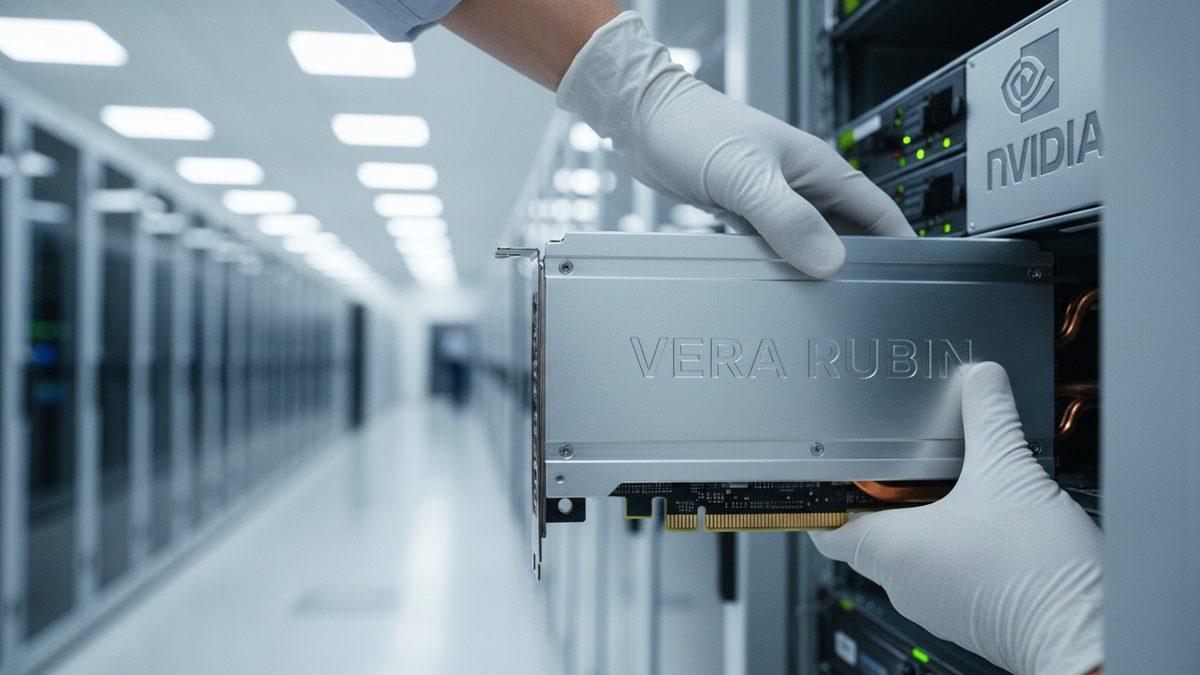
The Vera Rubin NVL72 began shipping this quarter and, according to Nvidia, had the fastest production ramp-up in the company's history. The system packs 72 Rubin graphics units and 36 Vera processors into a single rack, designed to train and run AI models at scale. It's the platform that succeeds Blackwell Ultra at the most expensive end of the portfolio.
How much of this jump came specifically from Vera Rubin is a question the earnings report itself doesn't answer precisely. The Wall St Engine account, on X, went as far as claiming the platform generated nearly $20 billion in its debut quarter, but Nvidia's official statement doesn't break out that figure. In August, Kress had estimated that Vera Rubin would account for around 20% of the period's data center revenue, a projection that isn't the same as the actual result.
In short: Nvidia attributes the division's growth to three combined fronts, not just one. Besides the complete NVL72, there were sales of standalone Vera processors and continued growth of Blackwell Ultra, the previous generation. This means Vera Rubin arrived without cannibalizing, for now, demand for the chip that's still on current customers' assembly lines, a detail that changes the math for anyone who was waiting for Blackwell Ultra to get cheaper with the generation switch.
The number that matters to the board: margin falling before it rises
The quarter's GAAP gross margin came in at 74.8%, down 0.2 points from the previous quarter. Nvidia attributed the drop to the early production phase of Rubin, a period when volume still doesn't offset the cost of manufacturing the new generation. So far, nothing unusual: every chip architecture transition carries a ramp-up cost.
What stands out is the guidance for next quarter: gross margin between 71% and 72%, below the current level. Normally, scale reduces unit cost; here, Nvidia itself is telling the market that the cost of producing Rubin will weigh more before it weighs less. For whoever decides infrastructure budgets, this is a direct signal that the price of cutting-edge compute capacity won't ease in the short term, because the sector's dominant supplier isn't seeing that happen in its own operation.
The $130 billion revenue forecast for next quarter (give or take 3%) also comes with a relevant fine print: it doesn't include data center compute revenue from China, a market that remains under regulatory restriction and that, by itself, is already a geopolitical risk variable that any founder dependent on Nvidia hardware should monitor.
What this changes for whoever builds AI in Brazil
No Brazilian startup buys NVL72 directly from Nvidia. The way this chip reaches the local founder is through the cloud, AWS, Azure, Google Cloud, or providers specialized in GPU, which compete with each other for limited capacity allocation. When more than 90% of a single supplier's revenue comes from one product category, the priority line for who gets new hardware first favors whoever signs billion-dollar reservation contracts, not the startup renting an on-demand instance.
Three practical implications for anyone planning compute budget for 2027:
- Prices shouldn't fall anytime soon. Nvidia itself projects lower margin as Rubin scales up, which indicates production cost is still high, not excess supply.
- Previous-generation capacity remains expensive. The lack of Blackwell Ultra cannibalization shows that even the "old" chip isn't oversupplied enough to get cheaper.
- Risk of concentration in a single supplier. With Nvidia's leadership transition still open, an analyst cited by Exame cut the stock's price target by 25% after Huang's resignation, even while maintaining the thesis of demand for AI chips, a reminder that the product roadmap of whoever dominates 90% of the market can change hands before it changes direction.
The question the CTO should answer before the next budget
The exercise that falls to the board isn't to root for Nvidia or run from it, it's to ask the CTO which slice of the product roadmap depends on cutting-edge GPU versus what can run on cheaper silicon, whether previous-generation chips or alternatives like the in-house accelerators AWS, Google, and Azure have been pushing into their own clouds as a way to reduce dependence on Nvidia itself. The answer isn't standardized: it depends on how much of the product's value proposition sits on the performance edge or on cost margin per user.
What this Tuesday's earnings report makes clear, regardless of who ends up permanently succeeding Jensen Huang, is that cutting-edge compute scarcity isn't a problem that solves itself next quarter. For the founder designing the cost structure of an AI product for the next two years, that's the variable that weighs more than any new chip announcement.
Translated from the Brazilian Portuguese original · Read the original

OpenAI completed conversion to public benefit corporation in October 2025
Since October 2025, OpenAI Foundation, a nonprofit entity, formally controls OpenAI Group PBC, owner of the API that powers thousands of products. This changes the risk calculus for anyone who built a business on top of it.