Google tests button to revert automatic search correction
- Reading
- 4 min
A single user spotted the feature and not even the editor of Search Engine Roundtable could reproduce it, but the test exposes something bigger: the growing distance between what people type and what Google decides to show.
What was spotted
On November 19, 2026, Search Engine Roundtable reported that Google Search is testing a button labeled "Show original results" on its results pages. The discovery didn't come from an official Google announcement: it was Khushal Bherwani who posted the screenshot on a social network, and Barry Schwartz, the site's editor-in-chief, noted that he couldn't reproduce the behavior in similar searches.
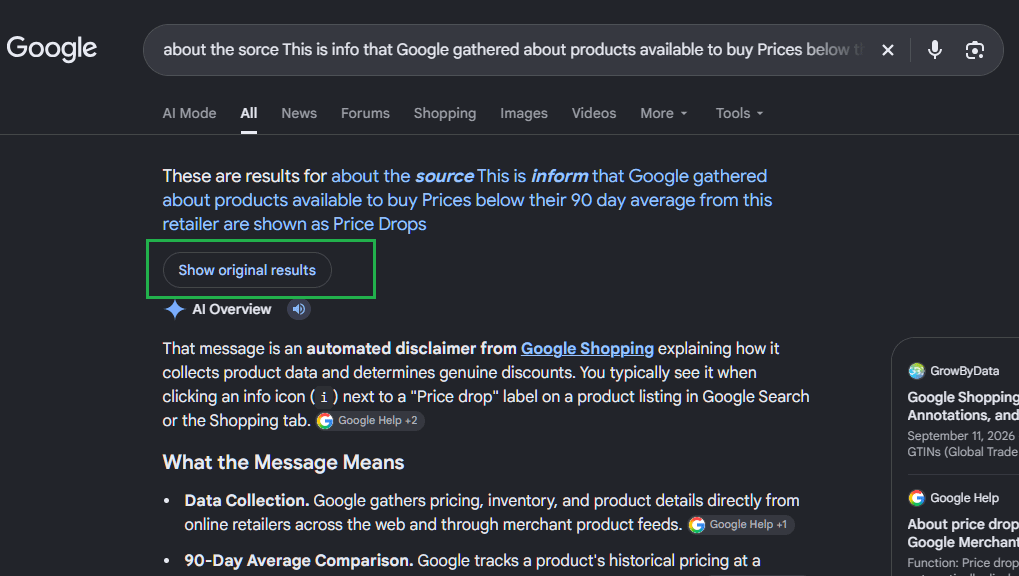
According to the report, the button appears when someone types a query with scattered characters or a heavy typo, and Google decides to reinterpret that query to deliver results based on "what it understands" the person meant to search for. The button would let users go back and see results tied to the literal text, without the engine's reinterpretation.
Google is displaying a "Show original results" button when users enter random typo characters words in a search query and Google interprets the query to show results based on its understanding.
Khushal Bherwani, via Search Engine Watch
Not quite "Search instead for"
Google has had the "Search instead for" link for years: when a user misspells a word, the search engine corrects it automatically and offers a discreet link to force the search for the term exactly as typed. "Show original results" appears to play a similar role, but with a more explicit label and, according to the report, triggered by a messier kind of input than a simple typo: seemingly random characters that Google decides to reinterpret on its own.
The difference is subtle, but it matters: one is spelling correction, the other sounds like semantic interpretation of a malformed query. Since only one person reported the test and the site's editor couldn't replicate it, it's prudent to treat this as an isolated interface experiment, possibly limited to a small fraction of users, that may never become a permanent feature.
Why this matters to those who live off search traffic
Even if this specific button never leaves testing, it exposes something that's already happening: Google increasingly returns results based less on the literal string typed and more on an interpreted version of the intent behind it. Spelling correction, synonym expansion, semantic matching and, now, AI-driven retrieval in AI Mode are successive layers of that same logic.
For those measuring organic search performance, this has direct consequences:
- The queries report in Search Console attributes clicks to the query as the user typed it, but the page that received that click may have been chosen based on a reinterpreted version of the search, not the literal one.
- CTR benchmarks built on exact matching between keyword and page become less reliable as a standalone cause-and-effect signal.
- On the same day, Search Engine Roundtable itself published another note about Google bringing Lens results into AI Mode: one more sign that the gap between what the user types (or photographs) and the result delivered only tends to grow.
What to do with this signal now
The right reaction isn't to optimize for a button that may never reach everyone. It's to use the test as a reminder to revisit measurement assumptions and keyword strategy:
- Audit the Search Console queries report looking for patterns of similar terms (typos, variations) that receive similar impressions: this indicates where Google is already grouping queries by interpretation, not by exact string.
- Reduce reliance on exact long-tail variations as a content planning unit; invest in topic and entity coverage, since the search engine itself is willing to loosely match queries with the right page.
- For those tracking GEO, test how brands and products appear when the user's query is ambiguous or poorly written in generative AI tools: the reinterpretation behavior there tends to be even more aggressive than in traditional search.
- Track CTR trends by page group, not just by isolated keyword: if Google's interpretation layer changes, what varies first is which page appears, not necessarily which term was searched.
The limits of what's known
It's worth reinforcing the fragility of the material: this is a report from a single person, with one screenshot, without confirmation from Google and without reproduction by any other outlet, including the one that first reported the case. It could be a test limited to a few users, it could never move past the experimental stage. The practical lesson isn't to chase this specific button, but to register that keyword-level precision is losing ground to topic and entity relevance, and to adjust how search success is measured before this gap becomes an attribution problem.
Translated from the Brazilian Portuguese original · Read the original

Google's AI Overviews: what the official documentation requires (and doesn't require) from your page
Google Search Central updated the "AI features and your website" page and made it clear: there's no magic structured data for AI Overviews, but there are specific controls to limit or allow what appears.