Anthropic's IPO at $83 a share resets the entry price for frontier AI
- Reading
- 6 min
- Tables
- 1
Anthropic priced its IPO above the expected range, and when the private placement is added in, the deal moves more capital than SpaceX's debut. For those who found or invest in AI in Brazil, the number matters less than the web of dependency it reveals.
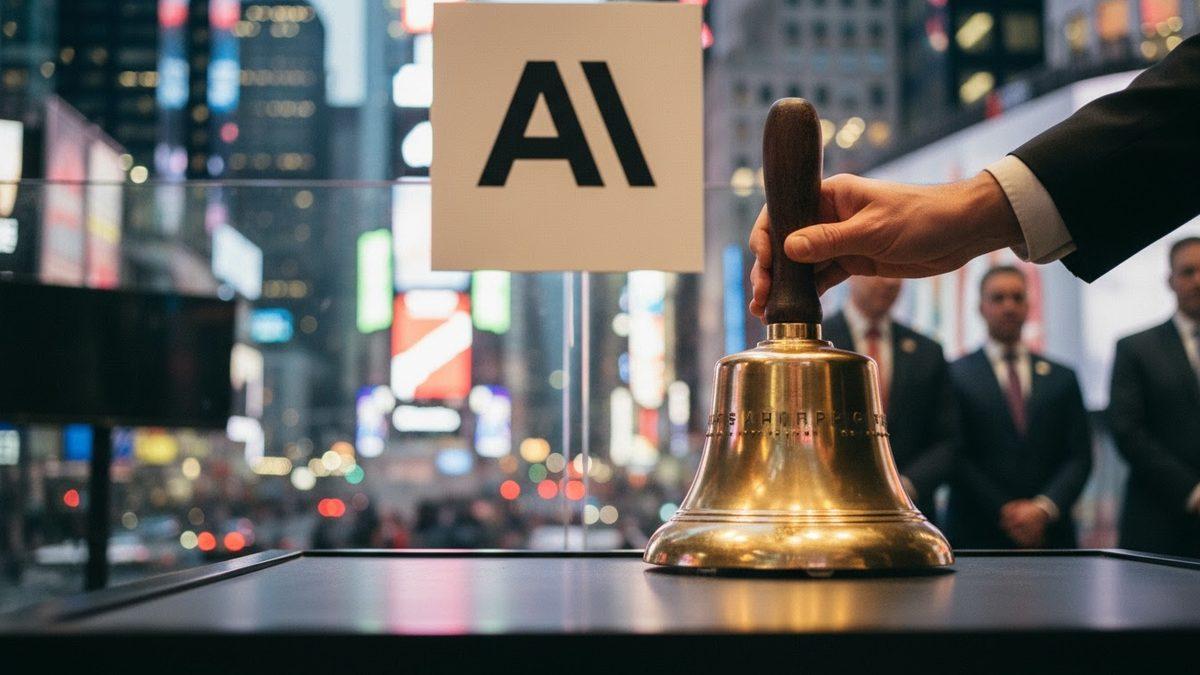
Anthropic closed its IPO price at $83 a share this Wednesday, November 18, above the indicative range of $70 to $78. The shares debut on the Nasdaq this Thursday, the 19th, under the ticker ANT. With that, the public offering moves around $68.5 billion and, combined with the $26 billion private placement, the deal reaches $94 billion, according to Exame.
I won't spend any lines explaining that this is a big number. Everyone has already read that. What matters for those who found or invest in technology in Brazil is what this price reveals about how capital is organizing itself around a handful of AI companies, and what it changes in the yardstick any board will use to evaluate AI deals from now on.
The price the market agreed to pay
With the stock at $83, Anthropic's valuation tops $1.4 trillion, a level the company itself had already been targeting before the roadshow. Demand, according to the Wall Street Journal, added up to "several times" the number of shares offered. Two banks, Goldman Sachs and Morgan Stanley, led a syndicate of more than 20 institutions.
The inevitable comparison is with SpaceX, which raised $75 billion in June and reached $85.7 billion after the over-allotment, the largest IPO ever recorded up to that point.
| Public offering | Total with private placement | Valuation | |
|---|---|---|---|
| SpaceX (Jun/2026) | $75B ($85.7B with over-allotment) | - | not disclosed in source |
| Anthropic (Nov/2026) | ~$68.5B | ~$94B | above $1.4T |
Anthropic comes up short against SpaceX in the public offering itself, but pulls ahead once the private placement is added. That difference isn't an accounting detail: it shows that a significant slice of the financing for a frontier AI lab doesn't go through the open market, but through a closed deal with parties that are already the company's own suppliers and customers.
The math nobody highlights in the press release
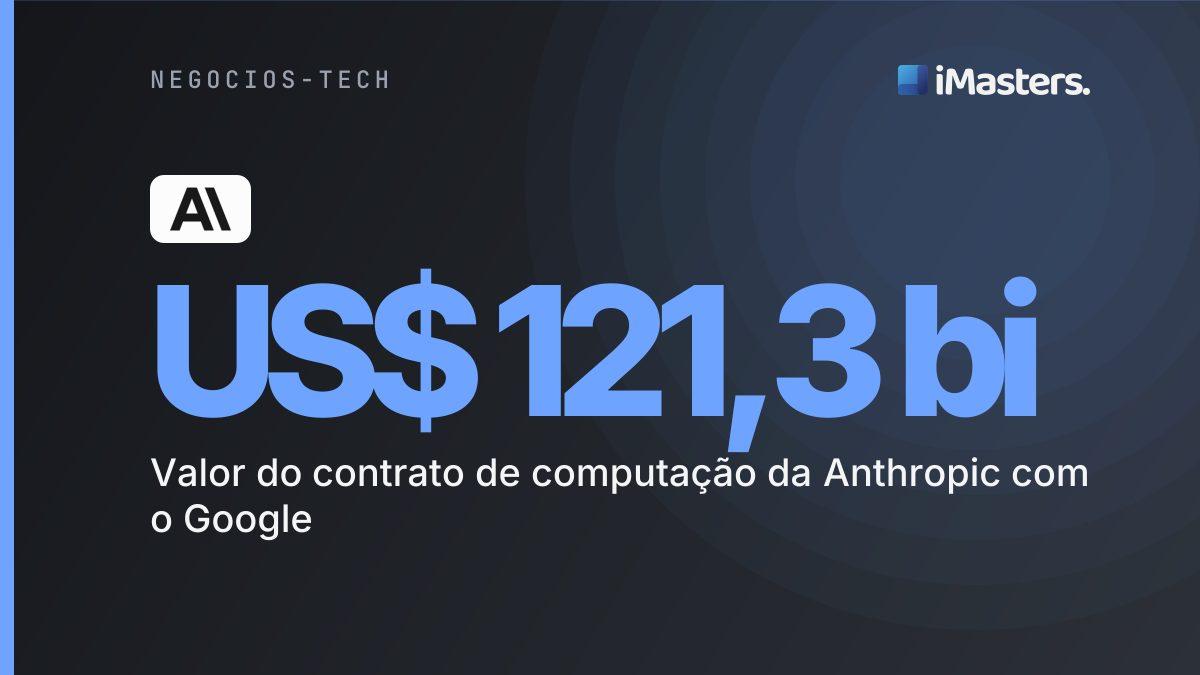
Amazon and Google each hold stakes in Anthropic valued at more than $100 billion. Google, Microsoft, Nvidia, and AMD are among those who committed to the $26 billion private placement. At the same time, Anthropic is a buyer of expensive systems from those same four names, and has racked up nearly $900 billion in computing spend commitments with partners such as Amazon and Google.
This is capital circularity: the investor is also a supplier, and the supplier is also a customer. It isn't exclusive to Anthropic (Nvidia does something similar with OpenAI and with neoclouds), but here the circle closes tighter because the list of names is short.
For anyone sitting on the board of an infrastructure, software, or AI application company in Brazil, the right question isn't "is Anthropic worth that?" It's: how much of my future revenue depends on a cloud contract with someone who is also an investor in my direct competitor, and what happens to that contract if their valuation drops?
Growth is getting expensive, and the margin shows it
Revenue for the nine months ended September 30 totaled $33.24 billion, up about 1,200% from the same period in 2025. Annualized revenue reached $81 billion by the end of October, driven mainly by Claude Code, the coding agent the company sells to engineering teams. The number of customers generating at least $100,000 in annual revenue jumped from just over 1,500 at the end of 2025 to 11,900 on September 30.
The $104 billion net loss for the period is alarming at first glance, but most of it comes from the fair-value change of convertible notes and derivative liabilities, not from the operation itself. The more interesting signal is in the quarterly operating result: Anthropic spent nearly $9 billion on computing capacity in the first half, almost four times more than a year earlier, plus another $5 billion in the third quarter. In the third quarter, that turned into a $567 million operating loss, after a $974 million operating profit in the prior three months, according to Reuters.
In short: revenue is accelerating, but the cost of sustaining that revenue is accelerating right along with it, and the margin swung from positive to negative in a single quarter. That's exactly the kind of line any CFO should be watching before signing a long-term capacity contract with any AI lab, Anthropic included.
What changes for those founding AI companies in Brazil
Three practical effects, no speculation:
- The valuation yardstick rises, but not linearly. A multiple of roughly 17 times annualized revenue ($1.4T over $81B) becomes a reference point for private AI rounds everywhere, including here. That doesn't mean a Brazilian applied-AI startup will fetch a similar multiple: it means growth investors will compare every AI deal against this benchmark, even when the comparison is unfair.
- Access to computing capacity has become a measurable competitive advantage, not a promise. Anyone who depends on cloud credit from Amazon, Google, Microsoft, or Nvidia to run a frontier model is competing, directly or indirectly, with a company that has those same names as investors. That weighs on price negotiations and on GPU allocation priority.
- AI M&A gains a new, expensive comparable. Every discussion of acquiring an AI startup in Brazil, the kind that would normally revolve around a recurring-revenue multiple, now has a $1.4 trillion case lurking in the background as an emotional anchor, even when it doesn't apply to the local scale.
The counterargument I take seriously
The debut comes at a bad moment for the sector. Jensen Huang stepped down from the helm of Nvidia a few weeks ago, chipmakers and cloud providers have been under pressure from valuation doubts, and Reuters notes that the biggest IPOs of 2026 have already lost market value after their debuts. CNBC adds the risk of high interest rates making data center debt more expensive for developers and neoclouds.
If that pattern repeats with Anthropic, the $83 price becomes the peak, not the floor, and the whole "new valuation yardstick" argument above loses force fast. That's a real risk, and I won't pretend that demand "several times greater than supply" during the roadshow guarantees support after the debut: it only guarantees there was appetite BEFORE the stock started trading freely.
That said, the difference between Anthropic and other AI IPOs that lost value is that here revenue is growing 1,200% year over year and the product (Claude Code) has verifiable corporate adoption, with almost 12,000 customers paying more than $100,000 a year. Bubble and fundamentals aren't mutually exclusive: you can have both at once, and it's up to the board of each company that depends on this chain to decide its risk appetite.
If we get this right, we could create an age of miracles in which humanity manages to solve problems that have eluded us for millennia.
Dario Amodei, CEO of Anthropicfoto: TechCrunch · CC BY 2.0
The question I'd take to the CTO
Amodei's line is beautiful and works well as the opening video for a roadshow. The question I'd ask before approving any AI infrastructure budget, with or without Anthropic in the mix, is drier: what fraction of my operating cost depends on a supplier that is also an investor in my competitor, and what do I do if that supplier's price rises on the day it also needs to justify its own trillion-dollar valuation to the open market.
That's the question today's debut puts on the table for every founder building on top of the big labs' infrastructure, not just Anthropic's.
Translated from the Brazilian Portuguese original · Read the original

OpenAI completed conversion to public benefit corporation in October 2025
Since October 2025, OpenAI Foundation, a nonprofit entity, formally controls OpenAI Group PBC, owner of the API that powers thousands of products. This changes the risk calculus for anyone who built a business on top of it.