Black Friday 2026 Exposes Brazilian Retail to AI-Made Purchase Decisions
- Reading
- 5 min
Research by TOTVS with Opinion Box shows that more than half of consumers already use generative AI to decide what to buy. For those who lead retail or sell to it, the challenge is no longer appearing in search, it has become convincing an algorithm.
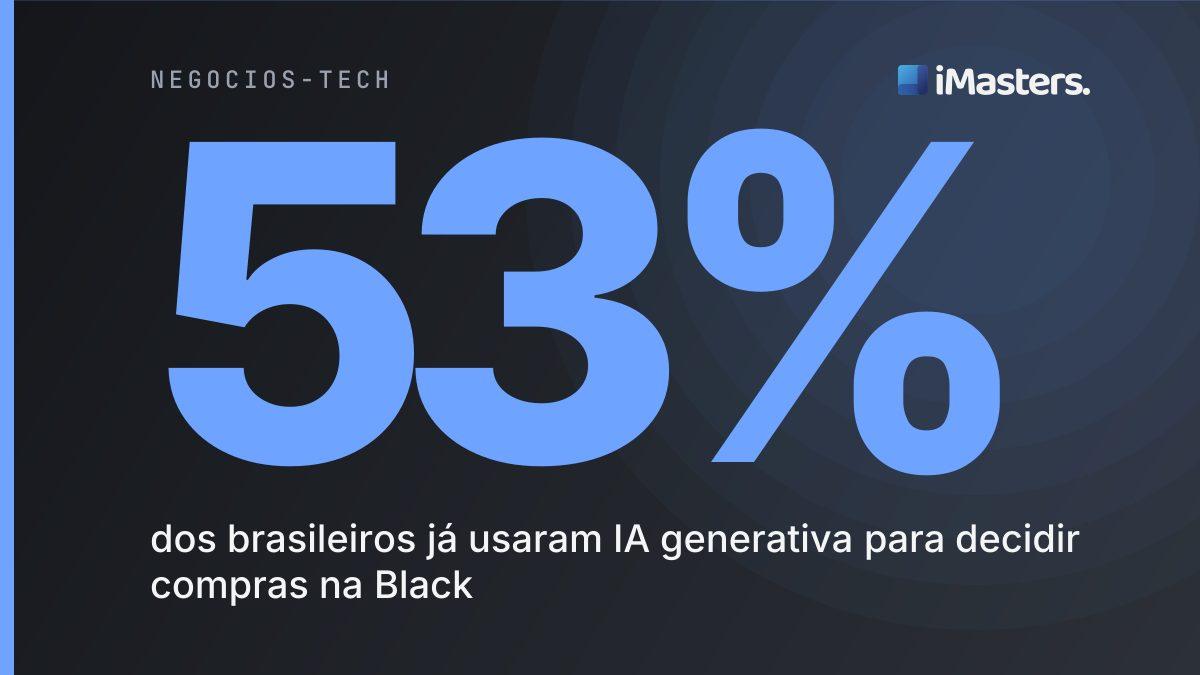
Black Friday 2026 brought a data point that should be in every retail board meeting, and in every meeting of those who sell technology to retail. According to research by TOTVS commissioned from Opinion Box, published by Exame (a Brazilian business magazine) on November 19, 53% of Brazilian consumers have already used generative AI tools to help with a purchase. This is not a projection, not a distant trend: it is behavior already in place during the most important sales season in Brazilian retail.
The detail that matters for whoever makes investment decisions is not the percentage itself, but what it replaces. Of the respondents who used generative AI in their purchase journey, 31% used the technology to compare products, 29% to look for brand recommendations, and 29% to compare prices and deals. These are three tasks that, until recently, belonged entirely to the consumer and to the marketing team trying to influence them directly with paid media, storefront display, and SEO. Now there is an intermediary in the middle of the path, and that intermediary has its own criteria.
The consumer still checks, but already delegates the screening
The data point the board needs to hold onto with both hands is the one about trust: 46% of respondents said they partially trust AI recommendations, but confirm the information in another source before completing the purchase. This means artificial intelligence does not yet decide alone, but it already decides what makes the shortlist. A product that is not considered relevant by the algorithm does not even get to compete for the consumer's final confirmation.
For whoever leads an e-commerce operation or a brand that sells through marketplaces, the business question shifts. It is no longer just "how do I appear at the top of search," it is "how is my product understood by a system that needs to decide, in seconds, whether it solves the need described by someone who doesn't always use the right words."
From ranking to relevance: the message from NRF 2026
The shift in logic was already being discussed outside Brazil. At NRF 2026, executives from chains like Lowe's and Abercrombie & Fitch described the same transition: moving away from a model that responded to keywords toward a model that needs to interpret context, intent, and occasion of consumption. The consumer doesn't search for "a dress," they search for something for a specific event, in a specific city, on a specific date. Traditional search systems were never designed for this level of interpretation; generative AI agents are.
This looks like a product and catalog problem, but it is, in practice, a P&L problem. Every poorly registered product attribute, every generic description, every outdated stock information is a sale the algorithm simply won't recommend, because it doesn't have enough confidence to recommend it. No media campaign can make up for that: the problem sits before the funnel, in the data layer.
Product data has become a balance-sheet asset, not an operational task
For years, product registration was treated as a back-office activity: someone fills out a form, the item goes up on the site, and the real priority stayed with media and price. The TOTVS research and the comments from executives at NRF 2026 point in the same direction: if an AI agent needs to decide what to recommend, it needs reliable attributes about availability, price, commercial terms, ratings, delivery time, and context of use, all synchronized in real time across channels.
For the founder designing the company's data architecture, or evaluating an investment in a startup that sells catalog infrastructure for retail, this is the budget question that needs to reach the board:
- Is my product catalog treated as a strategic asset or as a low-priority operational task?
- How much of my Black Friday revenue depends on the product being found through human search versus recommended by an AI system I don't control?
- Can my data team guarantee consistency of stock, price, and attributes across site, marketplace, and third-party AI agent, in real time, or is this still a manual process prone to delay?
- If an AI shopping agent (the kind that already compares prices and recommends brands) becomes a relevant acquisition channel, is my company ready to negotiate presence in that channel, or will it find out too late?
What changes in execution, and what still doesn't
The transformation isn't limited to the storefront. The same movement that brings AI into the consumer's purchase decision is already present backstage in the operation: demand forecasting, inventory management, dynamic pricing, logistics, and automated replenishment. The market reading is that AI has stopped being isolated experimentation in some innovation squad and has become part of the business's day-to-day execution. It's this combination, a consumer-facing side mediated by AI and a back office operated by AI, that gives Black Friday 2026 a different dimension from previous editions.
Even so, it's worth the warning against hype without evidence: the research itself shows that nearly half of consumers confirm the AI recommendation before buying. Blind trust doesn't exist yet, and that's good for those building their strategy now, because it leaves a window for correction. The costly mistake isn't being late to a sophisticated AI agent integration; it's continuing to treat product registration as a dead information warehouse while the competition already treats it as a live interface with the algorithm that decides who gets considered.
When it's not worth accelerating now
Not every operation needs to rush to integrate third-party AI agents this Black Friday. Businesses with a small catalog, a simple purchase cycle, and low dependence on algorithmic discovery (recurring direct sales, for example) can prioritize other fronts before restructuring their entire product data layer.
The decision criterion isn't "everyone's talking about AI," it's the size of the revenue slice that already, demonstrably, passes through machine-mediated recommendation. Where that slice is small, the return on investing heavily in context infrastructure for AI agents still doesn't pay off; where it grows, as TOTVS's numbers show, delaying becomes the most expensive risk on the balance sheet.
Translated from the Brazilian Portuguese original · Read the original


NewHack opens AI residency in São Paulo for ten startups starting January 2027
AI House Brasil, a NewHack project announced in June at Web Summit Rio, has reached its final format: a three-to-six-month residency, sponsorship from Oracle and Agora.io, and the promise of condensing a year of development into a single quarter.