Microsoft Confirms Ads Inside AI Overviews in Bing Search
- Reading
- 5 min
Microsoft has officially confirmed what had already been running for weeks: ads mixed into AI-generated responses on Bing. For media buyers, this changes where and how search budgets need to be monitored.
What Microsoft Confirmed
On November 19, 2026, Microsoft officially confirmed, on the Microsoft Advertising blog, that ads were already running inside Bing Search's AI Overviews. The news was reported by Search Engine Roundtable's Barry Schwartz, who had been spotting these ads for about three weeks before the official confirmation, meaning since late October 2026.
The company described the move as part of a broader strategy to monetize AI experiences, which already included ads inside Copilot. As Microsoft itself put it:
Ads in AI Overviews on Bing are the latest step in bringing ads to AI experiences, building on ads in Copilot.
Microsoft Advertising, official blog
For those managing paid search campaigns, this formalizes an inventory change that was already happening without prior notice or an explicit opt-out option.
How the Ad Appears Inside the Response
The example Microsoft itself gave helps visualize the format. Someone asks Bing about a trip to Snowdonia National Park, in Wales; the AI Overview puts together a sample itinerary with travel tips. If the advertiser sells lodging in the region, the ad appears alongside this AI-generated response.
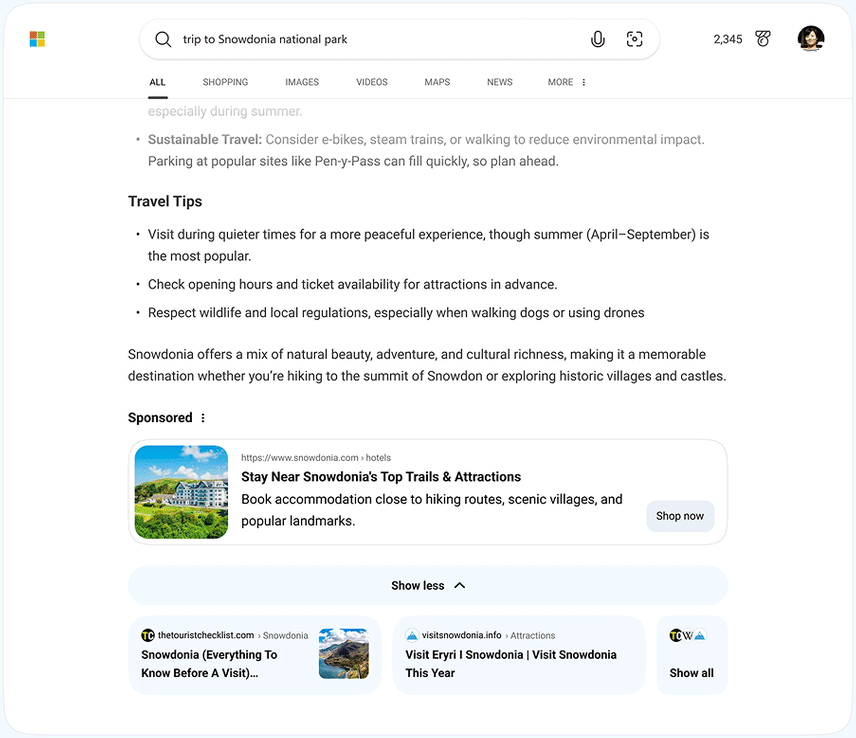
Your ads can now show up next to AI-powered answers on Bing when your offers are relevant.
In other words, the ad doesn't replace the AI-generated response or appear as a disguised organic result: it's positioned as a commercial complement, next to the synthesized content. This distinction matters because it changes the competition: it's no longer just about ranking a page, it's about competing for relevance within a response block that the platform itself has already decided to show.
The Conversion Figure Microsoft Uses to Sell the Idea
The company reported seeing a 21% increase in purchases after an interaction with Copilot. It's a figure that deserves skepticism from anyone who works with attribution: Microsoft didn't detail the methodology, the measurement period, or whether the figure refers specifically to interactions with ads in AI Overviews or to Copilot as a whole, including searches without advertising.
Even so, the number is the central piece of Microsoft's sales argument: convincing advertisers that the moment someone moves from a generic question to a purchase decision, within the AI conversation itself, is worth the spend. For those deciding where to allocate media budget, the figure works more as Microsoft's sales justification than as an auditable metric, at least until a more granular performance report appears inside the Microsoft Ads interface itself.
No New Campaign Type: Everything Runs Through Performance Max and AI Max
The most relevant detail for anyone already running campaigns on Bing Ads is operational: there's no separate campaign type for appearing in AI Overviews.
There's no separate campaign set-up required. Ads in AI Overviews run through the campaigns you already use, including Performance Max and AI Max.
This means that anyone who already has active Performance Max or AI Max campaigns on Bing Ads is now automatically competing for this inventory, without a dedicated opt-in or opt-out button. Microsoft also stated that ads in AI Overviews are now available in every market except China.
In short: anyone using automated campaigns on Microsoft Ads is already, by default, competing for this space, without having explicitly decided to do so.
What Changes for Media Buyers and SEO Professionals
The practical effect is split into two fronts that used to be more separate. On the paid side, Performance Max and AI Max budgets now compete for a space that mixes synthesized response and ad, which requires reviewing performance reports to separate clicks coming from traditional results from those coming from inside the AI Overview, once Microsoft makes that breakdown available.
On the organic side (GEO territory), the arrival of ads inside the response block itself further shrinks the visual space available for organic citations in the AI Overview. This reinforces a pattern that already applies to Google's AI Overviews: being cited inside the AI response is no longer enough, because the space next to it is now for sale.
A few points are worth direct monitoring for anyone handling paid and organic search at the same time:
- Click-through rate by position: compare CTR of ads inside the AI Overview versus traditional search ads, once Microsoft Ads releases that level of detail;
- AI Overview appearance rate: measure, by term, how many brand searches generate an AI response (and therefore an ad opportunity);
- Organic share within the response: track whether the brand's organic citation keeps appearing in the AI Overview even when a competitor pays for the space alongside it;
- Internal cannibalization: check whether clicks that used to go to the organic link cited in the response have migrated to the competitor's ad placed alongside it.
What's Still Unclear
Microsoft didn't detail how the ad auction inside the AI Overview decides relevance, nor whether there's any frequency control or exclusion for sensitive categories. It also remains unclear whether the performance report inside Microsoft Ads already separates impressions and clicks coming specifically from the AI Overview from the other formats covered by Performance Max and AI Max.
For those deciding paid search budgets in Brazil, the practical takeaway is to monitor the behavior of their own Performance Max and AI Max campaigns on Bing Ads over the coming weeks, since the change took effect automatically, without prior notice inside the account. Anyone handling SEO and GEO at the same time gets one more reason to treat AI Overview as a media surface, not just as a search result to be optimized for free.
Translated from the Brazilian Portuguese original · Read the original

Google merges Lens and AI Mode in image search, cutting clicks to websites
A combined Lens and AI Mode icon in Google's image results now opens a generative AI conversation instead of taking the user to the source page. For those who live on visual traffic, zero-click search has just gained new ground.