MySQLDev & Eng
Content type: Concept
5 min read
Oracle fixes three critical MySQL flaws exploitable without authentication
 Roberto DinizAuthor
- Reading
- 5 min
- Tables
- 1
Oracle's November 2026 CSPU brings ten fixes for MySQL, three of them exploitable over the network without login. Percona has already merged the fixes into version 8.4 and details what can be mitigated now.
On November 17, 2026, Oracle published its quarterly Critical Patch Update for MySQL, known as the CSPU (Critical Security Patch Update). There are ten security fixes in total, and three of them stand out for a specific reason: they can be exploited over the network without the attacker needing a valid account on the database. Percona, the maintainer of Percona Server for MySQL, published on November 24, a week later, a breakdown of the bulletin and the fix status in its own fork, according to a post signed by Dennis Kittrell on the company's blog.
For those running MySQL in production, the distinction between an authenticated and an unauthenticated CVE isn't a detail: it determines whether the firewall and the database's user list are already enough of a barrier, or whether the attack surface includes any host that can see the service's port. Of the ten flaws in the November bulletin, seven require a user already authenticated with some privilege. The three that don't are the starting point for any risk review.
The three CVEs that require immediate action
All the data below comes from Oracle's own advisory for the November 2026 CSPU, as reproduced by Percona.
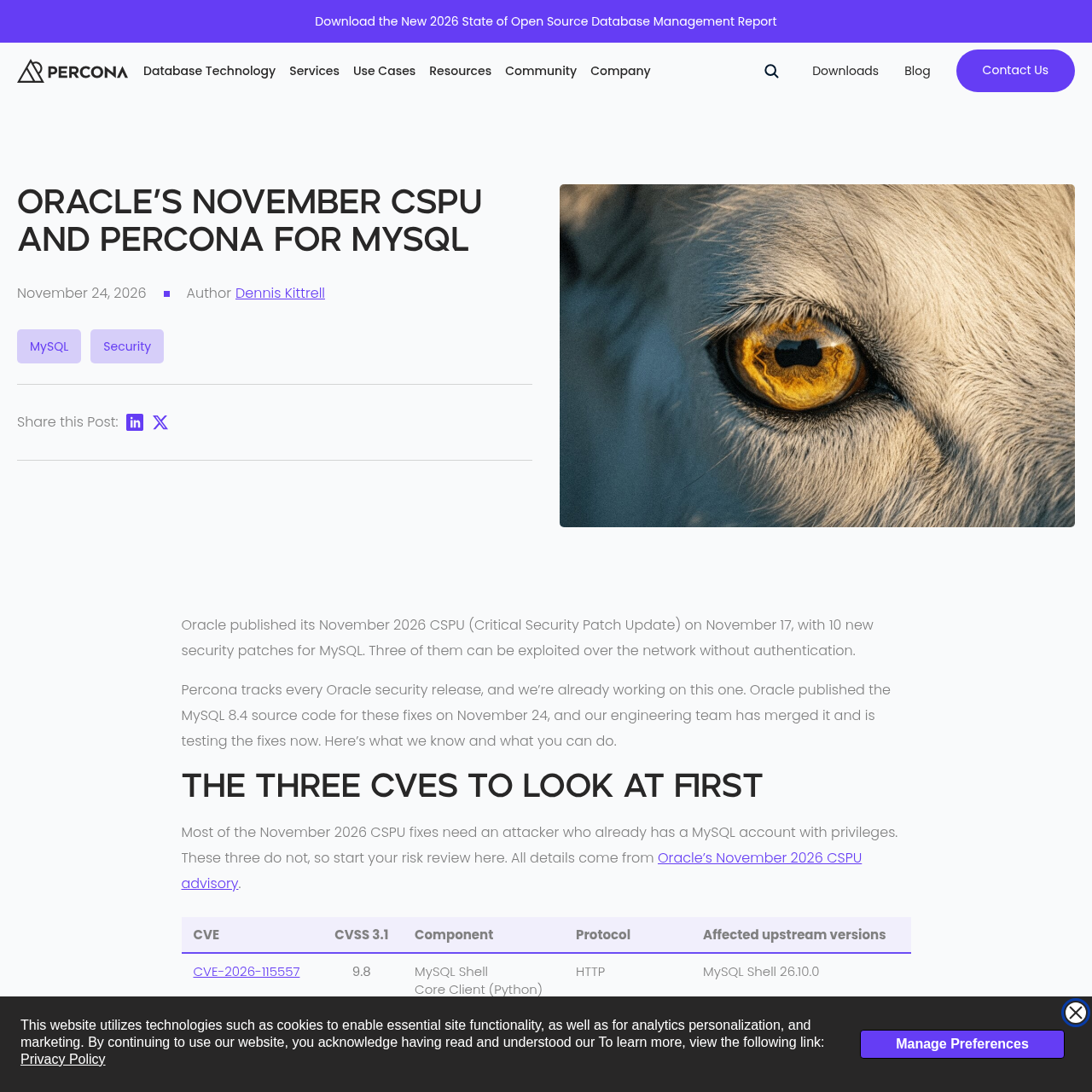
| CVE | CVSS 3.1 | Component | Protocol | Affected versions |
|---|---|---|---|---|
| CVE-2026-115557 | 9.8 | MySQL Shell (Python runtime) | HTTP | MySQL Shell 26.10.0 |
| CVE-2026-114952 | 9.1 | MySQL Server, client programs | MySQL protocol | 8.4.0 to 8.4.13, 9.7.0 to 9.7.4, 26.10 |
| CVE-2026-92392 | 8.1 | Packaging (curl) | HTTP/2 | Not detailed by the source |
The other seven flaws score between 2.5 and 7.2 on CVSS 3.1. Five of them are in the server, in replication, optimizer, logging, and GIS subsystems, and all require an authenticated user. It's the typical profile of a CSPU: most of the issues assume the attacker already has some foothold inside the database.

Expert views
What people are saying about it.
Kubernetes 1.38, expected on December 16, 2026, drops environment variables used in scripts, retires a legacy cgroup mechanism, and changes swap behavior. Here's what to review before upgrading your cluster.
Vercel announced Audited ZDR, an independent audit layer that verifies, in practice, whether inference providers actually delete prompts and completions after processing.
Nothing new, but nothing to ignore
Percona notes that this pattern of severity and vector has appeared before in Oracle bulletins. CVE-2026-115557 follows the same line as previous flaws in the MySQL Shell Python runtime, such as CVE-2025-15467, CVE-2025-6965, CVE-2026-46860, and CVE-2026-9547. CVE-2026-114952, meanwhile, has a profile similar to CVE-2024-11053, from the client programs.
In short: those who have already reinforced the network perimeter and account policy at each previous Oracle CPU aren't facing an entirely new scenario. But that doesn't excuse skipping the patch: a history of repeated severity is an argument for automating the response, not for relaxing it.
Where each fix stands in Percona Server for MySQL
Percona Server for MySQL is built on Oracle's upstream code. Percona can only merge and test a fix after Oracle releases the corresponding source code, which doesn't always happen on the day of the bulletin.
MySQL Shell (CVE-2026-115557)
This flaw is in the Python runtime that MySQL Shell bundles, not in the MySQL server itself. Percona has already rebuilt the MySQL Shell packages it distributes for the 8.4 and 9.7 lines with a fixed version of Python, and they were in testing at the time the post was published.
curl (CVE-2026-92392)
Oracle fixed this point by updating the curl library it bundles with MySQL. Percona Server for MySQL packages, however, use the operating system's own curl library instead of an embedded copy. In practice, this means that anyone running Percona Server needs to apply the curl update from their OS vendor, rather than waiting for a specific Percona package for this item.
Client programs and the server fixes (CVE-2026-114952 and others)
Oracle published the MySQL 8.4 source code with these fixes on November 24. Percona's engineering team has already merged that code into the 8.4 line and is testing the fixes now. The 9.7 line's code hasn't been published by Oracle yet, so that branch remains without the merge until then.
The fixes should land in releases of Percona Server for MySQL and Percona XtraDB Cluster (PXC) in versions 8.4.13-13 and 9.7.4-4. It's the same flow Percona follows for every quarterly Oracle CPU or CSPU: every quarter this year brought high-severity fixes for MySQL, delivered as soon as the upstream code became available, including the June CSPU.
What to do while the patch isn't out yet
Percona is direct about one point: none of the mitigations below replace the patch, and no configuration change has been confirmed so far as capable of neutralizing these CVEs on its own. It's also worth noting that none of the three flaws go through the X Protocol, so disabling the X Plugin with mysqlx=OFF does not reduce exposure to this specific CSPU.
That said, the steps below are standard hardening and reduce the attack surface while the patch hasn't yet reached your distribution:
- Restrict network access. Only known application hosts and administrative networks should be able to reach the MySQL ports; block everything else at the firewall or security group.
- Tighten privileges. Most of the bulletin's other CVEs require an authenticated user; remove accounts and grants that no one uses, especially broad admin and replication privileges.
- Update MySQL Shell and curl. Migrate to the rebuilt MySQL Shell packages as soon as they're released and keep the operating system's curl package up to date.
- Test before production. Network and privilege changes can break the application and replication; validate in a non-production environment first.
Percona promises to publish any configuration mitigation it finds during the code review, which suggests the post will be updated as the analysis progresses.
What changes for those who operate the database
For teams keeping MySQL or Percona Server for MySQL in production, the practical takeaway is twofold. First, CVE-2026-115557 is a reminder that MySQL Shell carries its own Python stack, isolated from the system runtime, and needs to be treated as its own attack surface in any patch inventory. Second, the dependency on upstream source code explains why the Percona Server 9.7 line remains without the fix for CVE-2026-114952 while Oracle hasn't released that branch: anyone running 9.7 in production needs to decide whether to reinforce network isolation as a stopgap measure or speed up an evaluation of a temporary downgrade to 8.4, where the fix is already being tested.
The immediate point of attention, before any formal release, is the inventory: which hosts and services can see the MySQL port today, and which accounts have replication or admin privileges without real use. This assessment doesn't depend on waiting for Percona's package and already reduces the exposure window to the three unauthenticated CVEs.
Translated from the Brazilian Portuguese original · Read the original
Shared memory error confuses Postgres-on-Docker users: disk is full, but that's not the issue
A survey published on Planet PostgreSQL measured, version by version, how the default /dev/shm limit in Docker containers breaks parallel joins and why the error seems random.