What's New in C# 8.0: Switch Expressions
In this article, Renato Groffe presents one of the new features of C# 8.0, Switch Expressions, a great option for those who want to simplify their code.

One of the new features introduced by C# 7.0 was the feature known as Pattern Matching, designed to eliminate the need to code a typecast and thus help achieve cleaner, more direct code. I already covered this in the following article:
C# 7.1 expanded the possibilities involving Pattern Matching by also supporting the use of generic types with this feature. I also presented this new feature in detail in the following article:
C# 8.0, in turn, further expanded the scope of use regarding Pattern Matching, and one highlight now is the introduction of switch expressions.
Note: the tests described in this article used Visual Studio 2019 Preview 4.3 and .NET Core 3.0 Preview 3.
Suppose a block of code like the one shown in the following listing (with the enum FiguraGeometrica and the static class Area), which uses the switch, case, and default statements inside a method:
using System;

namespace ExemploSwitchExpressions
{
    public enum FiguraGeometrica
    {
        Quadrado,
        Retangulo,
        Triangulo
    }

    public static class Area
    {
        public static double Calcular(
            FiguraGeometrica figura, double medida1, double? medida2 = null)
        {
            switch (figura)
            {
                case FiguraGeometrica.Quadrado:
                    return medida1 * medida1;
                case FiguraGeometrica.Retangulo:
                    return medida1 * medida2.Value;
                case FiguraGeometrica.Triangulo:
                    return (medida1 * medida2.Value) / 2.0;
                default:
                    throw new ArgumentException("Figura Geométrica inválida!");
            }
        }
    }
}
By using switch expressions, this code becomes much simpler, as shown in the next listing (which contains a refactored version of the Area type):
- The use of case was dropped, with the value to be evaluated followed by => and the return expression
- The use of the default keyword was replaced with _
using System;

namespace ExemploSwitchExpressions
{
    public enum FiguraGeometrica
    {
        Quadrado,
        Retangulo,
        Triangulo
    }

    public static class Area
    {
        public static double Calcular(
            FiguraGeometrica figura, double medida1, double? medida2 = null) =>
        figura switch
        {
            FiguraGeometrica.Quadrado => medida1 * medida1,
            FiguraGeometrica.Retangulo => medida1 * medida2.Value,
            FiguraGeometrica.Triangulo => (medida1 * medida2.Value) / 2.0,
            _ => throw new ArgumentException("Figura Geométrica inválida!")
        };
    }
}
The following listing shows an example of using the Area class and the FiguraGeometrica enum:
using System;

namespace ExemploSwitchExpressions
{
    class Program
    {
        static void Main(string[] args)
        {
            Console.WriteLine("Área de um quadrado de lado 4: " +
                Area.Calcular(FiguraGeometrica.Quadrado, 4));
            Console.WriteLine("Área de um retângulo de 5 x 6: " +
                Area.Calcular(FiguraGeometrica.Retangulo, 5, 6));
            Console.WriteLine("Área de um triângulo de base 7 e altura 8: " +
                Area.Calcular(FiguraGeometrica.Triangulo, 7, 8));
        }
    }
}
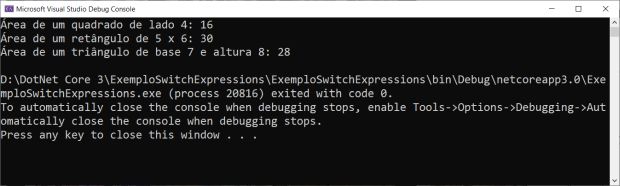
As a result of running this application, we get:
Here are links to the other articles I've already published about the new features in C# 8.0 and Visual Studio 2019:
- Visual Studio 2019 and .NET Core 3: First Tests
- What's New in C# 8.0: How to Enable, Ranges and Indices
- What's New in C# 8.0: Nullable Reference Types
- Visual Studio 2019: Preview 2.1 and New Features in Debugging Console Applications
- .NET Core 3 Preview 3, VS 2019 Release Candidate, Using Declarations in C# 8.0
- What's New in C# 8.0: Static Local Functions
Also, here's the recording of the hangout held on March 6 on the Canal .NET, in which I discussed new features involving .NET Core 2.2, ASP.NET Core 2.2, .NET Core 3.0, ASP.NET Core 3.0, and Visual Studio 2019:
References
Translated from the Brazilian Portuguese original · Read the original