Vercel Raises Token Pass to $150 in Monthly AI Credits, Same $30 Price

- Reading
- 5 min
- Tables
- 1
The AI Gateway's Token Pass add-on now includes $150 in open-weight model credits per month, up from $80 before, without changing the $30 monthly fee per team. See how the credit works, what happens when it runs out, and who actually comes out ahead.
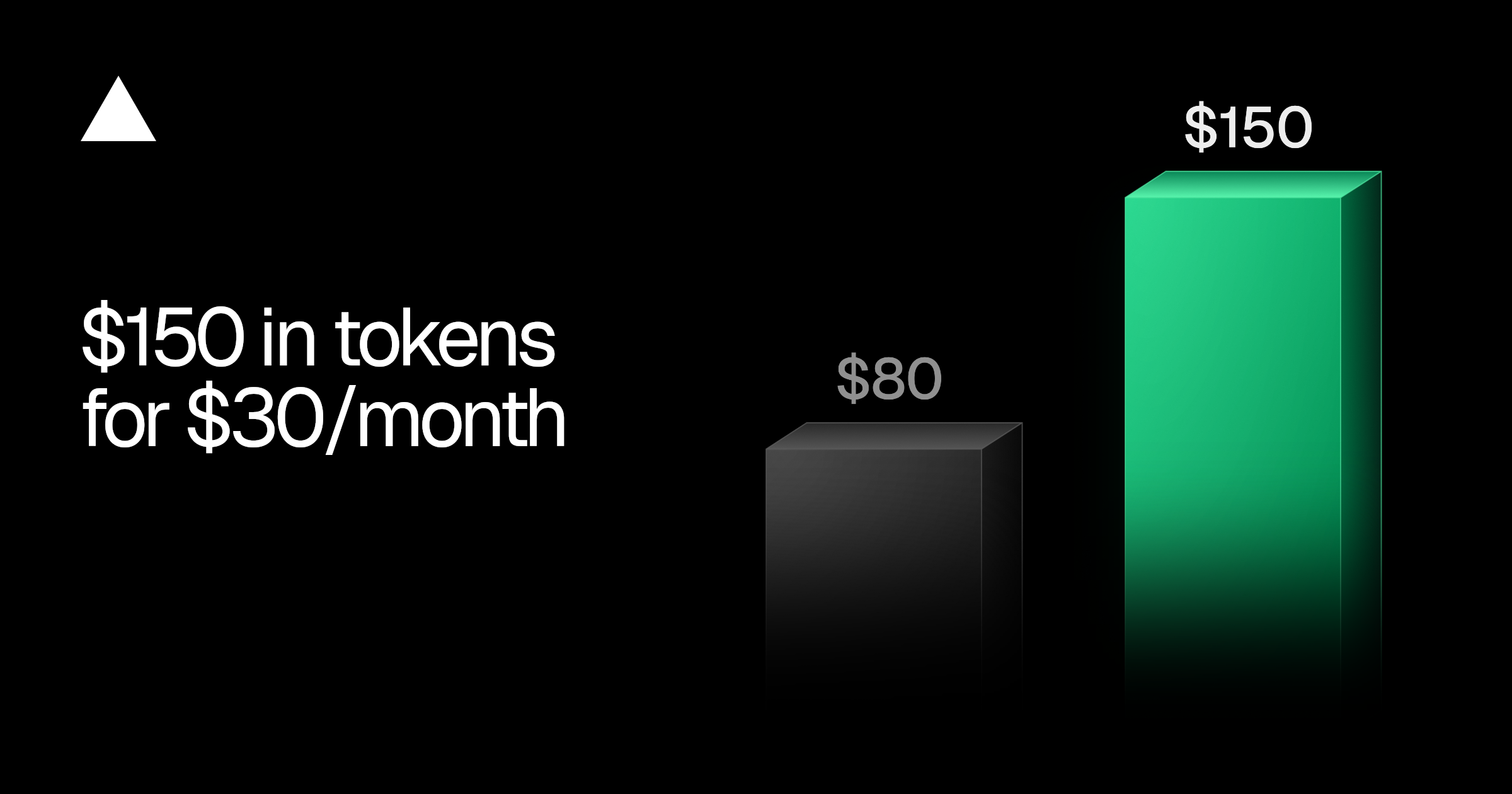
Vercel updated Token Pass, the AI Gateway add-on aimed at teams on the Pro plan, to include $150 in monthly AI model usage credits, up from $80 before. The subscription price hasn't changed: it remains $30 per team, per month. The information is in Vercel's official changelog, which lists the change without citing a cutoff date, suggesting a gradual rollout within the product's Early Access.
The credit applies to a specific set of open-weight models served by Vercel's own AI Gateway: Kimi K3, Kimi K3.1 Pro, GLM 5.3, GLM 5.3 Flash, and DeepSeek V4.1 Flash. These are models with open weights, hosted by inference providers and exposed via the Gateway, unlike closed models such as GPT or Claude, which only exist behind the manufacturer's own API.
What Changes in the Math, in Numbers
The math here is simple and worth breaking down, because the subscription price stayed the same: only the included credit went up.
| Before | Now | |
|---|---|---|
| Monthly fee | $30/team | $30/team |
| Included credit | $80 | $150 |
| Multiplier (credit per dollar paid) | 2.67x | 5x |
The difference between the 2.67x and 5x multiplier amounts to an 87.5% increase in available credit for the same fixed spend. It's this number, not a reduction in the models' list price, that underpins the "savings" idea behind the announcement: those who already paid for Token Pass now convert the same money into nearly double the usage before hitting the cap.
It's worth separating two things that Vercel's announcement blends together by talking only about credit: the increase in included credit (87.5%) and its effect on the cost per token actually spent. Running the math in reverse, before, each dollar of model usage cost, on average, 37.5 cents in subscription fees (30 divided by 80); now it costs 20 cents (30 divided by 150), a drop of roughly 47% in the average cost per token used, but only within the range covered by the credit.
How the Credit Behaves When It Runs Out
Token Pass has no rollover: the credit resets every billing cycle, and whatever is left over simply doesn't carry over to the following month. What happens once it's exhausted depends on the type of key used to access the AI Gateway, and that choice changes the cost risk for anyone integrating the Gateway into a CI pipeline, a coding agent, or a production app:
- Standard AI Gateway keys or OIDC tokens: once the credit runs out, requests start falling back to the team's general AI Gateway balance, billed at each model's normal price. In other words, the app keeps working, but billing switches regimes without explicit warning in the code.
- Token Pass-scoped keys: once the credit runs out, requests simply stop, with no overage. This mode guarantees a spending cap, at the cost of the agent or app failing mid-month if usage exceeds what was planned.
This choice of key is, in practice, an architectural decision: teams running autonomous coding agents or background functions with variable usage tend to prefer the scoped key, which cuts the cord rather than springing a surprise at billing time; teams that prefer continuous availability, even if it costs more, stick with the standard or OIDC key.
Where This Fits in a Front-End Developer's Stack
The most direct use case for front-end developers isn't AI chat, but rather the points where the AI Gateway already shows up in Vercel's stack: model-assisted UI generation, coding agents integrated into the editor, Next.js API routes that call a model to summarize, classify, or generate content, and build pipelines that use AI for auxiliary tasks.
Models like DeepSeek V4.1 Flash and GLM 5.3 Flash are historically cheaper per token than closed frontier models, which already makes them natural candidates for high-volume, low-criticality tasks, such as generating alt text, summarizing changelogs, or routing simple requests.
Token Pass reduces the friction of testing this type of architecture: instead of registering an API key for each provider separately, the team uses the AI Gateway as a single layer and pays a fixed monthly amount that already bundles a volume of usage for those specific models. For a small team validating a generative AI feature in an interface, this feels like subscribing to an observability plan: cost predictability at the start of the project, before any scaling decision.
What Still Limits Token Pass
The add-on remains in Early Access, with limited slots and a waitlist once they run out, according to Vercel's own changelog. This means availability isn't guaranteed at the moment a team decides to test it, and that Vercel can adjust terms, model coverage, or pricing before a formal exit from Early Access. Another point is coverage: only specific open-weight models count toward the credit, so a team that relies on GPT or Claude for most of its usage doesn't see the same benefit.
To activate it, the path is running vercel token-pass in the CLI, or using a Token Pass API key if the coding agent already supports the AI Gateway. The subscription itself is done through the AI Gateway dashboard, inside the team panel on Vercel.
Who It Makes Sense to Sign Up Now
In short: Token Pass pays off for those already on Vercel's Pro plan, already using the AI Gateway as their access layer for models, and with an appetite to experiment with open-weight models for medium- to high-volume tasks. It doesn't pay off for those who primarily rely on closed frontier models, for those running outside the Vercel ecosystem, or for those who need guaranteed continuous availability without the risk of the scoped key simply stopping mid-month.
Translated from the Brazilian Portuguese original · Read the original
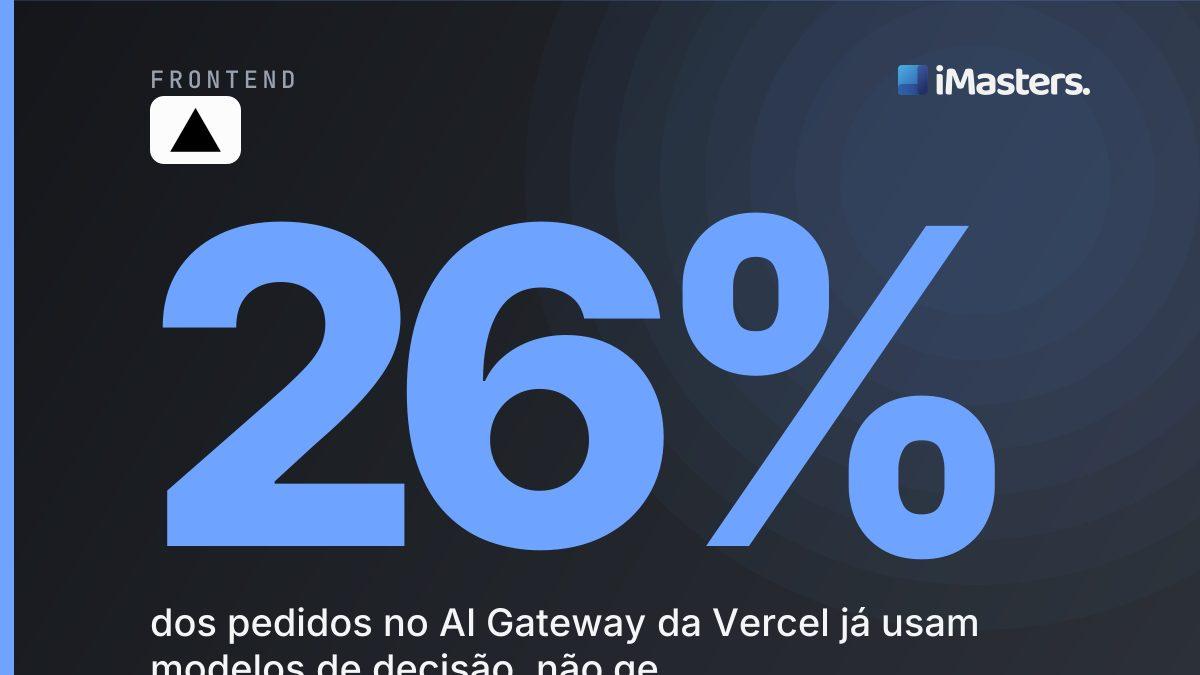
Decision models reach 26% of requests on Vercel's AI Gateway
Vercel's November report on the AI Gateway shows teams using decision models, cheaper and faster, to classify and route instead of generating text, while Anthropic leads the choice among new teams.