From Las Vegas to São Paulo: what Oracle brought to Brazilian companies

- Reading
- 6 min
From AI World to Beyond The Club, how Oracle connects data, agents, and applications to the operations of Brazilian companies.
Originally published on NewHack, on November 4, 2026.
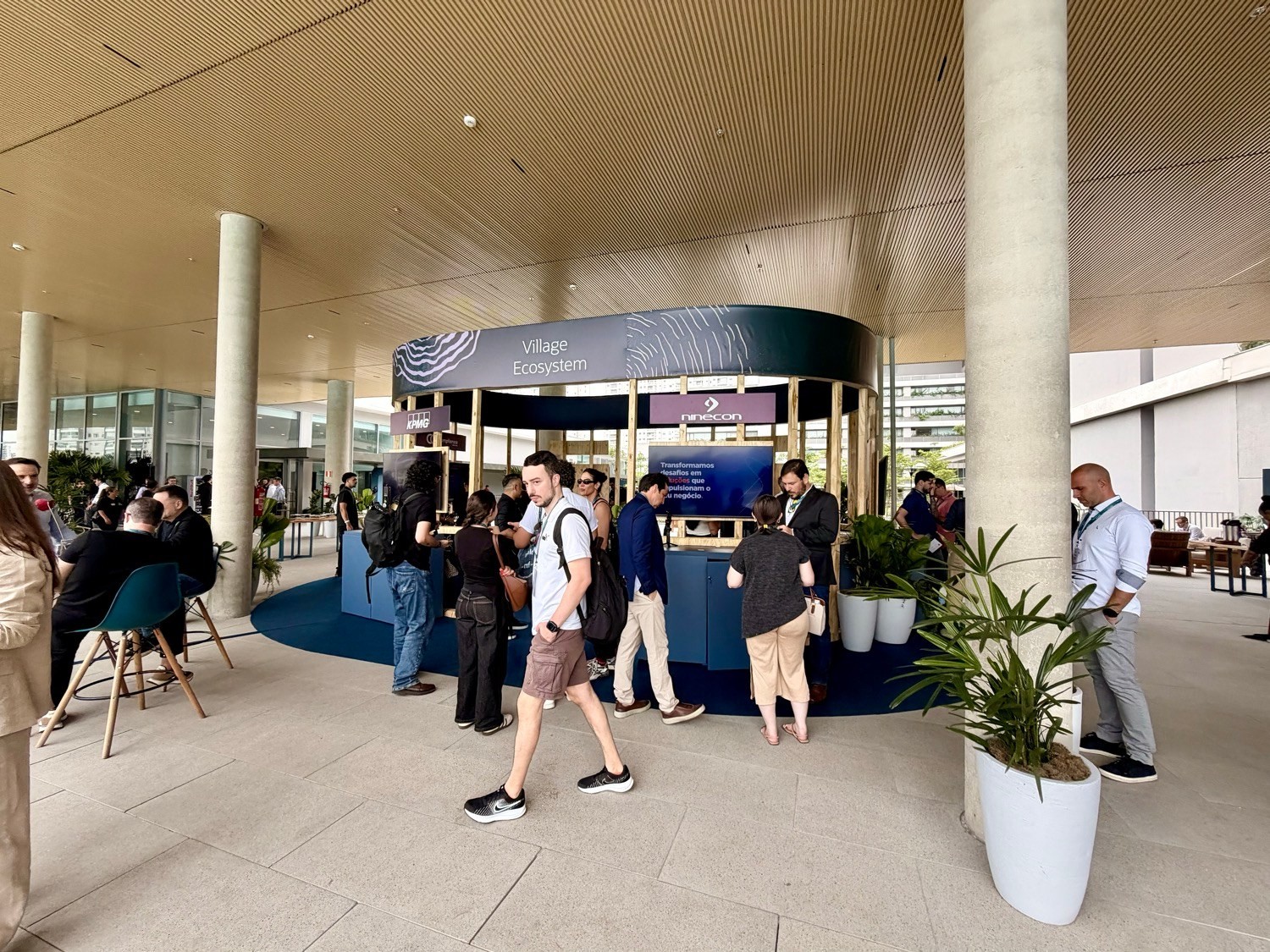
A week after Oracle AI World, Oracle brought a download of the global conference to São Paulo. At Oracle AI Experience Brasil, the discussion covered the systems companies already use, the rules they need to comply with, and the processes where artificial intelligence can generate results.
Oracle AI World took place from October 25 to 28 in Las Vegas. On November 4, exactly one week after it ended, the Brazilian agenda included the AI World Las Vegas Download session, with Adrián Durán and Marcelo Christianini. The São Paulo edition combined this update with conversations among customers, partners, and technical teams. According to Paulo Ribeiro, Oracle's marketing director for Latin America, the program was designed for more than two thousand attendees over two days, with around 80 sessions.
Oracle chose Beyond The Club, in São Paulo. The club began operating in 2025 and announced in October 2026 the opening of Terraço The View, its new events space. Oracle AI Experience Brasil was the first corporate event held on the terrace. The wave pool next to Marginal Pinheiros, a riverside expressway in São Paulo, sets the scene for the gathering: on one side, a surf club in the middle of the city; on the other, rooms with labs, panels, and customers discussing how to bring AI into operations.

The download got a local accent
In Las Vegas, the conversation was about the platform's direction. In São Paulo, the agenda put that direction in front of operations with their own rules. November 4 covered finance and healthcare, along with labs on agents connected to Oracle AI Database, NVIDIA infrastructure on Oracle Cloud, and engineering with Codex. Governance, security, and integration ran through these tracks.
An agent for a financial operation, for example, needs to know which data it can access, what it can execute on its own, and when it should hand the decision back to a person. If there's no way to reconstruct the path to a decision, it's hard to fix an error or understand why an exceptional case was treated as routine. This is the part of the work that shows up when the demo needs to fit into a real operation.
Data: a query can run and answer the wrong question
The São Paulo lab on agents with Oracle AI Database 26ai gives an example of how the local agenda connects to what came out of Las Vegas. Version 26.10 of Private Agent Factory, published on October 26, added Deep NL2SQL, which helps turn natural-language questions into SQL queries using business definitions. The tool also allows the generated query to be inspected.
Imagine a retail manager asking which stores lost margin. The answer changes depending on whether the company counts returns on the sale date or the refund date, and whether it attributes shipping and discounts to the store or to the digital channel. The database tells you where the figures are. Someone in the operation needs to define how they factor into the calculation. Before making the agent available to the team, it's worth testing questions whose answer is already known, including cases where the definition changes the answer.
Oracle also announced a semantic layer for the Autonomous AI Lakehouse, aimed at sharing metric definitions and context across data sources, including Apache Iceberg tables. Here the timeline distinction matters: the announcement projects this capability for the 12 months following the announcement. It's a direction for the platform, not a feature that can be assumed to be available in every customer's environment.
Applications: authorization matters when the agent starts acting
On the other end, the announcements for Oracle Fusion show a bet on agents within processes such as finance, HR, and supply chain. Fusion Claw is the execution environment used in these applications. Fusion Companion and Agentic Home were presented as ways to describe a goal, delegate the work, and track its progress. This is the connection to the Brazilian track on enterprise applications: beyond answering questions, the software starts coordinating steps in a process.
One way to evaluate the proposal is to follow an exception, not just the case that already runs smoothly. In accounts payable, an agent can gather information on a disputed charge and route it to the responsible person. Releasing the payment is a different action, subject to different approval levels and controls. A pilot needs to show which step was authorized, how the system records what happened, and what the team does if a partial execution leaves the process halfway through.
This helps explain the strategy: Oracle is connecting the place where the data lives, the tools that interpret that data, and the systems that record the work. For the customer, the potential advantage is making use of context and permissions that already exist. The question is how much of that context remains accessible when the flow crosses tools from other vendors, and how much effort the team needs to invest to maintain that integration.
Startups gain speed. Scale depends on access to the operation
Marcelle Paiva, vice president of Oracle's AI Hub for Latin America, pointed out an advantage of startups born with AI: they can design the process from scratch, without reorganizing decades of systems and routines. She also highlighted the challenge of winning customers and reaching the data and problems that make the solution relevant.
A partnership makes a difference when it provides access to a task worth solving and to someone who can monitor the test. A startup can arrive with technical speed; a large company knows the exceptions in the process and can show what happens when volume grows. For both, a pilot becomes more useful when it starts with a clear criterion: what result needs to improve, compared to the current process, to justify a rollout?
In robotics, the environment is part of the product
The discussion also touched on physical AI. Victor Rysovas, director at AutorIA, described proofs of concept with the Cruiser S2 humanoid robot. The focus is on figuring out which tasks make sense and what needs to be adapted and trained for each environment.
A demonstration of object manipulation helps show the equipment's capability. The decision to place it in a factory or warehouse involves other questions: does the task repeat often enough, does the robot handle the site's variations, and can the team operate and maintain the system? It's a good example of how the outcome depends as much on implementation as on the technology.
What to watch for on the second day
For November 5, Oracle's agenda includes a keynote featuring OpenAI, discussions on data sovereignty with Dataprev, Brazil's social security IT agency, Serpro, Brazil's state-owned IT company, and Caixa, Brazil's federal savings bank, and tracks focused on the public sector, retail, telecommunications, and enterprise applications.
A useful case shows the process before and after AI. In a triage pilot, for example, reducing the time to first routing says little if the human review queue grows at the same rate. A convincing case shows the time to resolution, the exceptions that needed intervention, and the cost of maintaining the flow. This is the kind of evidence that makes it possible to assess what moved from the demo into the routine.
Translated from the Brazilian Portuguese original · Read the original
Datasette Agent gets chat panel to build database apps with prompts
datasette-agent 0.5a0, released by Simon Willison on November 3, adds a chat panel that sits next to Datasette tables and apps, making it possible to build and adjust databases using only prompts.