mod_wsgi creator uses AI to reinvent the Python application server in Rust
- Reading
- 6 min
Graham Dumpleton, who created mod_wsgi about 20 years ago, has been publicly documenting since November 4, 2026 the building of Muru, a Rust server for running WSGI and ASGI apps with heavy AI assistance.
Simon Willison published, on November 21, 2026, a post highlighting Muru: a new Rust server created by Graham Dumpleton to run Python WSGI and ASGI applications in both development and production. What stands out isn't just the project, but the process: since November 4, 2026, Dumpleton has been publishing an almost-daily, detailed account of every technical decision, with AI playing a heavy role in the implementation.
Who He Is
Graham Dumpleton isn't a startup or a product team: he's the person behind mod_wsgi, the Apache module that, about 20 years ago, became one of the most widely used ways to put Python applications into production. He has spent two decades thinking about what the ideal way to serve Python apps would look like, and Muru is the current attempt in that search.
According to Willison's post, Muru's stated goal is to "provide the best possible tools for running Python ASGI and WSGI apps in both development and production." There are no revenue figures, customers, or funding rounds to cite here, because there is no company: it's a personal, open-source project, built and documented publicly.
This format of extensive documentation isn't new for Dumpleton. Willison recalls that he had already done the same with an earlier project, wrapture, publishing an equally detailed account as the work progressed. With Muru, the pace was even more intense: 19 posts between November 4 and 22, 2026, covering everything from worker architecture to telemetry.
How It Works
The "team" here is one person with 20 years of production scars plus an AI assistant. It's an atypical team setup even by solo-project standards: it's not just one person writing code alone, it's one person using AI to generate much of the code's surface while reserving the final quality judgment for themselves.
The titles of the posts Dumpleton has published function as a changelog of architecture decisions, and together they sketch out what Muru is trying to solve:
- A worker model that imports the application once and forks it into multiple processes ("import once, fork many"), a direct descendant of the preloading strategy that
mod_wsgialready used, now reimplemented in Rust; - Native HTTPS support already in local development, without needing a separate proxy;
- WSGI and ASGI served side by side by the same process, without requiring two different stacks;
- Releases without taking the server down ("releases, not restarts") and canaries without depending on a service mesh;
- Integration designed to run well inside a container and work with Kubernetes instead of working around its abstractions;
- Autoscaling (including scaling to zero) based on metrics reported by the workers themselves, plus configuration "overlays" applied on a schedule;
- A debugging toolbar embedded in every page served, with distributed tracing exposed directly in it;
- Lazy imports deliberately used as a lever for startup performance.
On where AI actually comes in, Dumpleton was direct in one of the series' posts, "AI as a lifestyle choice":
The AI may be doing a lot of the work on the surface, but deciding what isn't good enough yet is still down to me, and twenty years of getting things wrong with mod_wsgi turns out to be useful for that. I am prepared to put in the hard work to keep polishing Muru until it is something I would trust, and something you would too.
Graham Dumpleton, creator ofmod_wsgiand author of Muru
What's Different
A server infrastructure project at a conventional company usually goes through a product manager, roadmap review, a platform team with multiple people, and release notes written after the fact, already filtered for external communication. Muru flips that logic: technical documentation comes out in near real time, as blog posts, even before the project is ready for general use.
In short: the central difference isn't the use of AI itself, which is already common in corporate teams as an IDE copilot reviewed by peers, but the concentration of 100% of the quality judgment in a single person who is also the field's top technical authority. At a company, the decision about what "isn't good enough" goes through process and consensus; at Muru, it's a personal standard, built over 20 years of mod_wsgi, applied without intermediaries to code that AI helped write.
Another contrast is the pace of transparency: while an infrastructure team typically publishes on a quarterly or per-release cadence, Dumpleton published almost one post a day for three weeks, documenting even the decisions that were still open while he was making them.
What to Copy
Documenting the technical decision in public, not just the final changelog, is the most replicable practice here. It forces whoever is writing to explain the reasoning behind an architecture choice, not just the outcome, and creates a searchable history that any team can revisit when the same problem comes up again.
Explicitly separating "what AI decides" from "what only the person decides" is another practice worth bringing into any AI-assisted development workflow in Brazil. Without that stated criterion, teams tend to accept generated code without a clear standard for what counts as "good enough," which is exactly the point Dumpleton frames as the role AI doesn't take on for him.
Reusing the scars of an old project as a quality standard for a new AI-assisted project is also a direct lesson: the 20 years of mod_wsgi didn't turn into code reused line by line, they turned into judgment criteria. For anyone rewriting a legacy system with AI assistance, prior experience is worth more as a quality filter than as a shortcut for code generation.
Designing observability and deployment as part of the server's core, rather than as a layer added later, shows up in several of Muru's features: canaries without a service mesh, autoscaling based on metrics reported by the worker itself, tracing already built into the debugging toolbar. For teams building their own infrastructure, the lesson is to treat these points as design requirements from the start, not as later integrations.
Publishing frequently with short technical content, instead of a single long post, is also a replicable communication practice: it helps keep the material readable and makes it easier for other people to follow the reasoning in real time, rather than only receiving the consolidated result.
Risks and What Remains Open
The biggest practical risk for anyone considering adopting Muru is the bus factor: it's a server maintained by a single person, with no co-maintainers mentioned in the available material. Any architecture decision, critical bug fix, or response to a vulnerability depends, for now, on Graham Dumpleton being available.
The project is also very recent: the post series began on November 4, 2026, and by the time the source was published, on November 21, Muru had been publicly in existence for just under three weeks. The material contains no production use case, adoption figure, download count, or company cited as running Muru today.
The actual proportion of AI-generated code also remains open. Dumpleton is clear about who decides what's "good enough," but he doesn't quantify how much of the code was written by AI and how much was written or rewritten by hand, which makes it harder to assess how much of the architecture is actually audited line by line.
The source material contains no information about the usage license, the project's sustainability model, or any form of funding for Muru (the sponsorship model mentioned in Willison's post belongs to his own newsletter, not to Dumpleton's project). And the promise of parity with two decades of mod_wsgi edge cases remains a stated goal, with no public benchmark backing it up so far.
Translated from the Brazilian Portuguese original · Read the original

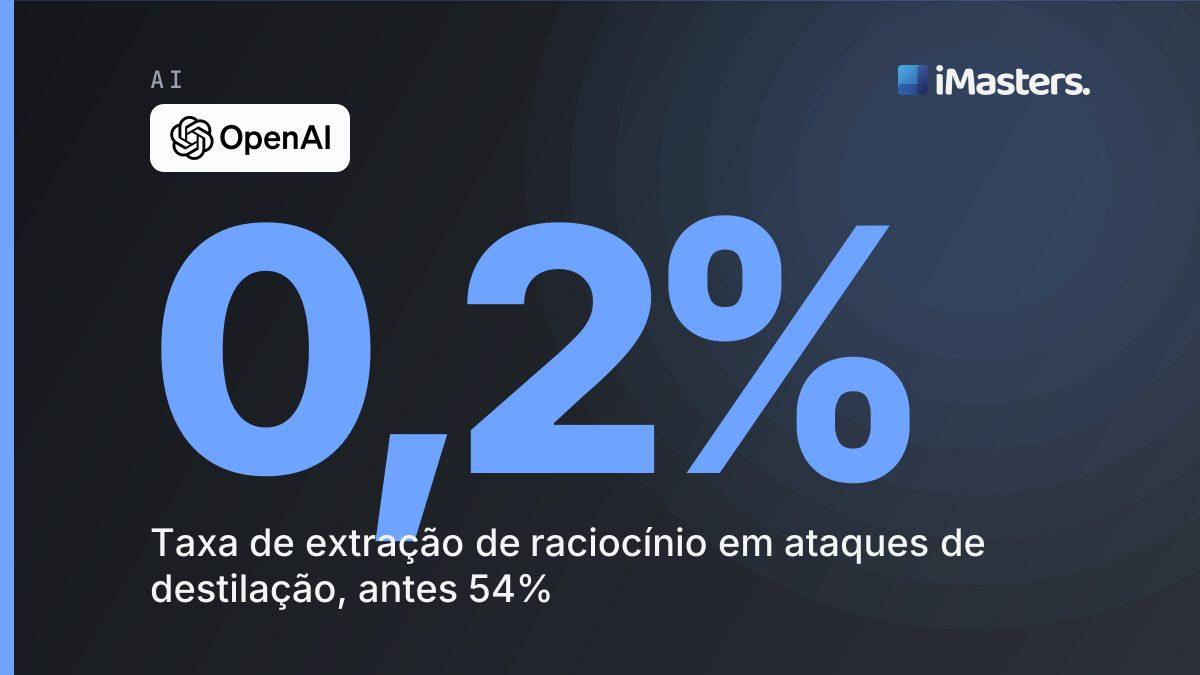
OpenAI cuts reasoning extraction rate from 54% to 0.2% in its models
In a November 20 report, OpenAI details the layered defense that shields GPT-6.2 Astra and GPT-6.2 Sol against adversarial distillation, the technique used to copy a model's capabilities without inheriting its safeguards.