OpenAI Builds Benchmark to Measure Whether GPT Models Help Choose Candidate Drugs
- Reading
- 6 min
- Tables
- 1
- Code
- 1
MedChemBench, released on November 20, 2026, evaluates whether reasoning models can read molecular structures and suggest the next compound to test in a medicinal chemistry lab.
OpenAI published MedChemBench on November 20, 2026, a benchmark focused on a very specific problem: whether a language model can reason like a medicinal chemist when faced with real drug discovery data. It is not a test of creativity or new molecule generation. It is a test of reading comprehension: given the history of a research program, the model must understand structures, compare compounds, and predict properties based on already published experimental evidence.
This framing matters because drug discovery is, at its core, a problem of constant trade-offs. A compound may bind well to a protein linked to a disease while being poorly absorbed by the body or degrading too quickly in the liver. Medicinal chemists are constantly deciding what to sacrifice: more potency costs more stability, more stability costs more permeability. This is exactly the kind of decision OpenAI wanted to test in reasoning models.
What the Benchmark Actually Measures
MedChemBench brings together 99 problems drawn from 117 scientific papers and patents, covering 761 distinct molecular structures. For most tasks, the model receives the same context a researcher would have at a specific point in the project: the biological target, the research objective, the compounds already studied, and part of the experimental results collected up to that point.
The evaluation is divided into four areas, each with its own scoring rules:
- Molecular structures: the model must correctly assemble atomic bonds and stereochemistry from the drawings and chemical groups provided.
- Scientific reasoning: the model's explanations must be grounded in the evidence provided, for example when justifying the choice of one compound over another.
- Ranking and selection: the model must rank or choose compounds that meet the requirements stated in the prompt.
- Property prediction: the numerical values and categories predicted by the model are compared against the actual measurements reported in the original material.
The PRMT5 Example: Predicting the Trade-off, Not Just the Number
One of the problems used in the benchmark comes from research on PRMT5 inhibitors, a protein studied in cancer therapies. The model receives molecular structures and results from previous experiments and must predict how three related compounds will behave: how strongly they inhibit PRMT5 inside the cell, how easily they cross the cell barrier, and how quickly liver enzymes break them down in a lab assay.
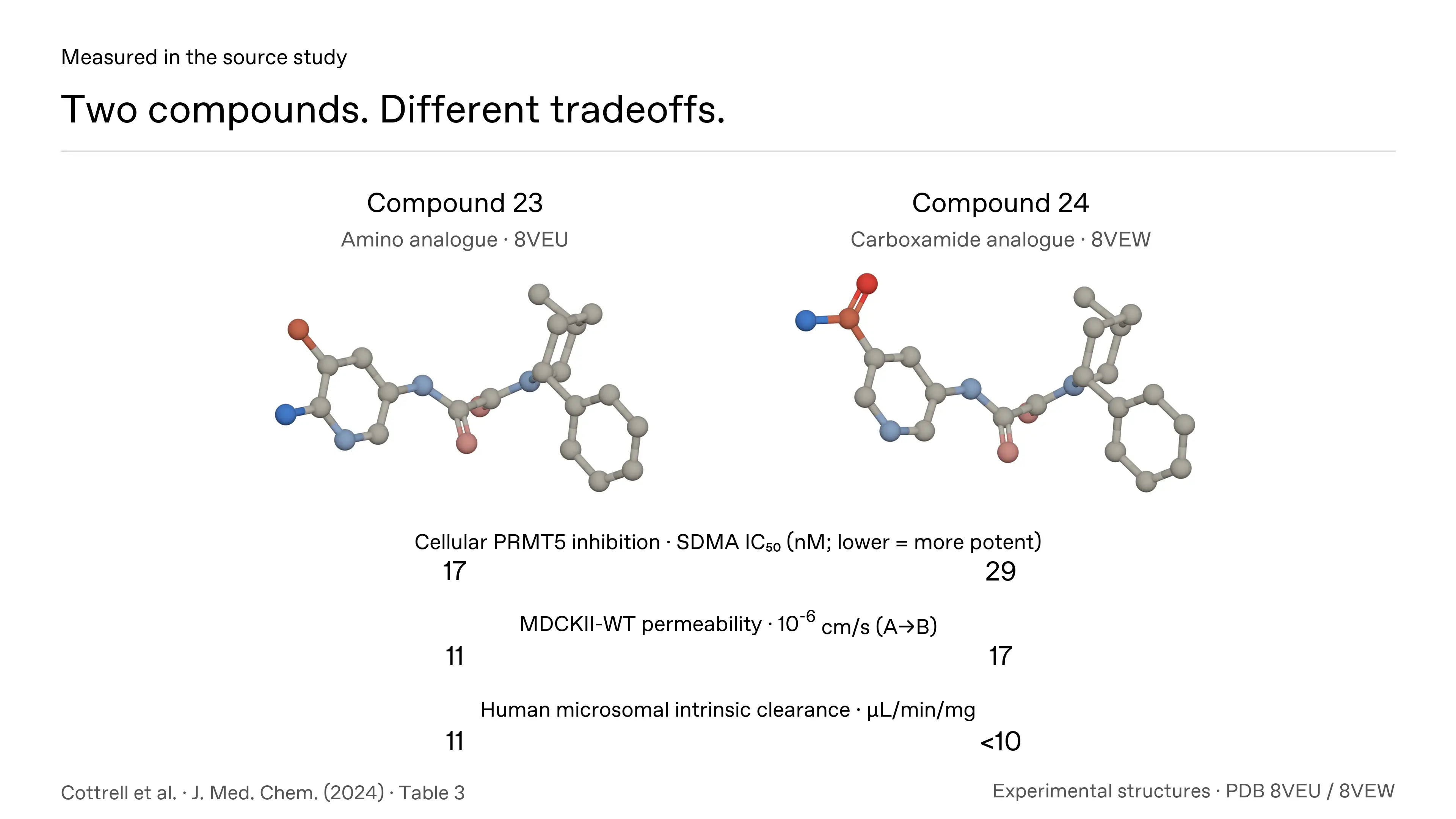
Later experiments, which were withheld from what the model received, showed exactly the kind of trade-off that characterizes this field: compound 23 inhibited PRMT5 at a lower concentration, while compound 24 crossed the cell barrier better and degraded more slowly in the liver assay. Predicting all three properties at once, in a way that is internally consistent, is what separates a model that understands the problem from one that just gets an isolated number right.
Before Predicting, You Have to See the Right Molecule
A second type of task tests something more basic but equally critical: correctly reconstructing the molecule from a chemical drawing. In one of the problems, the models had to assemble a compound from a central structure and two attached groups, preserving an 18-atom ring.
At the highest reasoning setting tested across all models (xhigh), GPT‑6 Astra correctly reconstructed this compound in all ten attempts made. GPT‑5.6 Sol and GPT‑5.6 Luna, on the other hand, got it wrong in all ten attempts: the first produced a 15-atom ring, the second split the molecule into two disconnected fragments. The error is not a cosmetic detail; it changes the identity of the compound being analyzed, which invalidates any prediction built on top of it.
The Numbers: Who Leads and Where Each Model Falls Short
OpenAI evaluated eleven models from the GPT family at different levels of reasoning effort. At the highest level common to all of them (xhigh), the results were as follows:
| Model | Effort | Overall score |
|---|---|---|
| GPT‑6.2 Astra | xhigh | 84.5% |
| GPT‑6 Astra | xhigh | 83.3% |
| GPT‑6.1 Sol | xhigh | 82.0% |
| GPT‑6.1 Terra | xhigh | 75.1% |
| GPT‑5.6 Sol | xhigh | 58.2% |
With maximum reasoning effort, GPT‑6 Astra reached 83.8%, a small improvement over xhigh. The pattern observed was consistent: increasing reasoning effort improves the score but does not close the gap between models from different generations.
The most revealing detail is in the breakdown by component. GPT‑6 Astra scored 95.4% of the available credit in molecular structure reconstruction, its strongest point along with explaining scientific evidence. But in compound selection and numerical property prediction, the score dropped to about half of the possible credit. In other words: the model is good at describing what it sees, but it still gets it wrong a good portion of the time when it has to decide what to do next.
What the Benchmark Does Not Prove
OpenAI itself is explicit about MedChemBench's limitations. The problems come from already published papers, so it cannot be ruled out that the models saw part of this material during training. Each response was a single attempt, with no external tools, no feedback, and no possibility of running a new experiment to confirm the hypothesis.
This means MedChemBench tests reasoning over historical evidence, not the ability to discover a new drug from scratch. That is a significant difference: a model can be excellent at explaining why a compound that was already tested worked and still be useless for suggesting the next compound to synthesize in a real-world scenario, where there is no correct answer waiting to be retrieved.
What Changes for Those Building AI Pipelines
Editor's note: the code in this section was not executed in a real environment. Validate before using in production.
For those developing scientific support tools, the practical lesson from MedChemBench is not that "AI already chooses drugs," but rather where it actually helps today: reading and normalizing molecular structure, explaining trade-offs based on existing data, and serving as a first filter before human screening. OpenAI's tests controlled the models' reasoning effort through a parameter called reasoning_effort; anyone wanting to reproduce this kind of control in their own pipeline should check the current OpenAI API documentation to see if and how this parameter is available.
The approach I would take in a typical assisted-screening project would be to structure each query the way the benchmark structures its problems: biological target, research objective, compounds already studied, and partial evidence, all in a deterministic prompt, never in loose language.
from openai import OpenAI

client = OpenAI()

response = client.responses.create(
 model="gpt-6-astra",
 reasoning_effort="xhigh",
 input=[
 {"role": "system", "content": "You are a medicinal chemistry screening assistant. Answer only based on the evidence provided."},
 {"role": "user", "content": contexto_do_programa_de_pesquisa}
 ]
)
This skeleton only makes sense with a verification layer afterward: validating the reconstructed molecular structure against a chemistry parser (RDKit, for example) before trusting any numerical prediction the model returns. The benchmark's own data shows why: a model can be nearly perfect at explaining evidence (a component where GPT‑6 Astra did well) and still get compound selection wrong, because these are different skills, evaluated and scored separately.
For biotech or pharma teams evaluating whether to incorporate this kind of model into a real workflow, MedChemBench works less like a stamp of approval and more like a risk map: it shows exactly at which stage of the process (structure reading, explanation, ranking, or numerical prediction) the model still fails most often, which is more useful information than an overall score of 83% or 84%.
Translated from the Brazilian Portuguese original · Read the original

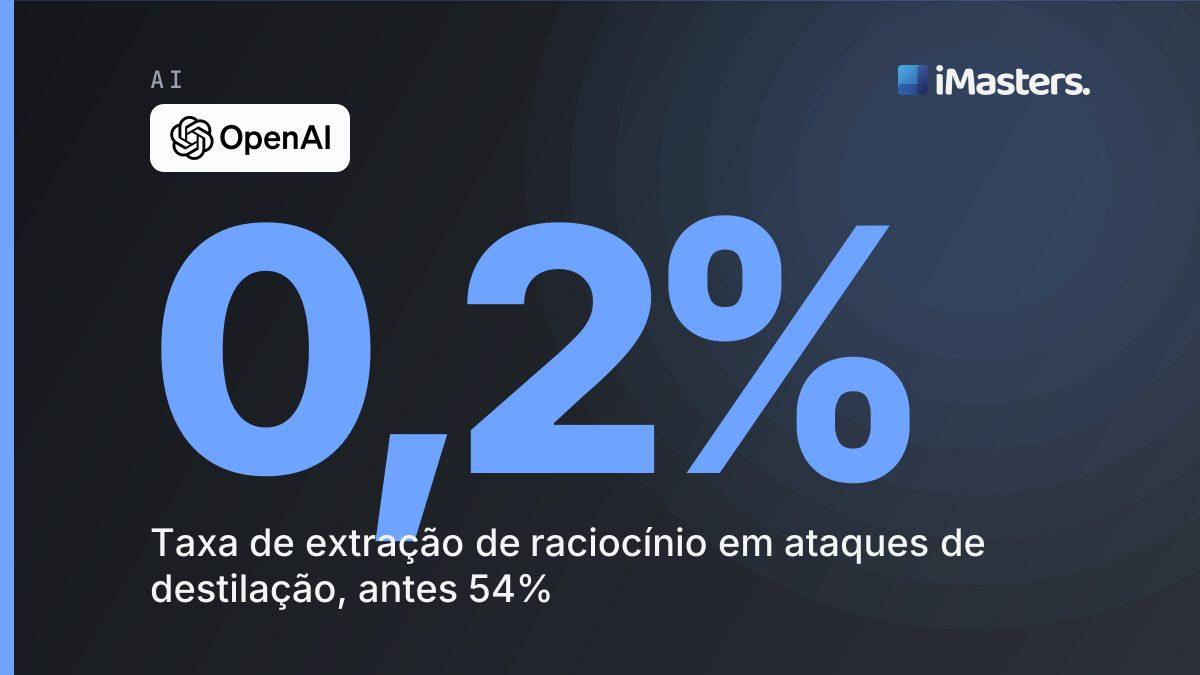
OpenAI cuts reasoning extraction rate from 54% to 0.2% in its models
In a November 20 report, OpenAI details the layered defense that shields GPT-6.2 Astra and GPT-6.2 Sol against adversarial distillation, the technique used to copy a model's capabilities without inheriting its safeguards.