OpenAI cuts reasoning extraction rate from 54% to 0.2% in its models
- Reading
- 6 min
- Tables
- 1
In a November 20 report, OpenAI details the layered defense that shields GPT-6.2 Astra and GPT-6.2 Sol against adversarial distillation, the technique used to copy a model's capabilities without inheriting its safeguards.
From common distillation to a security problem
Distillation is an established technique in machine learning: a smaller model (the "student") learns from the responses, reasoning, or judgments of another, larger model (the "teacher"). This is how many companies reduce inference costs, training compact versions from the outputs of expensive models.
The problem, described by OpenAI in a report published on November 20, 2026, is when this technique turns into an attack. In adversarial distillation, an actor extracts outputs from a frontier model without authorization, trains a second model with them, and puts it into production without the same safeguards. The result is a model that inherits the capability but not the guardrails.
OpenAI gives the most direct example: an attacker can distill a model's cybersecurity capability and use the resulting model to support attacks that the original would refuse or that its protections would block. The risk isn't just intellectual property, it's security in practice, in dual-use domains such as cybersecurity and biology.
The main target: protected reasoning
The centerpiece of the defense OpenAI describes is what the company calls protected reasoning: the intermediate steps a model generates internally before arriving at a response, the chain-of-thought. These traces can contain information the final answer doesn't show, which makes them training data too valuable for anyone looking to copy a capability.
To gauge the size of the problem, OpenAI ran an internal study on cyber capability transfer. Starting from the same base model, it trained a "student" with two types of data: what the user normally sees (final answers, reasoning summaries, tool interactions) and, separately, the teacher model's exact reasoning traces.
The result: after supervised fine-tuning, the student trained on exact reasoning outperformed the one trained on summaries. After a light round of reinforcement learning, the student with access to the exact traces still came out ahead at the largest inference budget tested, even on defensive cybersecurity tasks permitted under OpenAI's usage policies. A footnote in the report cites a similar finding from Anthropic on SWE-bench Verified, using full reasoning transcripts instead of summaries.
The numbers: from 54% to 0.2%
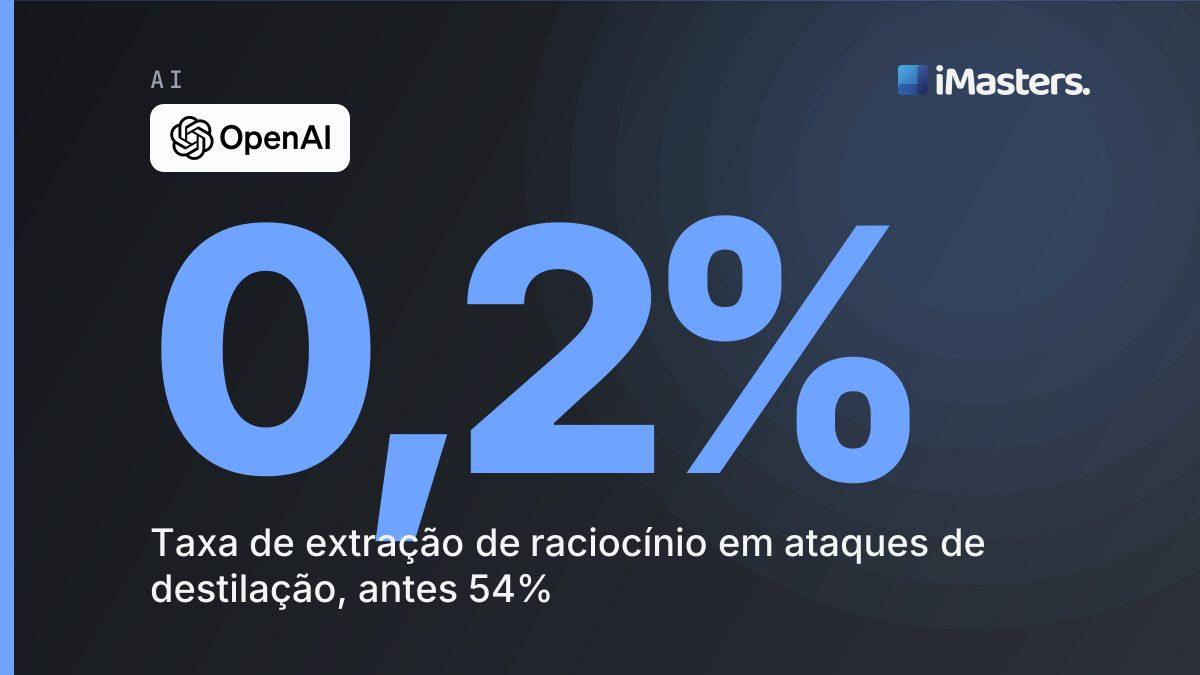
OpenAI strengthened its defenses against protected reasoning extraction in the GPT-6.2 Astra and GPT-6.2 Sol models. To measure the effect, it used adaptive automated red-teaming attempting to recover the reasoning the model generated while answering a previous prompt or the current prompt.
| Attack type | GPT-6 Astra (original safeguards) | GPT-6.2 Astra (updated safeguards) |
|---|---|---|
| Extracting reasoning from a previous request | 54.0% | 0.2% |
| Extracting reasoning from the current request | 22.9% | 0.9% |
The attack success rate (ASR) dropped to under 1% for each type tested, aggregating results from six different attacker models. OpenAI says it's already applying some of these improvements back to the original GPT-6 Astra.
Layered defense: request by request, campaign by campaign
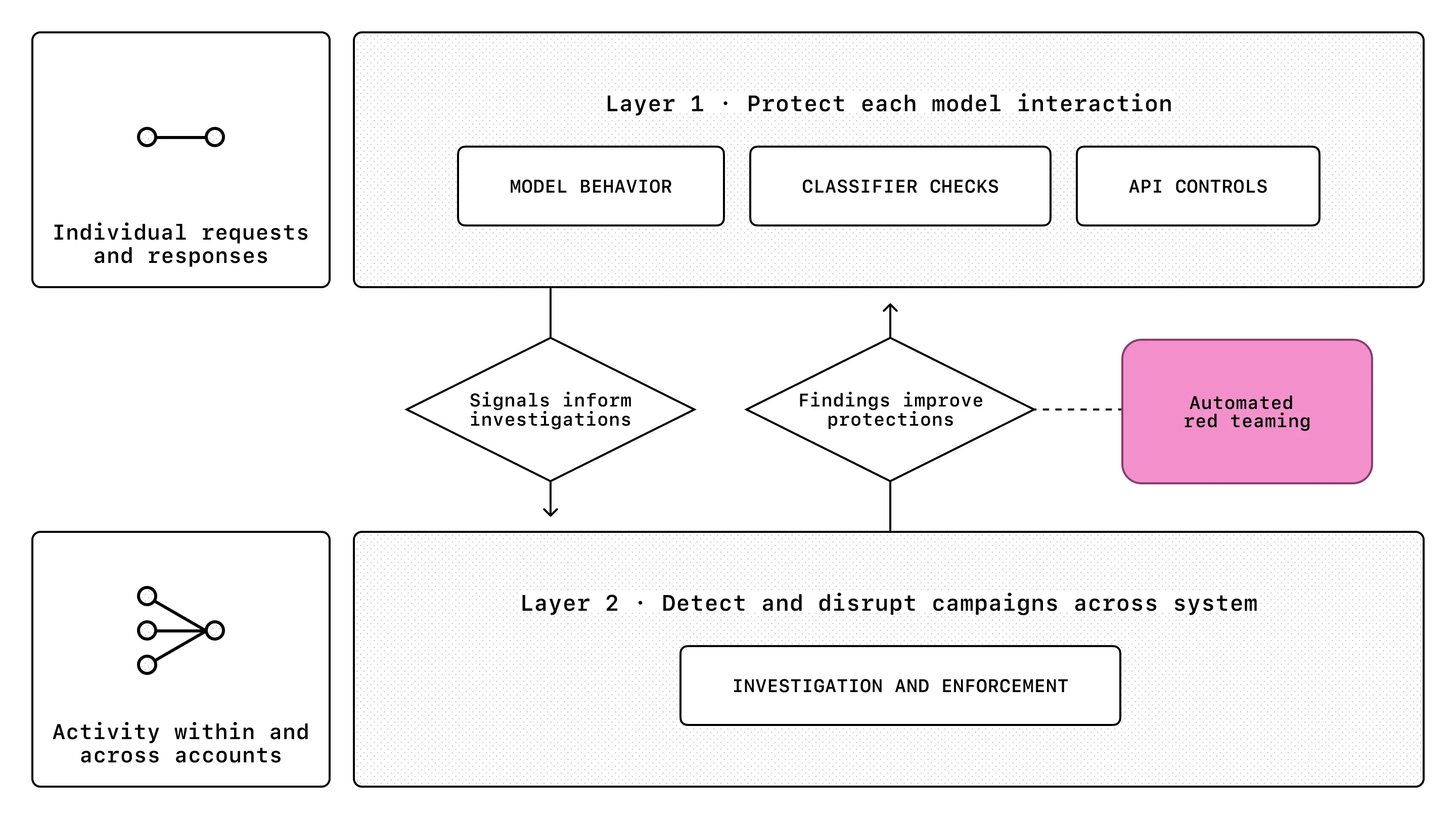
OpenAI describes two levels of protection that reinforce each other. At the request level there are three fronts: adversarial training (the model learns to recognize extraction attempts and refuse them, without failing to answer legitimate requests for explanation), input and output classifiers (they detect extraction attempts and reasoning leaks both in messages and in tool-call arguments, whether streamed or not), and API protections.
API protections are the ones that most affect product builders. OpenAI now ties protected reasoning to the conversation history that generated it: if a previous message is rewritten, the API discards the reasoning that came after it. The company also started blocking older model families, with weaker safeguards, from reading the protected reasoning of GPT-6.2 Astra and Sol, and closed a gap that allowed another user's encrypted reasoning to be exposed across conversations, organizations, and workspaces.
At the campaign level, OpenAI monitors account and request patterns that indicate coordinated extraction attempts, investigates them, and applies network-wide bans. According to the report, weekly actions against these campaigns ranged from thousands to tens of thousands of accounts this year, with the pace picking up considerably this past Northern Hemisphere summer. Findings from each investigation become training and test examples for the next round of safeguards.
What changes for those building in production
For those building on top of OpenAI's API in Brazil, three points of the architecture deserve practical attention:
- Editing a message breaks the reasoning cache. If the product lets the user edit a previous message and regenerate the response, the rule of discarding reasoning that comes after the edit means recomputing that reasoning from scratch, with extra cost and latency. It's worth measuring the impact on chat flows that rely on editing and regeneration.
- Tool calls are now audited against leakage. Agents that do intensive function calling may see tool arguments blocked by the output classifier if the content resembles raw reasoning leaking out. This can generate false positives on legitimate but verbose payloads; testing before taking a complex agent to production is prudent.
- Legitimate distillation becomes more restricted. Teams that trained smaller internal models using full API outputs, a common practice for reducing inference costs, should assume reliable access only to final answers and reasoning summaries, not to the full chain-of-thought. This reduces the effectiveness of an in-house distillation pipeline that depended on that access.
In short: the defense against external attackers also closes the door on those doing benign distillation with cost savings in mind, and that applies both to those copying capability from outside and to OpenAI itself building a smaller model from a larger one internally.
The geopolitical backdrop
OpenAI's report also ties adversarial distillation to geopolitical dispute. In February 2026, the company informed the U.S. Congress of indications that DeepSeek was attempting to distill frontier models from the United States. In September, OpenAI reported having disrupted a protected reasoning extraction campaign and attributed part of it to individuals linked to Moonshot AI, developer of the Kimi model.
The company also declared support for American bills aimed at giving the government more tools to identify and sanction foreign actors that extract capabilities from American AI models, among them the Chip Security Act, the AI OVERWATCH Act, and the MATCH Act. For those developing outside the United States, the message is indirect but relevant: the regulatory and technical tightening around distillation tends to shape how, and with what limitations, frontier models become available via API outside their country of origin.
What remains open
OpenAI hasn't published the classifiers' false positive rate against legitimate requests for explanation, nor detailed how much protecting the chain-of-thought hampers the ability to debug why an agent made a given decision, something that matters a great deal for those building regulated applications, such as fintech or healthcare, and need explainability.
It also remains open how far the updated defenses of GPT-6.2 Astra and Sol will carry over into the next model families, and whether smaller providers, without the same scale of automated red-teaming OpenAI describes, will be able to replicate this layered architecture. For now, the report works more as a reference blueprint than as a ready-made solution for those running their own models.
Translated from the Brazilian Portuguese original · Read the original


OpenAI Builds Benchmark to Measure Whether GPT Models Help Choose Candidate Drugs
MedChemBench, released on November 20, 2026, evaluates whether reasoning models can read molecular structures and suggest the next compound to test in a medicinal chemistry lab.