8 min read
XPeng details physical AI architecture linking cars, humanoid robot and robotaxis
 Lucas CardosoAuthor

- Reading
- 8 min
At AI Day 2026 in Guangzhou, XPeng presented the Turing Physical AI architecture, a single cognition and physical control stack for cars, the IRON humanoid robot and the YOYO-01 robotaxi. CEO He Xiaopeng also spoke about competing with OpenAI and keeping the robot from becoming a showcase piece.
Between November 24 and 26, XPeng held its eighth AI Day in Guangzhou, combining test rides, a main conference and technical sessions with the press. According to a report by Pandaily, the central conference, held on the 25th under the theme "ORIGIN", was the stage where founder and CEO He Xiaopeng presented the Turing Physical AI Architecture (also called VLA 3.0): a single framework for cognition, real-time decision-making and physical execution designed to run on both cars and the IRON humanoid robot, as well as to underpin the company's robotaxi and flying vehicle projects.
The event's format already says something about the strategy: instead of a single standalone keynote, XPeng organized a robotaxi test ride on the 24th, the conference and live interactions with the humanoid on the 25th, and technical panels on the 26th led by executives from different areas (intelligent driving heads John Ma and Yuan Tingting, flying vehicle lead Tan Wang and humanoid robot lead Jacky Gu). It's the same logic as the announced architecture: separate units sharing a common core.
One architecture, three speeds of reasoning
The core of the announcement isn't a single, generic model, but a three-layer stack operating at different speeds, according to XPeng's official material reproduced by Pandaily:
- System 0 (ultra-fast layer): integrates physical body control into the AI loop, coordinating power, communication and actuators to give the model real-time feedback on hardware state.
- System 1 (fast layer): run by XPeng's own VLA 2.0 model, it translates environmental perception into immediately executable actions.
- System 2 (slow layer): combines vision-and-language task planning with an Agent Runtime state machine, responsible for high-level reasoning, memory and multi-step coordination.
For anyone who works with distributed systems or agent orchestration, the split sounds familiar: it's the same principle of separating a reactive "fast path" from a deliberative "slow path", just applied to a physical body instead of an API. The practical difference is that here System 0 has to respond to hardware constraints (power, actuators) that don't exist in a regular backend.

Expert views
What people are saying about it.
OpenAI, Anthropic, and Microsoft are already selling AI that executes entire tasks instead of answering prompts. What's missing is the data every CFO will ask for before approving the budget line.
Official Google Search Central guide, updated in December 2025, brings together in one place the technical controls for AI Overviews and AI Mode and explains how to measure the impact in Search Console.
The AI infrastructure fintech raised $6 million led by NXTP after quadrupling its enterprise client portfolio in 2026, going from two to eight contracts. The bet behind the round says more about verticalized models than about the check itself.
VLA 2.0 and training 10 to 12 times faster
XPeng said at AI Day that the latest version of VLA 2.0, 6.4.0, now supports closed-loop, autonomous, agent-guided training, with a 10x to 12x gain in training speed over the previous version. The company described the process as capable of sustaining recursive self-improvement (RSI) and model self-distillation.
In practice, this means the system itself generates and evaluates its own training episodes without relying solely on manually collected data, and that a larger model teaches smaller versions of itself, a process similar to what machine learning teams already do when distilling a large model to run on limited hardware. The difference is the scale of the loop: here it's closed with the car or robot in real operation, not just in simulation.
This distillation process has a concrete application: XPeng said a VLA 2.0 Lite model, derived from the larger model, begins rolling out in December 2026 for vehicles equipped with two Orin-X chips (from NVIDIA), embedded computing hardware already common in driver assistance systems. It's the kind of engineering trade-off any team running edge AI inference will recognize: a smaller model, cheaper to run, sacrificing some of the original model's capability.
The car as a four-wheeled robot
At the intelligent driving technical panel on the 26th, led by John Ma and Yuan Tingting, XPeng reinforced the framing of the modern car as a "four-wheeled robot", whose AI goes beyond driving. The X-VMC 2.0 system unites propulsion, braking, steering and suspension under a single AI coordination layer.
The first consumer feature of what's called Turing AI Co-driving, named VLA Adaptive Deceleration, uses scene understanding to modulate regenerative braking when the driver lifts off the accelerator. XPeng said tests in urban congestion showed a 12.4% increase in usable range compared to regenerative braking turned off, with an OTA rollout planned for December 2026. The company also showed AEX, a 360-degree active avoidance system still under development, and reported a 13.93% drop in accident incidents in China since it started running VLA 2.0.
Outside China, after localization tests in Germany, the Netherlands and France, XPeng opened public urban NGP test rides at its Paris store in November, with a global launch target for the feature in the first half of 2027, when it also plans to offer a Turing AI intelligent driving subscription to new buyers worldwide.
Robotaxi: from manned testing to driverless operation in eight months
At the test ride on the 24th, XPeng showed the progress of its robotaxi program: according to the company, the move from manned testing to driverless on-road testing took eight months, and L4 demonstration operation qualification in Guangzhou came 11 months after the business was announced. Driverless passenger testing is already underway, with demonstration operation in selected areas planned by the end of 2026.
A business-model detail is of interest to anyone building a platform: XPeng doesn't intend to operate its own fleet, but rather to supply technology and vehicles to operating partners. Its first purpose-built robotaxi model, the YOYO-01, is slated to launch in 2027.
IRON: the humanoid that slipped up live
The IRON humanoid was the center of attention at the event, with a public debut featuring bilingual on-stage interaction, followed by hands-on testing with the press on the 25th. According to XPeng, the robot has 76 degrees of freedom, more than 1,500 tactile sensing points covering over 80% of relevant body surfaces, and three proprietary Turing AI chips that allow on-board operation without constant reliance on the cloud, a point relevant to anyone dealing with latency and privacy constraints in AI inference.
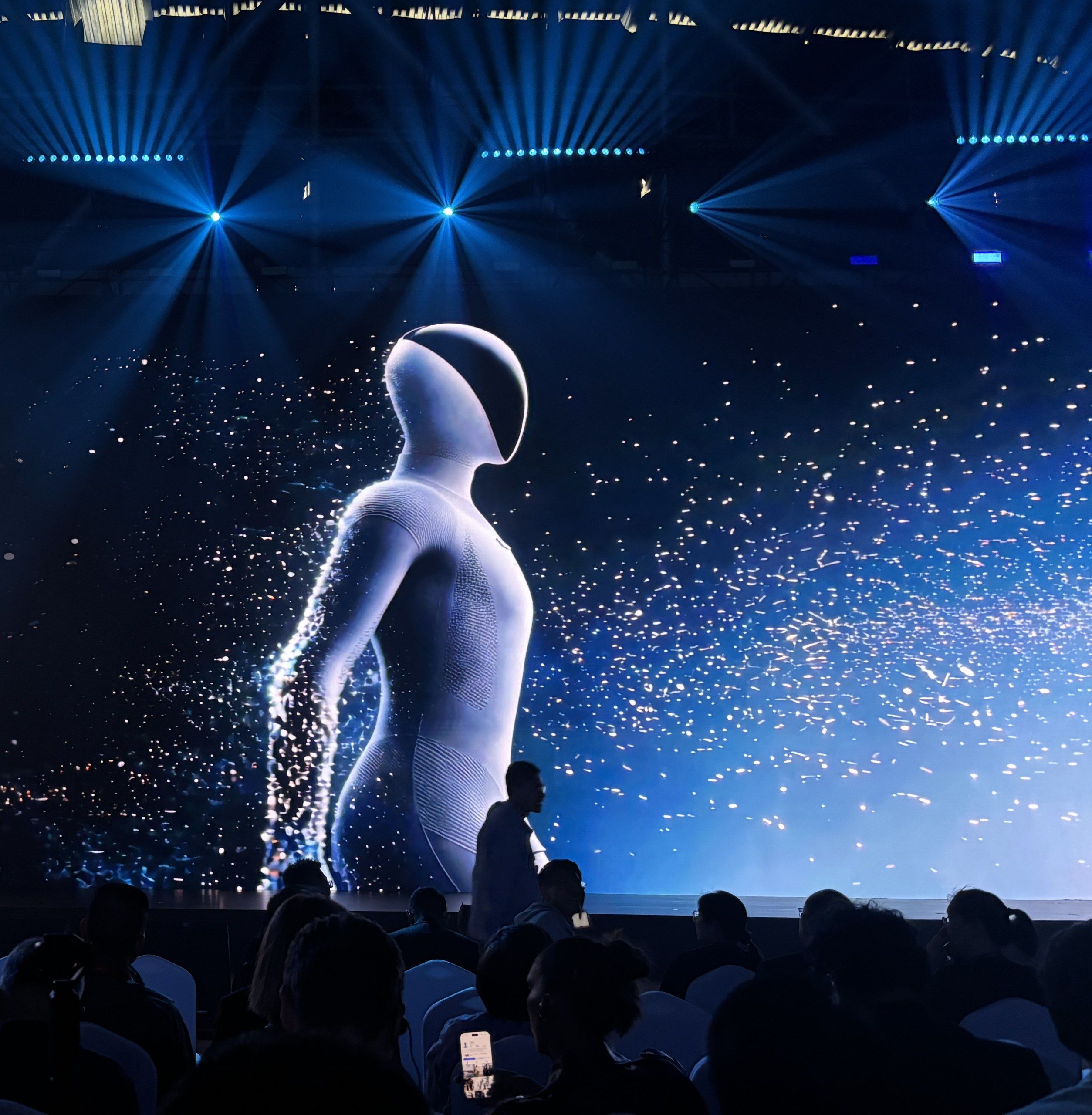
To support this development, the company built a Robot Data Factory covering more than 250 scenarios and 15 job categories, plus an automated assembly line with more than 600 holographic AI checks and more than 1,000 component and full-unit tests. IRON's training as a store assistant begins in selected stores in the first quarter of 2027, with a public commercial launch planned for the second quarter of the same year.
At the technical panel with robotics lead Jacky Gu, He Xiaopeng bluntly admitted to a live bug that occurred during that same day's demonstration: after answering a user's question, the robot asked a question back on its own, behavior XPeng didn't intend and that, he said, shows the model's training still has room to mature. The units shown at the event were ET2 prototypes; pre-production units are being built along a chain linking hardware, data, motion control, software and AI.
Open ecosystem: capability packages for partners
Beyond the hardware itself, XPeng's official material describes an open robotics ecosystem, in which partners can download capability packages and develop new skills for specific applications. It's a model similar to an SDK or extension store applied to physical robotics: instead of rewriting perception and motion control from scratch, a partner would inherit the lower-level layers and build specific behaviors on top.
Competing with OpenAI by costing less, not doing more
In the Q&A session with the press, Pandaily asked He Xiaopeng how XPeng plans to differentiate itself should OpenAI expand into robotics and autonomous driving at scale, or launch its own physical AI hardware. He answered by drawing on his experience more than a decade ago at a major internet software company in China, arguing that internet and pure-AI companies tend to underestimate the engineering of the physical world.
The example he gave was about cost discipline: early in his automotive career, he assumed boosting a capability by 30% was the main goal, until he learned that delivering the same capability at 20% to 30% lower cost can be more decisive in the physical world.
An entirely different paradigm
He Xiaopeng, Chairman and CEO of XPeng
On the risk of IRON becoming just another showcase robot that impresses in a demo and then sits idle, he called the question "very good" and pointed to five structural differences between cars and humanoid robots, the main one being that cars operate on roads with standardized rules and human oversight, while robots act in generalized, unpredictable spaces, with practically unlimited tool combinations.
A very good question
He Xiaopeng, Chairman and CEO of XPeng
What hasn't been tested yet
Among the announcements, it's worth separating what's actually running today from what's still a target for 2027: VLA Adaptive Deceleration has an OTA date set for December 2026, but the YOYO-01, IRON's commercial launch, the global NGP rollout and the international expansion of the Aridge flying vehicle division (which includes a deal with Ras Al Khaimah, in the United Arab Emirates, signed in September 2026, and the first Land Aircraft Carrier test unit destined for the Emirati program, which rolled off the line in Guangzhou in October) are all commitments for next year.
He Xiaopeng's candor about IRON's live bug is, in this sense, the most useful data point from the event for anyone assessing China's race for physical AI: the gap between a well-rehearsed stage demo and a reliable production system remains the bottleneck, and XPeng itself acknowledges this instead of simply selling the embodied-AGI narrative.
Translated from the Brazilian Portuguese original · Read the original

AI agents want to replace the prompt, but the board still doesn't have the number that justifies the budget
OpenAI, Anthropic, and Microsoft are already selling AI that executes entire tasks instead of answering prompts. What's missing is the data every CFO will ask for before approving the budget line.