OpenAI uses thousands of AI agents to analyze brain data in 32 minutes
In partnership with PerturbAI and Scripps Research, OpenAI split the analysis of a genetic atlas of mouse brains among thousands of agents running in parallel. The result matters to anyone who designs agent systems, not just to biologists.

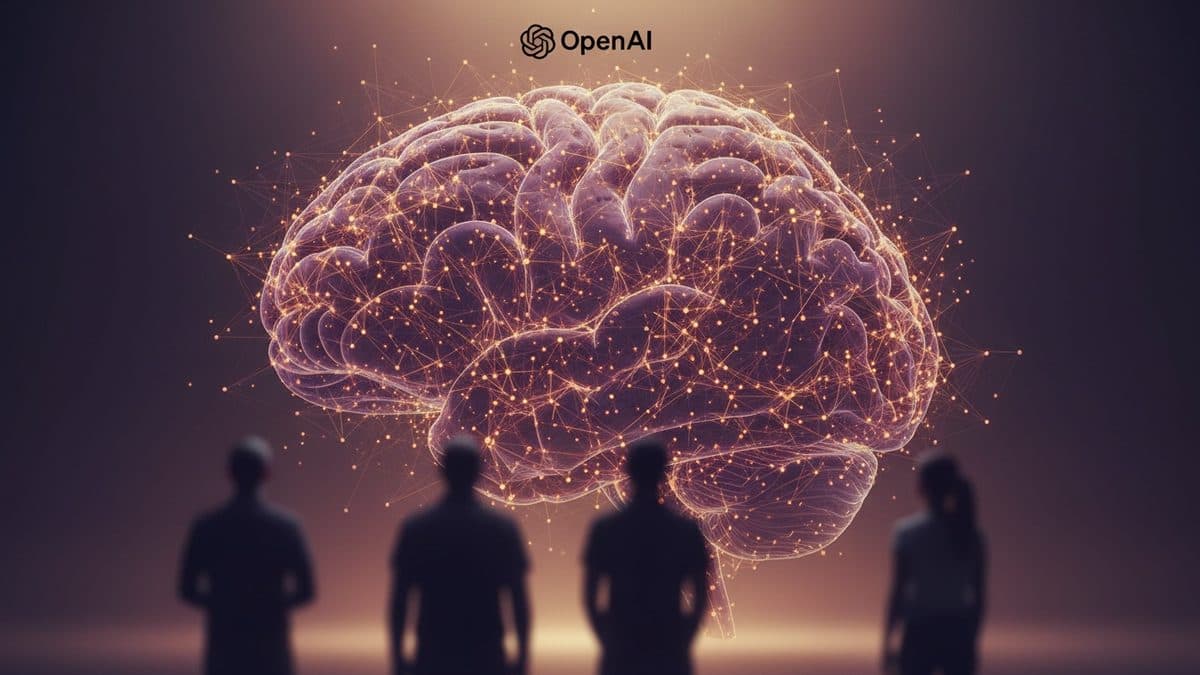
In partnership with PerturbAI and Scripps Research, OpenAI split the analysis of a genetic atlas of mouse brains among thousands of agents running in parallel. The result matters to anyone who designs agent systems, not just to biologists.
OpenAI published, together with startup PerturbAI and the Scripps Research institute, the results of an experiment that tackles a problem common to anyone who works with data at scale: how to extract useful signal from a dataset too large for a human team to fully review. The paper came out on bioRxiv on October 15, 2026, and OpenAI treats the case as a proof of concept for an agent architecture that goes beyond the lab.
The starting problem is concrete. Modern biology experiments make it possible to alter thousands of genes and measure the effect on millions of cells at once, but connecting this volume of results to already published scientific knowledge (scattered across decades of literature) is a bottleneck that no research team can solve on its own in a reasonable time. It's the same kind of bottleneck that shows up in any pipeline that generates more data than there are people available to interpret it.
The experiment: a reasoning atlas in 32 minutes
The team used thousands of AI agents based on a model called GPT-Rosalind to process a whole-brain CRISPR atlas of mice, previously published by Scripps Research and available on Hugging Face as perturbai/wholebrain_crispr_atlas. This atlas records how disrupting individual genes alters the behavior of different cell types in the brain.
Each agent received a specific genetic perturbation, analyzed the associated cellular response, searched for relevant scientific papers, and proposed a biological explanation for the observed pattern. The reports from all the agents were then combined into a single artifact, called a reasoning atlas, linking genes, cellular effects, cited publications, and proposed biological mechanisms.
According to OpenAI, a comparable human analysis, perturbation by perturbation, would take months to a year. The agents reproduced findings that human researchers had already validated and also surfaced additional leads, with novelty and scientific relevance assessments that matched the judgment of experts in blind review.
One experiment, two agent designs
The most interesting part of the material, for anyone who builds agent systems, isn't the biology: it's a controlled test the team itself ran to compare two architectures, keeping the model and computing budget fixed.
On one side, a single agent received the entire dataset and had to process it alone. On the other, the work was sliced among thousands of agents, each responsible for a small fraction of the problem. The result was asymmetric:
- The single agent, at the largest workload tested, cited only 11 references from the scientific literature.
- The distributed agents, working in parallel on the same workload, cited more than 700 references in total.
- In blind comparisons, human experts preferred the distributed agents' reports 75% of the time.
The explanation is predictable for anyone who has already run into context limits: stacking everything into a single agent degrades the depth of each search, because the model has to spread its attention across more signal than it can go deep on. Slicing the problem into smaller units, each with dedicated context and a specific search question, preserves the depth of each individual investigation, even if the total inference cost goes up.
Two findings that show the practical value
The OpenAI material details two examples of how this process generated concrete hypotheses, not just aggregate statistics.
The agents identified an unexpected difference between the genes Tsc1 and Tsc2, which together regulate the mTOR pathway (important for controlling cell growth and aging). Disrupting either one produced similar effects across several groups of neurons, but in the cerebellum, Tsc2 disruption altered the activity of dozens of genes linked to neuronal communication while Tsc1 barely changed anything. This matches the clinical observation that cerebellar abnormalities in patients with tuberous sclerosis are strongly associated with mutations in TSC2, not TSC1. The finding gives researchers a more specific cellular target to test in the lab.
The second example involves the gene DCTN1, whose mutations cause Perry syndrome, a neurodegenerative disease with Parkinson's-like symptoms. Disrupting Dctn1 in the atlas, the agents noticed increased expression of genes linked to cholesterol production and connected that observation to literature suggesting that cholesterol transport problems force the cell to produce more of it. That turned into a testable hypothesis: does the DCTN1 failure change cholesterol distribution within the neuron, and would correcting that distribution protect the cell? Human experts considered the hypothesis novel and relevant enough for future investigation.
We build cell atlases so that other scientists can make discoveries we haven't imagined yet. AI could help more researchers explore these resources and turn unexpected observations into new questions to test.
Sarah Teichmann, Ph.D., Chair in Stem Cell Medicine at the University of Cambridge and founding co-chair of the Human Cell Atlas
What generalizes beyond biology
The architecture OpenAI describes is, in essence, a fan-out-and-aggregate pattern: split a large dataset into atomic units, assign one unit per agent with a search tool available, and then consolidate the individual reports into a single, navigable artifact. There's nothing in this design specific to molecular biology.
The same pattern applies to any scenario where a team has more data than manual review capacity: security log analysis, code auditing in a giant monorepo, support ticket triage, or pattern mining in product databases. The lesson from the 11-versus-700-references test is the most transferable part: before pushing a single agent's context to its limit, it's worth testing whether slicing the problem into smaller agents, with narrow scope and their own search, produces a deeper result for the same inference cost.
Sometimes the clues are already there, scattered across different fields—we just haven't connected them. The possible link between neuronal function and cholesterol metabolism shows how those pieces, once brought together, can give us a new way to think about disease biology.
Tomasz Nowakowski, Ph.D., associate professor of neurological surgery at UCSF
Where the code is and what remains open
OpenAI published the reasoning atlas resulting from the experiment in the jinlabneurogenomics/distributed_agent repository on GitHub, letting other researchers compare related genes and investigate unexpected responses without repeating the analysis from scratch. The raw dataset remains available at perturbai/wholebrain_crispr_atlas on Hugging Face, and the full paper is on bioRxiv.
The material doesn't detail the computational cost of running thousands of agents in parallel, nor how much the process cost in API calls, which is a relevant gap for anyone trying to reproduce the approach in another domain: the quality gain shown (700 references versus 11) doesn't come for free, and deciding whether it's worth the cost depends on the data volume and how critical each false positive generated by the agents would be.
It's also clear that the final role is still human: OpenAI is explicit that scientists remain at the center of the decision process, using the agents to prioritize experiments, not to replace them. For anyone building similar pipelines outside biology, this division of labor (machine generates and prioritizes hypotheses, human validates and decides) is probably the safest design to copy, at least until there's more public data on the false-positive rate of these systems in production.
Fonte 1: OpenAI News (https://openai.com/index/scaling-ai-research-for-complex-biological-data)
Title: Using thousands of AI agents to uncover new leads in biological data
URL Source: https://openai.com/index/scaling-ai-research-for-complex-biological-data
Markdown Content: What if scientists could uncover new clues about Alzheimer's and Parkinson's in minutes instead of months? Working together, OpenAI, PerturbAI(opens in a new window), and Scripps Research(opens in a new window) used thousands of AI agents powered by GPT‑Rosalind(opens in a new window) to analyze and interpret existing experimental data from millions of mouse brain cells(opens in a new window) in just 32 minutes.
The agents connected the effects of gene disruptions with findings from scientific literature, uncovering unexpected biological connections that can help scientists understand disease and identify research directions for new treatments. The work shows how AI can help researchers explore more of what large biological experiments reveal.
Modern experiments generate far more data than scientists can thoroughly investigate. Researchers can now alter thousands of genes and measure their effects across millions of cells. But understanding what these results mean for human disease requires connecting complex experimental findings with decades of scattered scientific knowledge. This is where AI can help scientists uncover promising leads that might otherwise be missed.
"We build cell atlases so that other scientists can make discoveries we haven't imagined yet. AI could help more researchers explore these resources and turn unexpected observations into new questions to test."
—Sarah Teichmann, Ph.D., Chair in Stem Cell Medicine at the University of Cambridge and founding co-chair of the Human Cell Atlas
The team divided the analysis among thousands of AI agents powered by GPT‑Rosalind, an approach we call distributed biological reasoning. The agents examined a whole-brain CRISPR atlas(opens in a new window), a dataset showing how gene disruptions affect different types of cells across the mouse brain. Each agent investigated a gene disruption, analyzed cellular responses, searched scientific literature, and proposed explanations for the results. Their reports were combined into a reasoning atlas linking genes, cellular effects, relevant publications, and possible biological mechanisms.
The research team estimated that comparable human analysis and literature review, conducted one perturbation at a time, would take months to a year. The agents reproduced findings from human analyses while uncovering additional leads. Their assessments of novelty and scientific value also aligned with judgments from blinded human experts. These findings help prioritize further experiments needed to test the proposed biological mechanisms.
Some of these insights point to new leads for understanding brain disease. The agents identified unexpected differences in how two disease-linked genes affect brain cells differently, as well as a potential connection between cholesterol regulation and neurodegeneration. These findings could help scientists investigate how disease develops and where future treatments might intervene.
"Sometimes the clues are already there, scattered across different fields—we just haven't connected them. The possible link between neuronal function and cholesterol metabolism shows how those pieces, once brought together, can give us a new way to think about disease biology."
—Tomasz Nowakowski, Ph.D., associate professor of neurological surgery at UCSF
Researchers can begin exploring these findings today. The reasoning atlas is available(opens in a new window), allowing scientists to compare related genes, investigate unexpected responses, and identify promising leads to pursue. New discoveries often emerge when researchers from different fields bring their expertise together and connect familiar ideas in unexpected ways. AI can significantly scale these connections by linking new data with knowledge scattered across disciplines. The opportunity goes beyond analyzing data faster. By combining AI with experimental biology, human expertise, and scientific literature, we can help scientists turn more of their data into testable ideas.
Big experiments, unexpected clues
Some of an experiment's most interesting clues lie outside the story scientists set out to investigate. In a dataset spanning thousands of perturbations, those clues can be easy to miss.
The agents identified an unexpected difference between Tsc1 and Tsc2, two genes that work together to control mTOR, a major regulator of cell growth, metabolism, and aging. Disrupting either gene had similar effects in several groups of neurons. But in the cerebellum, which helps coordinate movement, Tsc2 disruption altered the activity of dozens of genes involved in neuronal communication, while Tsc1 disruption produced little change.
That difference may be relevant to human disease. In people with tuberous sclerosis, abnormalities in the cerebellum are strongly linked to TSC2 mutations. While medicines that reduce mTOR activity can treat certain brain tumors and seizures, learning and behavioral difficulties associated with the disease remain challenging to address. The agents pinpointed a specific group of neurons and cellular changes worth investigating: which changes might existing medicines correct, and which might point to new treatment approaches? This gives researchers a more specific set of questions to test in the lab.
Divide the work, deepen the reasoning
Could a single agent given the entire dataset do just as well as thousands of agents working in parallel? We tested this while keeping the model and resources fixed. As the workload grew, the single agent searched less of the literature, citing only 11 references at the largest workload, while the distributed agents cited more than 700 references. Human experts also preferred the distributed-agent interpretations.
Scientists have limited time and often focus on the strongest signals in their data. Distributed agents can help examine a wider range of responses, including subtle or unexpected ones, and connect them with relevant scientific literature. Running the agents in parallel allows many perturbations to be investigated at once. This helps scientists explore more of what an experiment contains and identify promising leads that might otherwise be missed.
_At the largest workload, distributed agents cited more than 700 references, compared with 11 for a single agent._
Finding the next experiment worth doing
A finding becomes more valuable when it points to an experiment worth doing. The agents found one such lead in _DCTN1_, a gene whose mutations cause Perry syndrome, a neurodegenerative disease with Parkinson-like symptoms.
DCTN1 is involved in moving cargo inside neurons. In the whole-brain CRISPR atlas, disrupting Dctn1 increased the expression of genes involved in making cholesterol. The agents connected this observation with research suggesting that problems with cholesterol transport may cause cells to make more cholesterol. This raised a question for follow-up experiments: could DCTN1 disruption change how cholesterol is distributed within neurons, and could those changes contribute to neurodegeneration? If so, could restoring normal cholesterol distribution help protect neurons?
Human experts also considered this hypothesis novel, consequential and worth following up on. This example shows how connecting an unexpected result with existing knowledge can turn a clue into a testable idea, and potentially a new direction for treating disease.
In blinded comparisons, human experts preferred distributed-agent reports over single-agent reports 75% of the time.
Scientists remain at the center of discovery. By uncovering more promising leads, AI can help researchers decide which ideas to pursue, design experiments, and interpret results. The goal is to turn more of the information in biological experiments into knowledge that, over time, can help guide the development of better medicines.
Translated from the Brazilian Portuguese original · Read the original
IBM updates Granite Speech family with open-source transcription, translation, and speaker identification
IBM released version 5.0 of Granite Speech and updated two sibling models, covering everything from fast transcription to identifying who is speaking in recordings with multiple people, all under the Apache 2.0 license.