

 Redação iMastersNewsroom
- Reading
- 4 min
The firm founded by Mercado Livre's founders closed a record fundraise to finance early-stage startups in the region, with a stated focus on artificial intelligence applications and infrastructure.
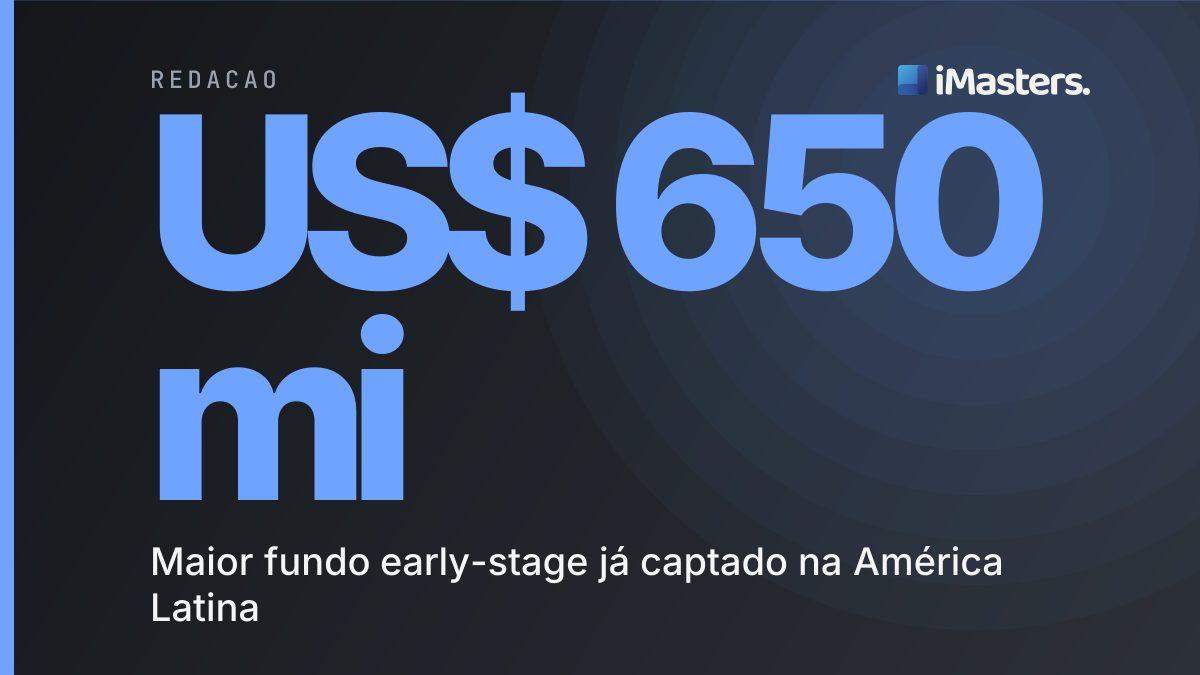
Kaszek Ventures, the venture capital firm founded by Mercado Livre founders Hernán Kazah and Nicolás Szekasy, has completed the raise of its seventh fund aimed at early-stage startups. According to a report by Brazil Journal, the vehicle raised $650 million, making it the largest early-stage fund ever raised in Latin America.
The fundraise began in September and lasted about two months, less time than a cycle of this magnitude usually takes. Managing partner Santiago Fossati told Brazil Journal that the initial target was $600 million, but investor demand led the firm to expand the final size. The fund has not made any investments yet: the first capital call is scheduled for early 2027.
Who's putting up the money
The contributions came from university endowments, trusts, foundations, and family offices concentrated in the United States, Europe, and Asia. Among the largest checks are the endowment of Washington University in St. Louis and the Wellcome Trust, a British philanthropic institution dedicated to funding scientific research. No single investor holds more than 10% of the vehicle, which preserves the firm's independence in deciding where to allocate capital.
This cap table design for the fund itself matters to outside observers: it shows that the money comes from patient capital, willing to wait for the long-term return typical of venture capital, rather than from players seeking quick returns. For an early-stage founder, this translates into less short-term pressure coming from the investing fund's side, although the pressure for results within each round remains intact.

Expert views
What people are saying about it.
Oracle's November 2026 CSPU brings ten fixes for MySQL, three of them exploitable over the network without login. Percona has already merged the fixes into version 8.4 and details what can be mitigated now.
Kubernetes 1.38, expected on December 16, 2026, drops environment variables used in scripts, retires a legacy cgroup mechanism, and changes swap behavior. Here's what to review before upgrading your cluster.
Vercel announced Audited ZDR, an independent audit layer that verifies, in practice, whether inference providers actually delete prompts and completions after processing.
The thesis: fewer people, more company
Fossati justified the fund's size with a specific reading of the current technology cycle:
We are living through a technological revolution like few others in human history, probably the biggest.
Santiago Fossati, managing partner at Kaszek
The practical argument behind the statement is familiar to anyone who follows the global VC market: artificial intelligence lowers the cost of building a product, which allows smaller teams to reach revenue and traction faster. Fossati told Brazil Journal that he sees "many repeat founders" and former big tech executives moving into entrepreneurship, with team quality "at an all-time high."
In practice, this changes the criteria the fund uses to evaluate a founder. When building is cheaper, an early-stage startup's competitive advantage stops being just about the product and shifts to distribution, proprietary data, and the team's execution speed, criteria that are harder to fake in a pitch meeting.
Where the capital will land
Fund VII is declaredly sector-agnostic, but the firm has signaled two areas of concrete interest in Latin America: AI applications for specific vertical problems, and infrastructure, including energy and data center development. The planned geographic allocation reserves half the capital for Brazil, with the other half split among Argentina, Colombia, and Mexico.
The plan is to distribute the funds among 25 startups, with half the capital going to initial checks and the other half reserved for follow-on in companies where Kaszek has more conviction after the first round. This model concentrates decision-making power within the firm itself: whoever gets the seed check has no guarantee of follow-on, and the metric that determines who gets the second round is controlled internally by the fund, not by an open competitive process.
What Kaszek's track record has already shown
The firm doesn't come to this fund without a track record. It co-led Nubank's seed round and remains an investor in the Brazilian digital bank, led Quinto Andar's Series A, and holds positions in Kavak, Creditas, NuvemShop, and Arq Finance. More recently, it backed Israeli company Wonderful for its entry into the Brazilian market and invested in Enter, described by Brazil Journal as one of the region's most valuable artificial intelligence companies.
These cases form the implicit argument behind the record fundraise: international investors are buying into the thesis that Kaszek knows how to identify, ahead of the competition, which Latin American founder will become a unicorn. For founders on this side raising a round, this track record means that having Kaszek's name on the cap table carries a quality signal for future rounds, but it also means competing for attention with founders who have already gone through this same firm's funnel before.
What hasn't been tested yet
Fund VII is committed money, not invested money: the first capital call only happens in early 2027, and none of the 25 planned bets had been made by the time the report was published. The thesis that AI makes building startups cheaper also doesn't solve the inverse problem, which is competition: if it's easier to build, it's easier for any competitor to build too, which could accelerate the commoditization of products that look differentiated today.
For the Brazilian founder, the practical takeaway is less about the size of Kaszek's check specifically and more about what it signals: international early-stage capital is willing to bet heavily on the region through a trusted intermediary, with an explicit thesis around applied AI and infrastructure. This increases the supply of capital available to those building in these areas, but it also raises the bar for comparison, because the firm writing the check has already seen up close what Nubank, Quinto Andar, and Enter look like before deciding on its next bet.
Translated from the Brazilian Portuguese original · Read the original