Lucas CardosoAuthor
- Reading
- 4 min
- Tables
- 1
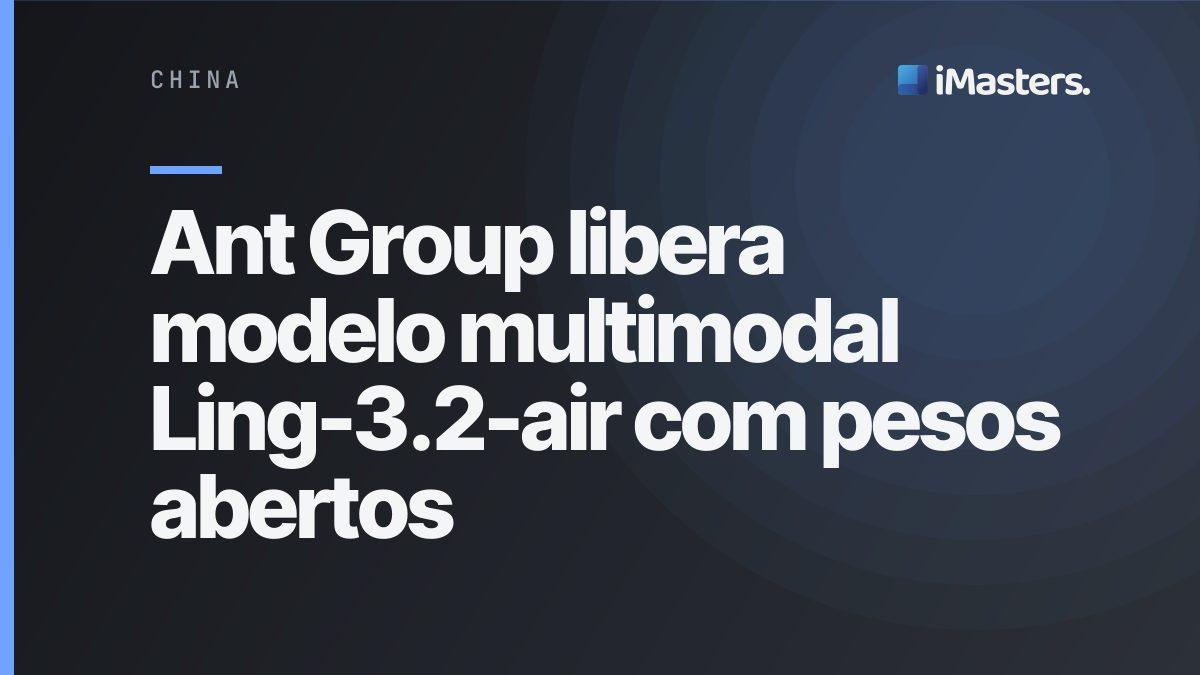
Ling-3.2-air, from Ant Group's research arm, has 124 billion total parameters but activates just 5.5 billion per token. The weights are already on Hugging Face, but running it takes more than a laptop GPU.
Ant Group, the financial arm linked to the Alibaba group and parent company of the Alipay payments app, announced Ling-3.2-air on November 24, a multimodal, open-weight model that accepts text, image, and video input. The information comes from a report by Chinese outlet IT Home and from the official model card published by the inclusionAI lab, as reported by Pandaily. The model targets code, workflow execution, and professional document reading.
Ling-3.2-air is a separate piece within Ant Group's Ling family: it should not be confused with the larger Ling-3.2-flash, nor with the medical branch LingSante. It inherits the native multimodal architecture of Ling-3.0-flash-VL, released earlier by the same team, and expands what that model already did with images to include video as input.
Inside the architecture: MoE with 512 experts
The model uses a mixture-of-experts (MoE) approach that combines linear attention with gated latent attention. In practice, this means the model has 124 billion total parameters but only activates 5.5 billion per processed token. The model card details 512 routable experts, of which eight are activated at a time, plus one shared expert that participates in every inference pass.
For anyone who has worked with Western MoE models, such as Mistral's Mixtral, the logic is the same: splitting the model into specialized sub-networks and routing each token only to the most relevant ones cuts the computational cost of inference without giving up the raw capacity of a much larger model. The context published in the deployment examples reaches 256,000 tokens, which covers long documents or extensive chat sessions without reprocessing everything from scratch.
The numbers that matter (and the ones that need a caveat)
The team published a direct comparison against Ling-3.0-flash-VL, the previous model in the same lineage:
| Benchmark | Ling-3.0-flash-VL | Ling-3.2-air |
|---|---|---|
| SWE-bench Pro | 26.40 | 58.28 |
| AutomationBench-AA | 15.7% | 61% |
| GDP.pdf (full task) | 8.4% | 16% |
These are significant jumps, but Pandaily issues a warning worth repeating: these numbers describe performance under a specific set of tasks and evaluation setups (harness), not a guarantee that real software repositories or business workflows will perform at these rates in production.
The most revealing case is the legal evaluation. The model card lists an 87.7% accuracy rate per isolated criterion, but only a 0.8% accuracy rate on the full task after applying a factual hallucination verification filter. In short: the model gets a good share of the individual points in a legal document right, but almost never delivers the entire document free of material error. For anyone evaluating generative AI for legal or compliance workflows in Brazil, this gap between partial and total accuracy is the figure that matters most, not the flashiest number.
Running this is not a laptop job
The official Hugging Face repository was created on November 23 and already brings together 13 main shards in Safetensors format, totaling about 129GB. In other words, the weights were already available for download before the Chinese announcement on the 24th was even published.
The serving documentation lists SGLang and vLLM as the recommended inference engines, with configurations for multiple GPUs. There is no suggestion of running the model on a single consumer card: the volume of active parameters (5.5 billion) helps the inference cost compared to a dense model equivalent to 124 billion, but the total size of the weights still requires memory distributed across several GPUs to load the entire model.
The model card declares an MIT license, but the repository listing checked by Pandaily does not include a standalone license file. For any team in Brazil evaluating using Ling-3.2-air in a commercial product, this inconsistency between the declaration and the published artifact is reason enough to check the license directly in the repository before assuming compliance, rather than just trusting the card's text.
What this says about the open AI race outside the US
Ant Group joins a line that already included DeepSeek and Qwen, from Alibaba itself, publishing open weights of competitive models at an accelerated pace. The Chinese pattern of open AI does not concentrate releases in a single lab: large internet and fintech groups, with the cash to train models with hundreds of billions of parameters, are competing to see who releases weights fastest and with stronger benchmarks.
For the Brazilian developer who today chooses between hosting their own model or paying for an API, this competition has a direct effect: more options for efficient MoE models for self-hosting, with more predictable inference costs than a dense model of the same size. It's the same reasoning that led part of the market to adopt Mixtral instead of equivalent dense models, except now with one more Chinese provider at the table, alongside Meta (Llama) and Mistral itself on the Western side.
What's still unknown
The released material does not include a direct comparison of Ling-3.2-air against Western models of similar size, nor does it detail training cost or the dataset used. There is also, as of this publication, no independent third-party report of the model running in production outside the Chinese ecosystem. Anyone evaluating Ling-3.2-air for a real project should treat the published benchmarks as a starting point, not a verdict, and test the model against their own workload before deciding.
Translated from the Brazilian Portuguese original · Read the original
Jensen Huang's return to Nvidia exposes a parallel governance track for AI founders
Ben Thompson, of Stratechery, uses Jensen Huang's ouster and return to the helm of Nvidia within two weeks to argue that AI companies will concentrate power in a few technical leaders, not in management hierarchies.