6 min read
Nvidia Dropped Singapore From Its Books, Now Faces SEC Accounting Investigation
 Vanessa GuerraAuthor
- Reading
- 6 min
The SEC is examining possible irregularities in Nvidia's accounting after the company changed how it discloses revenue by region; for anyone evaluating AI assets in M&A, the case is a practical lesson in due diligence.
The U.S. Securities and Exchange Commission (SEC) has opened a civil investigation into Nvidia, first reported by the Wall Street Journal on November 17, 2026. Three days later, Reuters added a detail that changes the weight of the case: according to two sources cited by the news agency, the SEC's enforcement staff is examining possible irregularities in the company's accounting practices, not just the quality of its disclosures to investors.
For anyone sitting on an M&A committee or weighing an investment check in AI infrastructure, the Nvidia case isn't just another market headline. It spells out, by name, a risk pattern that any founder should learn to spot before signing a term sheet: a change in accounting criteria, revenue concentration in a geopolitically risky jurisdiction, and circular financing between supplier and customer.
What the SEC Is Targeting
It's still unknown when the investigation began or which specific accounting points are under review. There is also no confirmation that Singapore's removal from the balance sheet or Nvidia's relationship with customer Megaspeed are among the SEC's formal targets. Nvidia did not respond to Reuters' requests for comment, and the SEC has not publicly commented on the case.
The market reacted before any official response. Nvidia shares fell about 13% on Friday, November 20, according to LSEG data, and the crisis has already wiped out more than a third of the company's stock value from its recent peak. It's the kind of drop that turns a still-unresolved regulatory inquiry into a risk-repricing event, which matters directly to anyone negotiating the valuation of assets tied to the AI supply chain.
The Accounting Trick That Made Singapore Disappear
Until last year, Nvidia allocated revenue by region based on customers' billing addresses. The company changed the criterion to consider the headquarters of the buying companies instead, arguing that this would better reflect the real origin of sales. The practical effect was dramatic: Singapore, which at one point accounted for nearly half of Nvidia's global revenue, simply disappeared from the balance sheet.
This kind of change in criteria isn't illegal on its own, companies revise reporting methodology all the time. The problem for anyone evaluating a tech asset in due diligence is different: a change in accounting criteria can, in practice, erase from the investor's radar exactly the jurisdiction where regulatory risk is highest. Before the change, it was possible to see how much of Nvidia's revenue depended on a route that would, months later, become the target of an investigation into chip smuggling to China.
Megaspeed, Alice Huang, and the Trail to China
Megaspeed is headquartered in Singapore and has historically been a significant Nvidia customer, according to sources cited by Reuters. The company was run by Alice Huang, whom U.S. authorities suspect of being a Chinese spy, and whose relationship with former CEO Jensen Huang (no relation, despite sharing a surname) brought down the chipmaker's leadership. Huang resigned on November 12, 2026, after admitting, in a statement on November 8, to an extramarital affair without naming the partner.
The U.S. Departments of Justice and Commerce said this week that they have been investigating Megaspeed since 2024 over suspected export control violations, involving the alleged shipment of Nvidia AI chips to China. Megaspeed says Alice left the company in August 2025 and conducted "legal business"; Reuters was unable to reach her to confirm the account.
Southeast Asia became a smuggling route for advanced chips into China after the Joe Biden administration banned the export of this type of equipment to the country, over concerns it would strengthen Beijing's military capabilities. There is, so far, no confirmation that the SEC is specifically investigating the Nvidia-Megaspeed link. But the coincidence between Singapore's accounting disappearance and a corporate espionage scandal is exactly the kind of pattern due diligence teams should flag beforehand, not after the fact.
Circular Financing: The Risk Every AI Founder Needs to Understand
The SEC investigation comes at a time when analysts are already questioning so-called circular AI financing deals. In these arrangements, chipmakers like Nvidia put together complex financial structures to help their own customers pay for the chips and the data center infrastructure that uses them. Nvidia has invested directly in AI companies and cloud providers, and has backed guarantees for data center projects built around its hardware.
The valuation problem is straightforward: when the supplier finances the customer buying the supplier's product, it becomes harder to separate real demand from capital-induced demand. This affects any founder or investor trying to price:
- an AI infrastructure startup whose revenue depends on a few customers financed by the same hardware supplier;
- a data center asset whose long-term contract has cross-guarantees with the chipmaker;
- an investment round where the lead investor is also a strategic supplier to the invested company.
Colette Kress, interim CEO and Nvidia's former CFO, said on the November 17 earnings call that the company is proud to support the AI industry, but signaled that going forward it will be far more selective about these kinds of deals. David Woodcock, the SEC's head of enforcement, had already told Reuters last month that the agency is examining AI companies' disclosures to ensure investors get a full picture of the risks.
What This Means for Buy-Side Players
Nvidia isn't the only open front: the U.S. Department of Justice is also reviewing the company's $12.9 billion acquisition of Hugging Face, the open-source AI platform, as part of a broader antitrust investigation into the company's acquisitions and practices. In other words, the same buyer that concentrates pricing power in the AI supply chain is now under three simultaneous regulatory fronts: accounting, export controls, and antitrust.
For a founder or investor evaluating assets adjacent to Nvidia, whether a GPU customer, a supply chain vendor, or a startup it has financed, the right question for the CFO or the board isn't "is the company profitable?" It's more specific:
- Does the revenue reported by region reflect where the end customer operates, or where it has its tax headquarters?
- Is any strategic supplier also an investor in or financier of the company?
- Has there been a recent change in accounting criteria that reduced visibility into a geopolitically risky jurisdiction?
- How much of the revenue depends on cross-guarantees or financing arrangements with the infrastructure supplier itself?
It's worth noting that the SEC, under the Trump administration, has reduced the overall volume of enforcement actions, but recently created a dedicated financial reporting and accounting unit within its enforcement division, specifically to build accounting and audit cases. This means accounting violations remain a regulatory priority even with fewer total cases, which changes the regulatory risk calculus for anyone structuring a cap table or an M&A deal backed by AI assets.
What Remains Unresolved
There is no public confirmation that the SEC is in fact investigating Singapore's disappearance from the books or the relationship with Megaspeed, nor any timeline for concluding the inquiry. Nvidia still has not directly addressed the scope of the investigation. What is already clear, regardless of the regulatory outcome, is that the combination of a change in accounting criteria, geographic revenue concentration, and circular financing between supplier and customer is a replicable risk pattern in any AI infrastructure deal, not a Nvidia-specific quirk. Anyone on the buy side of a tech deal would do well to treat this case as a checklist, not a market headline.
Translated from the Brazilian Portuguese original · Read the original
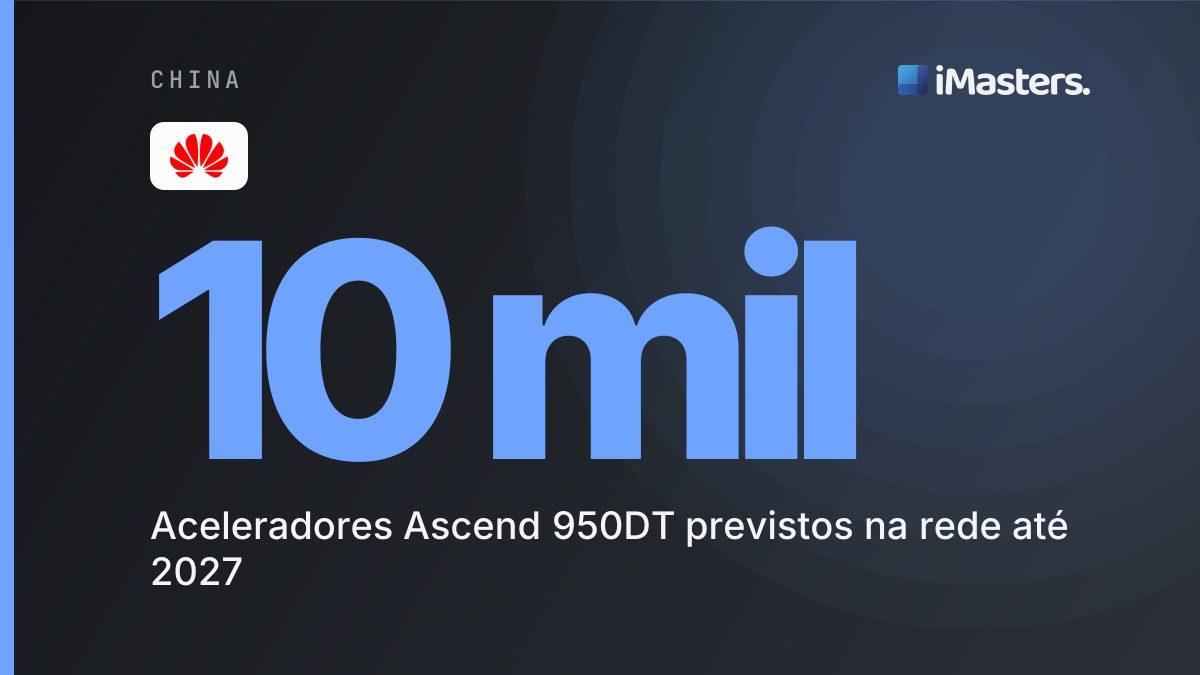
Qingmao Intelligence plans to federate 10,000 Ascend 950DT accelerators by 2027
China's Qingmao Intelligence detailed a joint operation model that combines Huawei's Ascend 950DT chips, third-party data centers and service-level agreements to sell inference as a single service. The goal is to reach 10,000 cards by 2027 and 100,000 in five years, but the plan is not yet operational.