Resumos de IA cortam o tráfego de notícias e ameaçam quem vive de SEO
- Reading
- 7 min
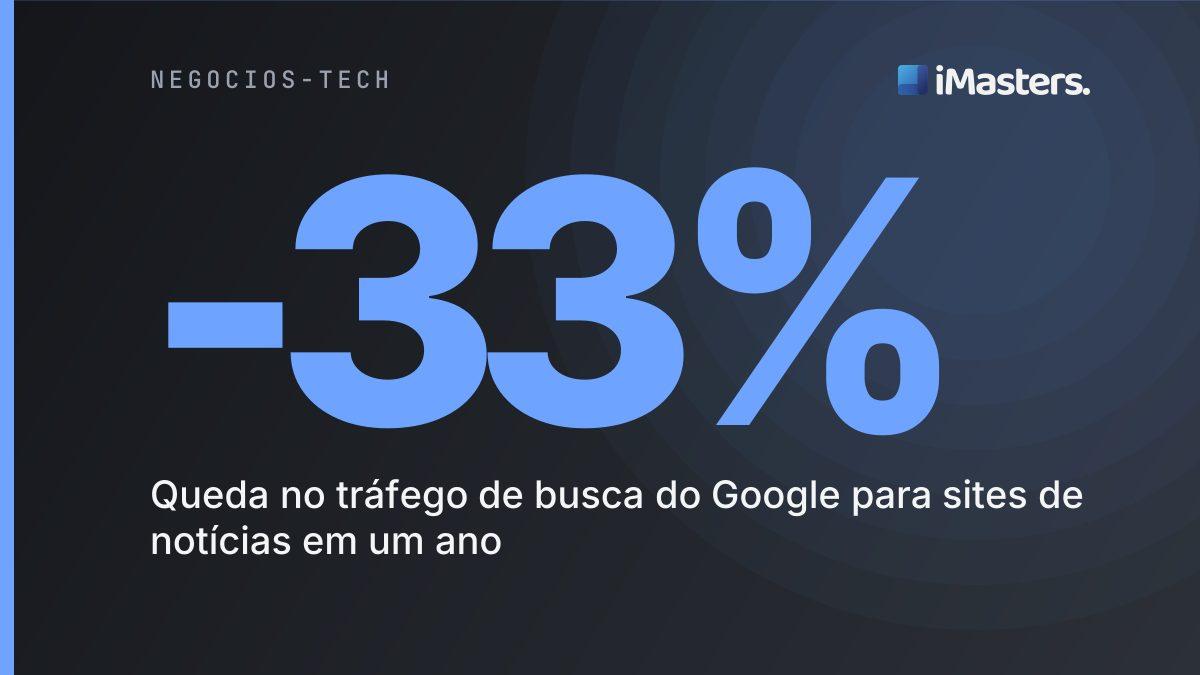
A Reuters Institute survey shows a drop of about a third in search traffic to news sites in one year. The same mechanism that is emptying newsrooms is already pressuring any business that depends on organic clicks to grow.
The fact every founder should be watching
Between November 2024 and November 2025, traffic from Google search to news sites fell by about a third worldwide. The figure comes from the Journalism, Media and Technology Trends and Predictions 2026 report, from the Reuters Institute at the University of Oxford, which projects a further 43% drop over the next three years.
A Pew Research Center survey in the United States shows that when search displays an AI-generated summary, the click rate on a traditional link drops from 15% to 8% of visits. On links cited within the summary itself, the click all but disappears: just 1%.
Anyone reading this story as a "journalism crisis" is only seeing half the problem. Journalism is the sector where the effect showed up first because it's the sector most exposed to search as an acquisition channel. But search as an acquisition channel is exactly what sustains much of the content marketing, SEO, and organic distribution of any B2B or B2C startup that has never paid a cent for media to grow.
The same economics that sustained the newsroom sustains your corporate blog
If the user is satisfied with the summary before clicking on a story from a major outlet, they are just as satisfied with the summary before clicking on the blog post a startup wrote to rank on Google. The yardstick is the same: content that AI can summarize well loses its reason to exist as an entry point.
This hits directly at the CAC of any business that builds its top-of-funnel on SEO. Educational content, product comparisons, tutorials, "what is X" pages made to capture long-tail search: this is precisely the type of material a chatbot summarizes effortlessly, without the user ever needing to leave the app.
The Reuters Institute records the same shift on the publishers' side: newsrooms plan to cut back on general news, service content, and evergreen text (the type of piece easiest to summarize) and invest in investigations, analysis, and stories that require human reporting. It's the rational reaction to a channel that has stopped converting. A founder building a 2027 content strategy with 2021 SEO logic is optimizing for a channel that is being emptied out right in front of them.
GEO: the new race, with a trap built in
The market's answer has a name: GEO, for Generative Engine Optimization, the set of practices to get a piece of content found and cited inside an LLM's response, not just listed as a blue link. Researchers from Princeton and other institutions, in a paper presented at the KDD conference in 2024, showed that including citations, statistics, and sources can increase a piece of content's visibility in these responses by up to 40%.
The number is real, but the temptation it creates is dangerous for whoever decides content budget. Producing, at scale, texts designed to please the model, with no reporting or proprietary data behind them, is the 2026 version of the shallow keyword-optimized content that already didn't work even for traditional SEO. The difference is that now the final judge isn't a ranking algorithm, it's a model that decides whether to cite the brand or cite the competitor.
In short: GEO is not a shortcut, it's a more demanding quality criterion. Proprietary data, case studies with real numbers, and citable sources weigh more than volume of posts.
The Folha-OpenAI precedent: a lead on monetization, not a ready-made solution
There's a legal and commercial path being tested right now, and it matters for any founder sitting on a valuable data set or body of content. In August 2025, Folha de S.Paulo (one of Brazil's largest newspapers) sued OpenAI for unfair competition and copyright infringement. In May 2026, Folha and UOL (a major Brazilian news and internet portal) reached a content agreement with the company that ended the lawsuit. Three months later, Folha took Perplexity to court.
The pattern that emerges is: litigate to negotiate, and negotiate to license. It's a model replicable for any company whose content, data, or user base feeds a model without compensation. But the very sector that has already gone through this isn't optimistic: only about 20% of the executives surveyed by the Reuters Institute expect meaningful revenue from these deals, and confidence in the future of journalism has fallen from 60% in 2022 to 38% today.
The takeaway for anyone thinking about M&A or digital product valuation is direct. If even outlets with decades of brand and data volume can't turn licensing into a robust revenue line, a startup shouldn't design its business plan assuming it will monetize data through a deal with an AI big tech company. It's a possible upside, not a revenue thesis.
When the model gets your brand wrong
There's a quality problem built into this transition that directly affects reputation, not just traffic. A study coordinated by the European Broadcasting Union (EBU) and led by the BBC, with 22 public broadcasters from 18 countries, evaluated more than 3,000 AI assistant responses about news. In 45% of them there was at least one significant problem, and in 31% there was a serious source attribution failure.
Translating that into the world of anyone building a brand: the model that summarizes what the press publishes about a product, a funding round, or a customer service controversy gets it wrong almost half the time, and almost no one is going to check the original source. This means monitoring what AIs say about the company needs to become routine, at the same priority level that monitoring social media mentions already is today.
The counterargument that deserves to be taken seriously
The strongest objection to this alarm is the following: every shift in distribution channel creates losers and winners, and whoever moves fast toward GEO could come out ahead with a lower acquisition cost than the bidding war over SEO and paid media that had already been saturated for years. It makes sense: Google Ads got more expensive with every cycle, and if AI models are going to decide who gets cited, arriving early with well-structured content, backed by data and sources, could be cheaper than fighting over keywords in a crowded auction.
The counterargument is valid, but it has a clear limit: it describes a positioning advantage, not a guaranteed revenue channel. The Pew study itself shows that even content cited within the summary converts into a click only 1% of the time. Winning the citation in the model doesn't solve the underlying problem, which is the structural drop in the volume of traffic reaching any site. GEO helps you avoid disappearing from the conversation; it doesn't replace the revenue that traditional search has stopped delivering.
Human oversight as risk control, not ethics talk
A 2025 study by Microsoft Research with Carnegie Mellon University, involving 319 professionals who use AI at work, identified a direct pattern: the greater the trust in the tool, the lower the critical-thinking effort of whoever uses it. For a founder, this is a governance problem, not a philosophical one.
If the marketing team starts trusting the summary that the AI itself makes of the competition, the press, and the market without checking the source, the company ends up making strategic decisions on top of an intermediary that gets it wrong in almost half of its responses about news, according to the EBU and BBC study cited above.
What changes on the agenda of whoever decides budget
Three concrete moves come directly out of this analysis, and none of them depend on waiting for the AI market to settle down:
- Reduce dependence on SEO as the sole acquisition engine, redirecting part of the budget to owned channels (email list, community, direct partnership with a media outlet);
- Monitor what the leading LLMs say about the brand, the product, and the competition, with the same discipline as social listening;
- Prioritize, in the content that's still worth producing, proprietary data and real case studies, because that's exactly what an AI summary has the hardest time reproducing and what the Princeton study links to a higher citation rate.
None of these actions solves the underlying problem described by the Reuters Institute. But all of them reduce a business's exposure to a channel that is losing traffic faster than any marketing team can compensate for with incremental optimization.
Translated from the Brazilian Portuguese original · Read the original


Work Trend Index 2026: 72% of Brazilians gain tasks with AI, but only 16% are rewarded
Microsoft survey of 20,000 professionals shows that Brazil leads in AI anxiety and also in task accumulation, but financial recognition remains rare. For company leaders, this is a turnover risk, not a culture detail.