CRSC obtains license for cell-free 4.9GHz base station in China
- Reading
- 4 min
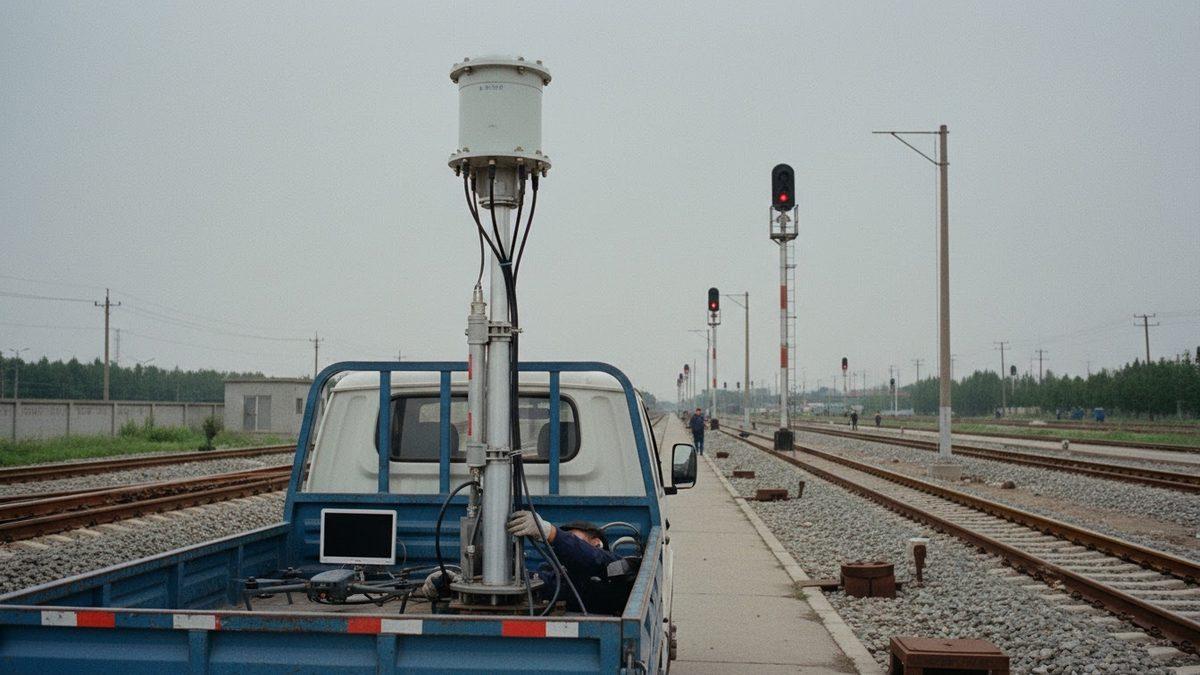
State-owned rail signaling maker CRSC says a cell-free base station, aimed at drones and emergency networks, received a license from MIIT. The approval is for equipment, not the launch of a national 6G network.
China Railway Signal & Communication Corporation (CRSC), the state-owned company responsible for signaling China's rail system, reported that a subsidiary dedicated to low-altitude technology obtained a network-access license from the Ministry of Industry and Information Technology (MIIT) for a mobile base station operating at 4.9GHz with a cell-free architecture. The information was disclosed in Chinese reports published on November 21 and picked up by Pandaily.
CRSC classifies the equipment as the first cell-free 4.9GHz base station licensed in China. It's worth noting the limit of that claim: it is the company's own assertion, not an independent comparison against the full record of MIIT approvals. What the license certifies is a specific telecommunications product, not the start of a commercial 6G network operating in the country.
What changes in a cell-free base station
Traditional mobile networks work through cells: each antenna covers an area, and the terminal switches cells (handover) as it moves, which can cause interruptions and signaling spikes at coverage edges. The cell-free architecture eliminates that rigid division. Multiple access points are connected by high-speed links and process the signal jointly, so that a moving terminal is served by a group of nearby antennas, with radio resources coordinated around the user rather than around a fixed cell.
According to CRSC, this coordination can improve signal continuity at coverage edges, better distribute simultaneous connection requests, and reduce the signaling and interruptions associated with frequent handovers between cells. These are engineering benefits described by the company, not independent measurements proving uniform performance across any terrain or mobility condition.
Where it was tested: low-altitude flight in Qingdao
The use case cited by CRSC is Qingdao's low-altitude air traffic management project, with equipment installed on the city's TV tower. The company describes applications in:
- low-altitude drone logistics;
- inspection in protected metropolitan areas;
- inter-island logistics;
- coastal patrol.
The technical justification is that public network signal tends to weaken above 120 meters in altitude, a range where many commercial and inspection drones operate. CRSC says the system helps cover that gap, but that is not the same as claiming universal aerial coverage: it is a one-off solution for a specific project, not a national connectivity standard for unmanned aircraft.
The topic connects with a discussion also underway in Brazil, where DECEA (Brazil's airspace control department) and ANAC (Brazil's civil aviation authority) have been drafting traffic rules for drones flying beyond visual line of sight, without dedicated telecommunications infrastructure yet equivalent to what was tested in Qingdao.
Emergency communication: the storage-tank fire exercise
For emergency scenarios, CRSC describes the rapid formation of a private network to carry command, video, and coordination traffic between response teams. The example cited in the reports is a storage-tank fire-response exercise.
It is important not to overstate this: a simulated exercise demonstrates technical feasibility under controlled conditions, but it is not evidence of uninterrupted operation in a real disaster, nor of resilience against every possible combination of power and backhaul failure. The gap between demonstration and operational robustness remains open until there are reports of use in real incidents.
Toward 6G, with important caveats
CRSC presents the cell-free design as a direction of evolution toward 6G, a standard still being defined by bodies such as 3GPP, with first specifications not expected until the end of this decade. A network-access license for a specific piece of equipment is not certification that a standardized, commercial 6G network is operating, nor proof of broad adoption by carriers.
Geographic coverage, compatible terminals, integration with existing infrastructure, and resilience at scale still depend on deployment decisions that are not detailed in the sources consulted. The MIIT license clears the equipment for commercial use, but it does not lay out a timeline for availability to the end consumer.
Sources, and what they guarantee
The news was carried by two Chinese outlets: IT Home, a technology portal that reproduced CRSC's announcement and application examples, and Science and Technology Daily, a state newspaper linked to China's Ministry of Science and Technology, which reported the equipment's approval. Because Science and Technology Daily is government-affiliated, its account of the license should be read as the official version of the regulatory process, not as independent verification of the technical results.
CRSC itself is a state-owned company: controlled by China State Railway Group and historically responsible for signaling across the entire Chinese rail network, including high-speed trains. That explains why a rail signaling company is developing telecommunications base stations: the low-altitude technology subsidiary was created to support critical infrastructure projects, such as TV towers and metropolitan areas, not to compete directly with traditional mobile carriers like China Mobile or China Unicom.
What is concrete, and what isn't
The verifiable fact is the equipment license granted by MIIT and the application examples cited by the company in Qingdao. The reports do not include independently measured transfer rates, nationwide coverage figures, or a date for general availability.
For those following connectivity infrastructure in Brazil, including discussions about private networks for industrial campuses, ports, and drone operations, the Chinese case works as an indicator of where radio engineering is heading: fewer isolated cells, more distributed coordination between access points. But, as in Brazil, the distance between certified equipment and a network running in production is usually greater than the initial announcement suggests.
Translated from the Brazilian Portuguese original · Read the original

MetaX adapts C-series GPUs to Tencent's Hy4 on launch day and releases FlagOS W8A8 weights
MetaX says its C550 GPUs already support Tencent's flagship Hy4 model (Hunyuan), released on November 20, and published a quantized version via FlagOS. The manufacturer's own numbers show throughput gains and worse initial latency.