The deal announced this Monday, November 23, unites the biggest name in endpoint protection with the biggest name in secure cloud access, creating a single vendor for a large share of corporate digital defense.
 Vanessa GuerraAuthor

- Reading
- 5 min
- Tables
- 1
The deal announced this Monday, November 23, unites the biggest name in endpoint protection with the biggest name in secure cloud access, creating a single vendor for a large share of corporate digital defense.
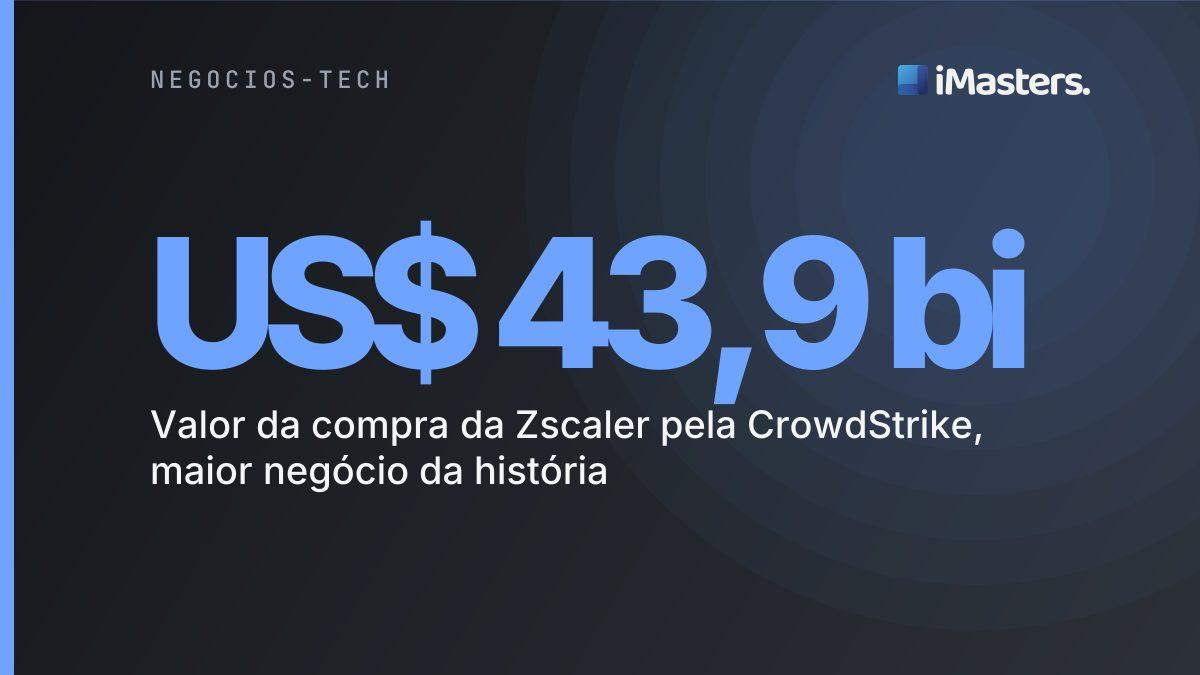
CrowdStrike announced on Monday, November 23, a deal to acquire Zscaler for $44 billion, entirely in stock, as reported by The Information. The deal brings together, under the same umbrella, two pieces that until yesterday any company bought separately: device protection (endpoint) and protection of the path to the cloud (network).
For anyone who founds or runs a technology company in Brazil, the announcement itself is just the starting point. What matters is understanding what this kind of consolidation does to price, to negotiating power, and to the risk of depending on a single vendor to protect the entire digital operation.
What each company sells, and why they fit together
CrowdStrike built its position around Falcon, the endpoint detection and response (EDR/XDR) platform that became one of the benchmarks of the corporate security market. Zscaler, in turn, is the name most associated with the concept of zero trust applied to the network: instead of a traditional VPN, user traffic passes through Zscaler's cloud before reaching any application, a model known as SASE (secure access service edge).
These are two layers of defense that today coexist in parallel at most companies: one handles what happens inside the laptop or server, the other handles what travels between the user and the application. Bringing the two together under a single contract is the promise of reducing so-called "console fatigue," the scenario in which the security team operates five or six different dashboards that don't talk to each other.
The business logic behind the $44 billion
The deal is entirely in stock, which means CrowdStrike isn't spending cash: it's diluting its own shareholders to buy growth and installed base. It's the same logic that led Cisco to acquire Splunk in a multibillion-dollar consolidation deal in security and observability, and that led Palo Alto Networks to accumulate smaller acquisitions in recent years to become a "single platform" instead of a set of products.
The stated rationale for this kind of deal tends to be the same: instead of competing item by item with specialized rivals, the buyer sells a bundled package, with a renewal discount for those who sign up for both modules and a higher exit barrier for those who have already integrated everything. In short: the more security layers a single vendor controls, the lower the chance the customer will switch vendors midway.
What still isn't certain
As of this edition's deadline, the premium paid per share, the final structure of the combined board, and the expected closing date had not been publicly disclosed, and that matters. Deals of this size in sensitive sectors usually go through antitrust review, and the precedent most cited in the technology market is Adobe's deal with Figma, a multibillion-dollar agreement that ended up abandoned after pressure from European and British regulators, who saw excessive concentration in the digital design market.
CrowdStrike and Zscaler operate in adjacent segments, not direct competitors, which in theory reduces the risk of a classic antitrust veto (horizontal concentration). But the size of the combination, $44 billion, already puts the deal on the radar of any competition authority in the United States and Europe, and the board of any company that is a customer of both companies should treat the closing as likely, not certain.
What changes for those who buy security in Brazil
For the CTO or founder who today pays separately for CrowdStrike's EDR and Zscaler's SASE, the practical question isn't whether the product will get worse, it's whether the renegotiated price will reflect the new bargaining power of the combined vendor. Three questions worth bringing to the next budget committee:
- Does the current contract with either company have an adjustment clause tied to a change of corporate control?
- Is there operational dependency (scripts, integrations, team training) that makes switching vendors expensive enough to justify accepting any post-merger price adjustment?
- What's the backup plan if the combination raises the price of the integrated package above what it would cost to keep two specialized, competing vendors?
Best-of-breed versus single platform
The choice between keeping specialized vendors and concentrating everything in a single package has no universal answer, and depends on each organization's risk appetite.
| Criterion | Separate vendors | Single platform (post-merger) |
|---|---|---|
| Customer negotiating power | Higher (competition among vendors) | Lower (only one vendor to negotiate with) |
| Operational complexity | More consoles, more manual integration | One dashboard, less day-to-day friction |
| Concentration risk | Low (vendor diversification) | High (single point of contractual and technical failure) |
| Incident response speed | Depends on integration between teams | Potentially faster, if the technical integration is real |
The table doesn't point to an absolute winner. Companies with a lean security team tend to gain more from the operational simplification of a single platform; companies with lower risk appetite for vendor concentration, or with regulatory obligations that require diversification, tend to prefer keeping two separate contracts even at the cost of extra complexity.
What remains open
The deal still depends on regulatory approval and structural details that CrowdStrike and Zscaler had not publicly disclosed by the time this column was published. Until then, any Brazilian company with a contract renewal for either company scheduled for the coming quarters would do well to treat the price adjustment clause and the termination clause as a priority in the next round of negotiations, before the new market power of the combined entity becomes an argument on the other side of the table.
Translated from the Brazilian Portuguese original · Read the original
Qingmao Intelligence plans to federate 10,000 Ascend 950DT accelerators by 2027
China's Qingmao Intelligence detailed a joint operation model that combines Huawei's Ascend 950DT chips, third-party data centers and service-level agreements to sell inference as a single service. The goal is to reach 10,000 cards by 2027 and 100,000 in five years, but the plan is not yet operational.