6 min read
Jensen Huang's return to Nvidia exposes a parallel governance track for AI founders
Ben Thompson, of Stratechery, uses Jensen Huang's ouster and return to the helm of Nvidia within two weeks to argue that AI companies will concentrate power in a few technical leaders, not in management hierarchies.
 Eduardo NogueiraAuthor
- Reading
- 6 min
- Tables
- 1
Ben Thompson, of Stratechery, uses Jensen Huang's ouster and return to the helm of Nvidia within two weeks to argue that AI companies will concentrate power in a few technical leaders, not in management hierarchies.
Two weeks, one trillion dollars
In the week ending November 24, 2026, Jensen Huang was removed from the presidency of Nvidia, and before two weeks had passed, he returned to the position. The episode, described by Ben Thompson on Stratechery in 'The Individual Exception,' echoes another case: three Thanksgivings ago (November 2023), Sam Altman was ousted and reinstated at OpenAI in the same weekend. Thompson notes the coincidence but marks the difference: Altman's departure stemmed from a poorly engineered internal coup; Huang's, according to Thompson, resulted from a more systemic campaign, driven by actors with access to the media and to the US national security apparatus.
The accusations against Huang blended two planes. On one side, his public defense of selling chips to China and his resistance to going beyond the minimum required by export control rules, including suspicions of smuggling. On the other, personal conduct, with extramarital relationships that included subordinates. Thompson is direct in separating the two: no one seemed to truly care about the second category. The real problem, for his harshest critics, was Huang's stance on China.
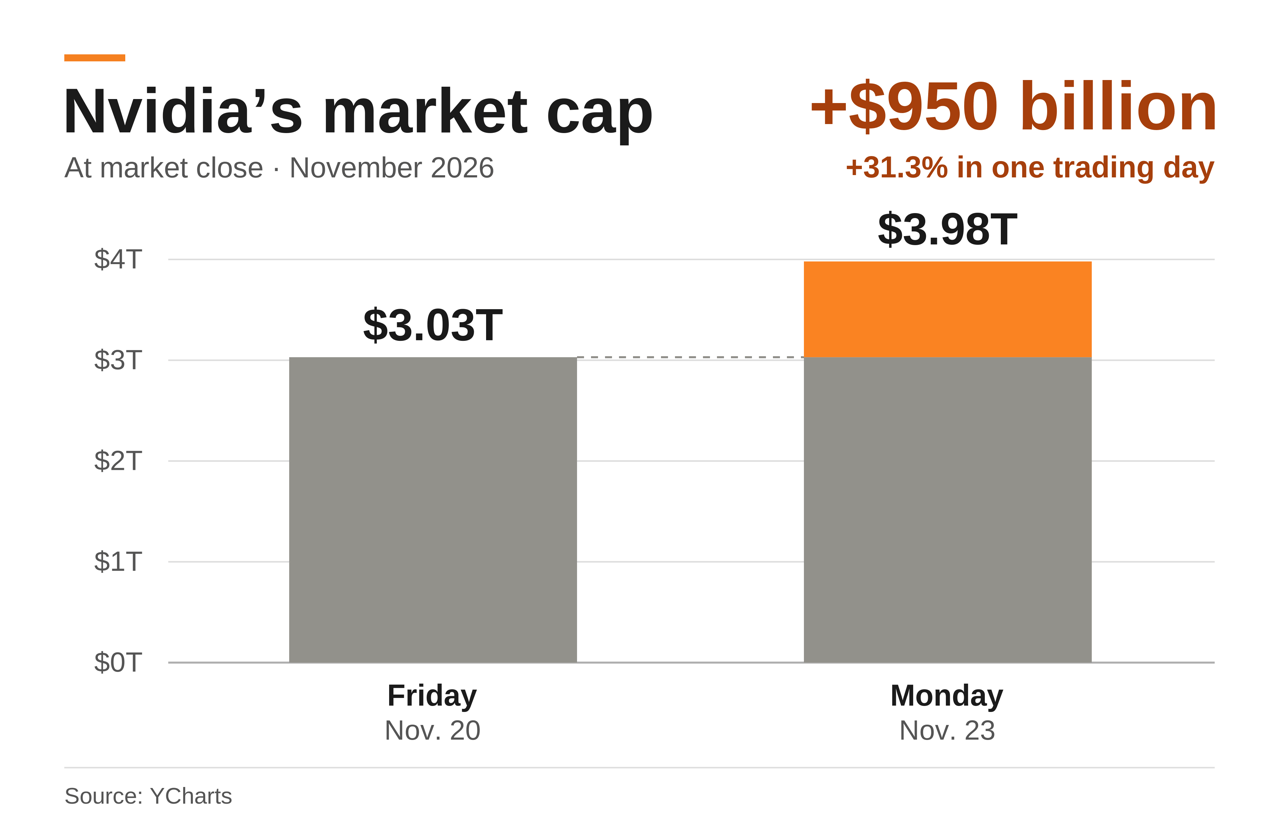
The reversal came after President Donald Trump personally called into a Nvidia board meeting to push for Huang's reinstatement. The market reacted with a jump of nearly one trillion dollars in market value on the announcement of his return alone, according to ChatGPT, which Thompson himself consulted to build his charts. To give a sense of scale: that single gain exceeds the entire inflation-adjusted market value ExxonMobil had in 2008 ($637.6 billion).
The employee who deflates the company
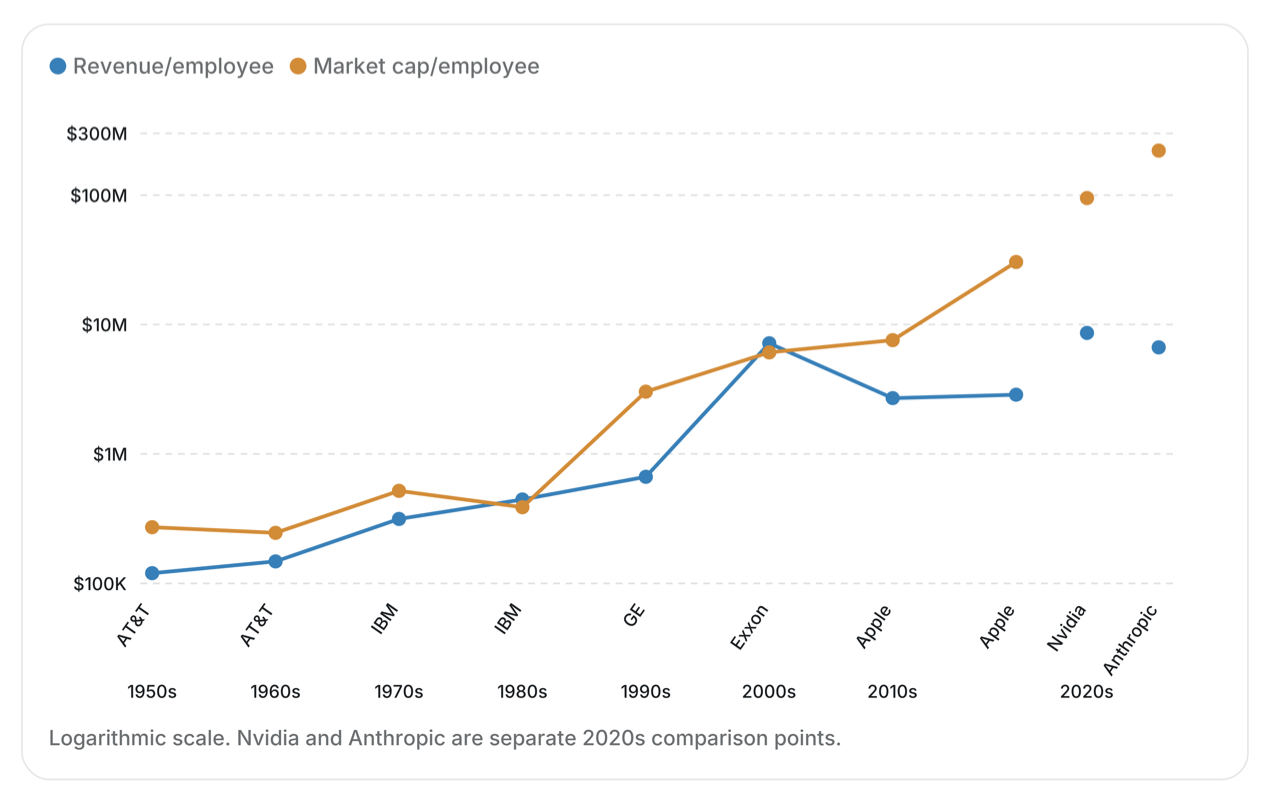
Thompson's argument does not originate from the Huang episode; he arrives there through a historical table of market value per employee. The comparison shows a reversal that has been accentuating since the 1950s, when AT&T held the world's largest market capitalization, sustained by an army of people.
| Company (year) | Real revenue | Employees | Real market value |
|---|---|---|---|
| AT&T (1959) | $87.5B | 729,000 | $198.4B |
| IBM (1979) | $106.3B | 337,119 | $174.8B |
| General Electric (1999) | $226.6B | 340,000 | $1.03T |
| ExxonMobil (2008) | $749.5B | 104,700 | $637.6B |
| Apple (2018) | $355.9B | 132,000 | $1.00T |
| Apple (2026) | $478.8B | 167,000 | $5.07T |
| Nvidia (2026) | $361.8B | 42,000 | $3.99T |
| Anthropic (2026) | $35.3B | 5,300 | $1.17T |
The numbers (in inflation-adjusted dollars, according to Thompson's research) show that Nvidia today generates $95 million in market value per employee, an order of magnitude with no direct historical parallel. Anthropic, with 5,300 people, is worth more than ExxonMobil was worth with nearly 20 times as many employees. It is this backdrop that makes the Huang case, for Thompson, not a governance accident, but a preview of how power will be distributed within AI-native companies.
Nvidia as one man's exoskeleton
Thompson draws on an earlier Stratechery interview with Tae Kim, author of the book 'The Nvidia Way,' to argue that the company was deliberately designed as the vehicle for a single vision.
I built Nvidia in a way where I could drive it, and manage it, and steer it perfectly.
Jensen Huang, CEO of Nvidia, quoted by Tae Kim in an interview with Ben Thompson (Stratechery)foto: The White House · Public domain
Kim describes Nvidia as a functional organization, not a divisional one: every specialist reports upward to Huang, who reads a hundred priority emails a day and discusses technical papers directly with senior engineers. The side effect, admitted by Kim himself, is that the structure leaves no room for generalists or for a reasonable succession plan. Removing Huang from the center is not swapping out a part; it is dismantling the engine.
In short: Thompson's thesis inverts the 85 years of 'The Managerial Revolution,' by James Burnham, which predicted that the individual entrepreneur would be replaced by technical bureaucracies in any economic system. For Thompson, AI is reversing that movement: an ever-smaller number of people, armed with agents and automation, can attack entire markets from the bottom up, as he had already argued in 2024 when analyzing the power of individual creators such as Marques Brownlee (MKBHD) over entire media and electronics industries.
The counterpoint the founder-exception defense doesn't resolve
Accepting Thompson's thesis without reservation ignores an uncomfortable detail: the piece itself admits that Nvidia held Huang to a different, and lower, standard than it would hold any other executive.
Is Huang being held to a different standard — a much lower standard, to be sure — than you or I? Without question.
Ben Thompson, Stratechery
This is the core of the governance problem that the 'you just need one individual' narrative tends to sweep under the rug. A board that bends to external political pressure (Trump's phone call) and reverses a removal decision because of the founder's economic irreplaceability is, in practice, giving up its fiduciary role in the name of innovation speed. It works as long as the individual delivers results; the systemic risk is dammed up, not resolved, for the day he truly makes a mistake or simply exits the scene, voluntarily or involuntarily.
What changes for those building AI-native companies in Brazil
The practical question isn't whether the founder deserves an exception, it's when the board (or the cap table) agrees to pay that price. For those building a lean-structure AI company in Brazil, the Nvidia case brings three concrete implications:
- Concentration of tacit knowledge becomes a valuation risk, not just an operational one: investors will price how much of the competitive advantage lives inside one person's head, and that affects the multiple and the terms of a round, not just the succession plan.
- 'Light' governance has a cost, it's not just agility: delegating less control to the board can speed up decision-making, but the price shows up exactly at the moment of crisis, when the absence of institutional checks becomes news, as nearly happened with Nvidia itself.
- The double standard needs to be explicit, not tacit: if the board of a Brazilian startup is really going to tolerate from a technical founder what it wouldn't tolerate from another executive, that should be written into the bylaws and shareholders' agreement, not decided under pressure during a crisis, as happened at Nvidia.
The Huang episode doesn't prove that every AI company should be organized around a single person; it proves that, when that happens, the market can reward it generously, but the board that allows it gets there without a safety net. For those deciding the corporate structure and board composition of an early-stage AI company, Thompson's lesson is worth reading in reverse: the value the 'individual exception' creates is real, but so is the risk it accumulates, and that risk usually doesn't show up in the pitch deck.
Translated from the Brazilian Portuguese original · Read the original

Ant Group releases multimodal Ling-3.2-air model with open weights
Ling-3.2-air, from Ant Group's research arm, has 124 billion total parameters but activates just 5.5 billion per token. The weights are already on Hugging Face, but running it takes more than a laptop GPU.