OpenAI turns ChatGPT into an app store for 800 million users
Since October 2025, OpenAI has let developers put apps inside ChatGPT via the Apps SDK. For AI startup founders, the question has become: build inside this showcase or keep your own distribution.

What OpenAI changed, and when
In October 2025, OpenAI announced that ChatGPT would start running third-party applications inside the conversation itself, not as separate plugins, but as interfaces that appear in the middle of the chat. The tool for building these apps, the Apps SDK, was released in preview in the same announcement, published on the company's official blog (openai.com/index/introducing-apps-in-chatgpt). On November 13, 2025, OpenAI updated the same post to extend the preview to ChatGPT Business, Enterprise, and Edu customers.
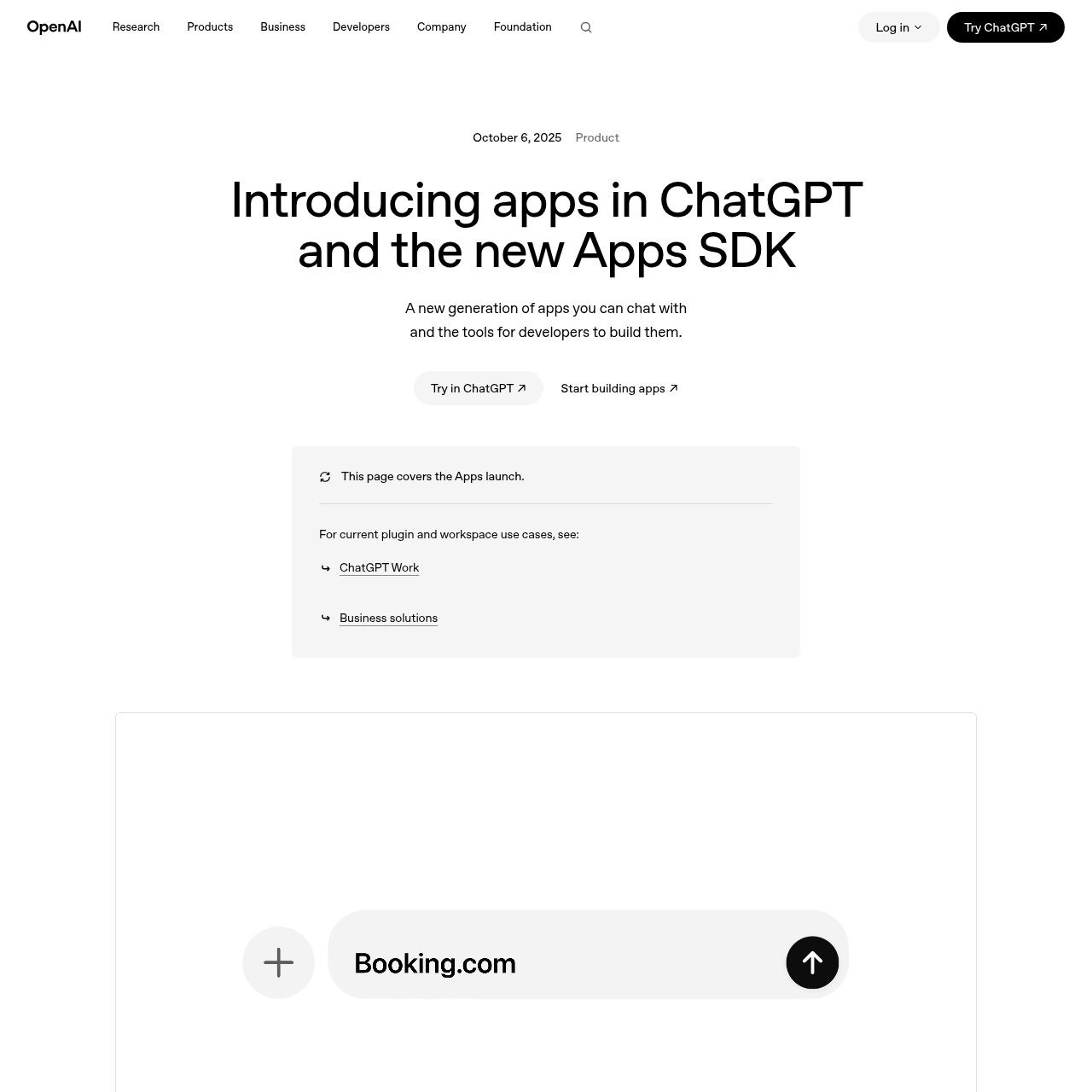
Seven partners joined the initial batch: Booking.com, Canva, Coursera, Figma, Expedia, Spotify, and Zillow, available in English in the markets where each service already operated. OpenAI stated, in the announcement itself, that the Apps SDK gives developers access to "more than 800 million ChatGPT users." It's a figure from the company itself, without external audit, but it's the baseline any founder will use to justify (or not) the investment in building for this platform.
How it works under the hood: MCP, not a proprietary plugin
The Apps SDK is not a closed OpenAI API. It extends the Model Context Protocol (MCP), the open standard that already connects ChatGPT to external tools and data, and it was released as open source. In practice, this means an app built with the Apps SDK can, in theory, run on any client that adopts the MCP standard, not just ChatGPT.
The developer writes the app's conversation logic and visual interface, and connects everything to their own backend, including login and paid features that already exist in the product. Two discovery paths coexist: the user calls the app by name ("Spotify, build a playlist for my Friday party") or ChatGPT suggests the app when it judges it relevant to the context of the conversation, as in the example OpenAI itself gave, with Zillow appearing when someone mentions buying a house.
The example OpenAI chose to sell the thesis
Zillow was the most cited case in the announcement, and the reason is clear: real estate pairs well with visual interface (map, photos, price filter) inside a conversation. The company's executive summed up the bet:
The Zillow app in ChatGPT shows the power of AI to make real estate feel more human. Together with OpenAI, we're bringing a first-of-its-kind experience to millions — a conversational guide that makes finding a home faster, easier, and more intuitive.
Josh Weisberg, Head of AI at Zillow
It's a launch-partner pitch, and needs to be read as such. What matters for those who aren't Zillow is understanding the rules that come with this showcase.
The approval bar every app will face
OpenAI published a draft of developer guidelines (developers.openai.com/apps-sdk/app-developer-guidelines) requiring every app to follow the company's usage policies, be appropriate for any audience, and have a clear privacy policy, collecting only the minimum data necessary. This isn't different from what the App Store or Google Play already require, but here the one deciding what "is compliant" is the same company that controls the model deciding when to suggest your app.
OpenAI also announced that apps with "higher standards of design and functionality" may be "featured more prominently" both in the directory and within conversations themselves. This creates a hierarchy of visibility within the platform, decided by OpenAI's own criteria, not by market ranking. For a founder, this is the equivalent of an app store algorithm: it dictates who gets seen and who stays invisible, even with a quality product.
The toll with no price tag yet
The most important point for anyone deciding where to invest engineering is what OpenAI didn't say: how much it will cost. In the announcement, the sentence is just "we'll share more details on monetization soon," alongside the mention of the Agentic Commerce Protocol, an open standard that enables instant checkout within ChatGPT (detailed at openai.com/index/buy-it-in-chatgpt). There's no published commission rate, no revenue-share model, and no firm timeline for open submissions of new apps beyond the preview period.
In short: OpenAI opened the distribution door before setting the toll's price. This is common for early-stage platforms (the iPhone itself launched the App Store a year after the device), but it means every founder building now is betting on a monetization term that doesn't exist in writing yet.
Build inside or keep your own distribution
The real strategic decision isn't technical, it's about business model. It's worth looking at the two paths side by side:
| Criterion | Inside ChatGPT (Apps SDK) | Own distribution |
|---|---|---|
| User acquisition | Potential to reach part of ChatGPT's 800 million users, without paid-media CAC | Traditional CAC: SEO, ads, partnerships, word of mouth |
| Discovery control | Depends on ChatGPT suggesting the app or the user calling it by name; ranking criteria belong to OpenAI | Total: the founder decides channel, funnel, and experiment |
| Monetization | Undefined at launch; Agentic Commerce Protocol still has no published terms | Defined by the product itself (subscription, transaction, ads) |
| Technical lock-in | Low, because the Apps SDK extends MCP, an open and portable standard | None, but without reusing a third party's distribution infrastructure |
| Regulatory dependence | Subject to content and privacy guidelines defined by OpenAI, revisable at any time | Subject to the founder's own policies and applicable law |
The counterpoint: MCP as insurance against lock-in
The strongest argument against treating this as "just another closed app store" is precisely the architecture choice. By opening the Apps SDK as an extension of an open standard and making the code available, OpenAI lowers the exit cost: an app well built for the Apps SDK doesn't need to be rewritten from scratch if tomorrow another MCP client, from another company, decides to host apps too.
This changes the risk calculation. Building for ChatGPT today isn't the same commitment as writing a native app exclusively for iOS in 2010. The interface and conversation-logic layer is portable; what isn't portable is the audience, the approval bar, and, until OpenAI publishes the terms, the revenue model itself.
What remains open for those deciding now
Three points remain unanswered by OpenAI as of the time covered by the source: the commission percentage (if any) on transactions via the Agentic Commerce Protocol, the exact ranking criteria that decide who gets "featured" in the future apps directory, and the real timeline for opening submissions to developers outside the initial group of partners.
For AI founders in Brazil, the practical math is: testing with the Apps SDK costs little, because the technical base (MCP) isn't lost if the bet doesn't pay off; betting your entire distribution strategy on this, before OpenAI publishes the monetization terms, is signing a blank contract with the most powerful party at the table.
Translated from the Brazilian Portuguese original · Read the original
OpenAI Has Been a Public Benefit Corporation Since 2025: What It Teaches Brazilian Founders
One year after the restructuring that separated control from economics at OpenAI, the capital design behind the announcement offers a rare case study on how to lock in mission without locking in growth.