
PMP vs Scrum Master: Which Certification Should You Choose in 2026?
If you work (or want to work) in Project Management, you've probably already asked yourself this question…. get the PMP certification or the Scrum Master one?

If you work (or want to work) in Project Management, you've probably already asked yourself this question:
“After all, what will be more worthwhile in 2026, getting the PMP certification or the Scrum Master one?”
With the market becoming increasingly hybrid, mixing traditional management and agile methodologies, the answer will depend on your profile, career goals and professional moment. This guide will help you decide clearly.
Why certifications will still matter in 2026
In a scenario where LinkedIn has become a professional showcase, certifications remain strong signals of credibility, but they aren't just about status.
In 2026, they will represent employability, updated knowledge and competitive differentiation.
Companies are looking for professionals who know how to deliver value with method, data and adaptability. Both PMP and Scrum Master develop these skills, but through different paths.
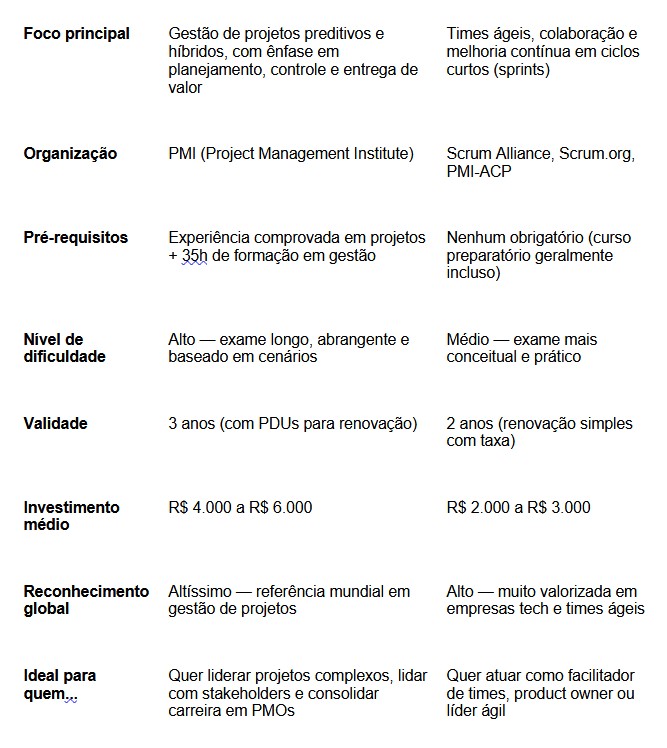
PMP vs Scrum Master: the side-by-side comparison
How to choose the right certification for you
✅ Choose PMP if you:
⚫ Already work with project management
⚫ Are looking for strategic roles such as Project Manager, PMO Specialist or Portfolio Manager
⚫ Like structure, planning and governance
⚫ Want to broaden your strategic and global view of management
⚫ Work in (or intend to work in) corporate environments or large-scale projects
✅ Choose Scrum Master if you:
⚫ Are starting out in the projects field or switching careers
⚫ Want to enter the agile world
⚫ Work (or want to work) with technology, product or innovation teams
⚫ Value collaborative, dynamic environments with fast experimentation
⚫ Prefer facilitating processes over controlling them
Study Roadmap: PMP 2026
1. Understand the current exam format
⚫ Based on PMBOK 7th Edition + Agile Practice Guide
⚫ Focus on three domains: People (42%), Process (50%), Business Environment (8%)
⚫ 180 questions in 230 minutes, situational and hybrid questions
2. Build your study plan (8 to 12 weeks)
⚫ Complete the 35-hour prep course (mandatory for eligibility)
⚫ Study PMBOK 7 and the Agile Practice Guide
⚫ Classic materials: Rita Mulcahy, Prepcast, Udemy (Andrew Ramdayal)
⚫ Focus on agile mindset and decision making
3. Practice with realistic mock exams
⚫ Goal: keep a consistent 75% score
⚫ Take at least 3 full mock exams before the test
4. Schedule and take the exam
⚫ Available online or in person
⚫ Prepare mentally: stamina and focus are essential
Study Roadmap: Scrum Master
1. Choose your certifying body
⚫ PSM I (Scrum.org): more technical, no mandatory course
⚫ CSM (Scrum Alliance): requires an official course, more community-oriented
2. Study the theoretical foundation (1 to 3 weeks)
⚫ Read the 2020 Scrum Guide (official, free document)
⚫ Understand the roles: Scrum Master, Product Owner, Developers
⚫ Master the pillars: transparency, inspection and adaptation
⚫ Understand Scrum events, artifacts and commitments
3. Practice with mock exams
⚫ Goal: 90% correct answers before the official test
⚫ Use free mock exams from Scrum.org
4. Get certified and apply the knowledge
⚫ Join agile communities (Meetups, Agile Brazil, LinkedIn groups)
⚫ Start facilitating ceremonies, even informally
The final verdict
🎯 If your goal is to lead complex projects and grow strategically: go with PMP.
🚀 If you want to be a reference in agility and innovation: bet on Scrum Master.
💡 And if you can, combine both: the market will become increasingly hybrid. Professionals who master both the agile framework and strategic planning will be the most sought after, and the best paid.
Conclusion
In 2026, the question won't be “which certification is better?”, but which one makes more sense for your career stage.
Both will open doors. The difference lies in the kind of path you want to follow.
And remember: certification is not a finish line. It's fuel for the next level.
Translated from the Brazilian Portuguese original · Read the original