

Google reinforces in updated guide that structured data and quality content define GEO
Search Central updated the official guide on AI Overviews and AI Mode in December 2025. The core message is uncomfortable for those selling GEO tricks: there is no new technical requirement, just well-executed fundamental SEO.

On December 10, 2025, Google updated the official "AI features and your website" page on Search Central, which explains how AI Overviews and AI Mode decide which sites appear in AI-generated answers. It is not an announcement of a new product: it is the reference documentation that SEO and GEO teams use to calibrate strategy. And its main message undermines much of the market discourse around "AI optimization."
In short: according to Google itself, there is no separate set of technical requirements for appearing in AI Overviews or AI Mode. The bar is the same as traditional Search, and what changes is how content is selected and combined into the answer.
What the guide says (and why it contradicts part of the GEO hype)
The documentation is direct: "To be eligible to appear as a supporting link in AI Overviews or AI Mode, a page needs to be indexed and eligible to appear in Google Search with a snippet, meeting Search's technical requirements. There are no additional technical requirements." This means that the entire ecosystem of tools selling "special schema for AI" or "exclusive LLM optimization" has no backing in the very source that defines the rules of the game.
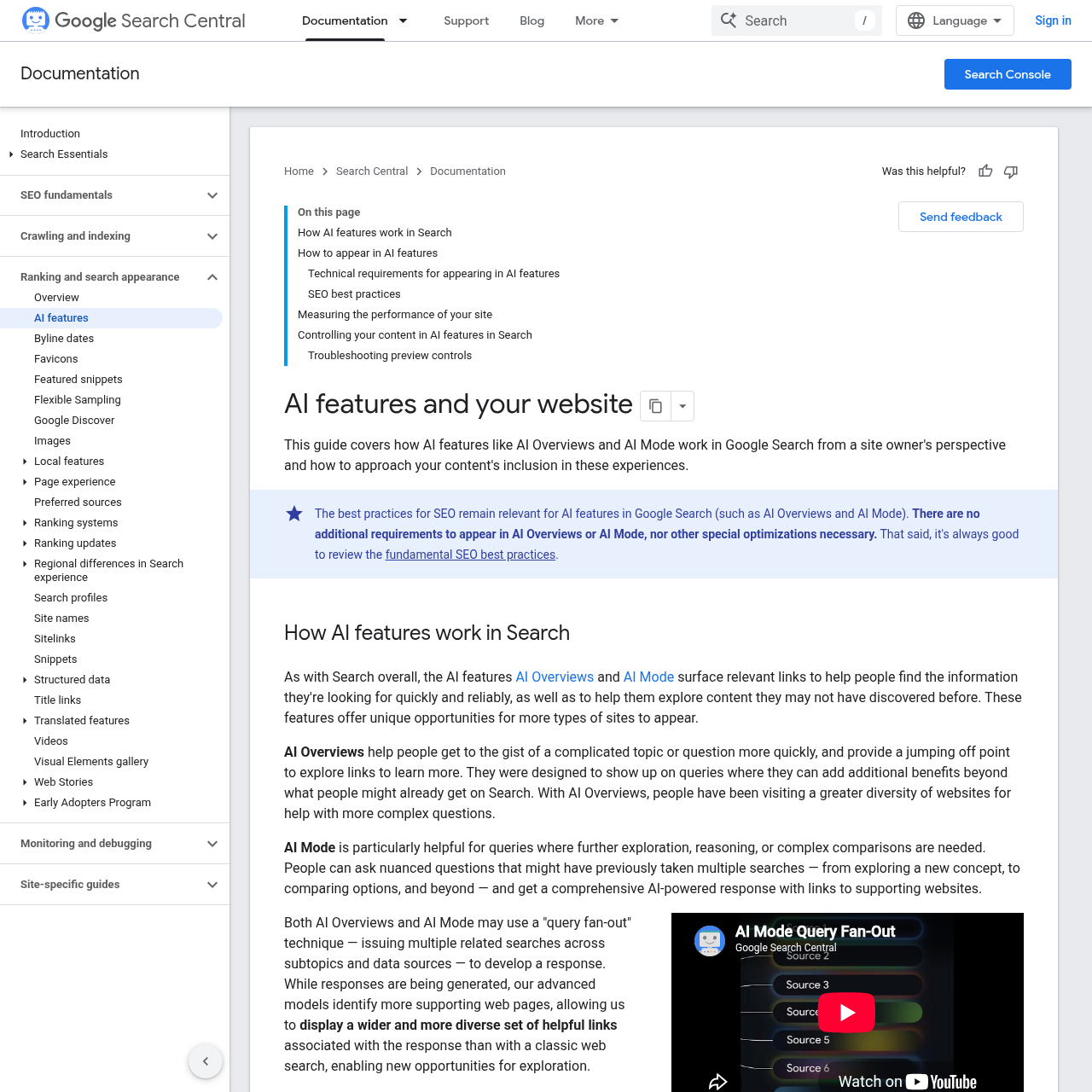
What exists, according to Google, is the list of SEO best practices that already applied before and still apply: robots.txt allowing crawling, internal links that make content discoverable, good page experience, explicit textual content, quality images and videos supporting the text, structured data that matches the visible content, and up-to-date information in Merchant Center and Business Profile for those who depend on product or local business data.
How AI Overviews and AI Mode choose who appears
Both features use what Google calls "query fan-out": the system fires off multiple related searches across different subtopics and data sources to build an answer. While the answer is generated, Google's models identify additional supporting pages, which allows a broader and more diverse set of links to be shown than in a classic search.
AI Overviews and AI Mode can use different models and techniques from each other, so the set of answers and links varies from one feature to the other. A point that often frustrates those measuring GEO: according to Google, AI Overviews only appear when the systems determine that doing so adds something beyond classic search, and because of that they are frequently not triggered. There is no guarantee of appearance even with technically perfect content.
The technical checklist, translated for GEO practitioners
Translating Google's list into auditable items:
- The page is indexed and eligible to appear with a snippet in regular Search (minimum prerequisite, without which there is no AI Overview or AI Mode)
- The site's
robots.txtand that of any CDN or hosting infrastructure allows Googlebot crawling - The internal link architecture makes content easy to find from other pages on the same site
- The page delivers a good experience (Core Web Vitals, usability, absence of aggressive interstitials)
- Important content exists in textual form, not just embedded in images or video without a transcript
- Supporting images and videos are of quality and reinforce the text, when applicable
- The page's structured data matches the visible text
- Merchant Center and Business Profile, when they exist, are up to date
Structured data: the requirement few teams audit
The most specific item on the list, and the one that matters most to those doing GEO, is the correspondence between structured data and visible content. Google does not ask for a new schema for AI: it asks that the existing schema (Product, Article, FAQPage, Organization, among others) describe exactly what is on the page, with no lag.
There's a practical reason for this. If a product's schema states a price or availability that the visible text doesn't confirm (or that has already changed), the AI system doing the query fan-out has an inconsistent source to cite, and tends to prefer a more coherent competing page. Auditing this correspondence becomes a recurring task, not a launch checklist: e-commerce catalogs and editorial content pages that change price, stock, or publication date without updating the corresponding schema carry a direct risk of silent exclusion.
Control: how to limit (or allow) the site's presence in AI answers
The documentation clearly separates crawling control from display control. General crawling is handled in robots.txt for Googlebot. To limit what appears in results without blocking crawling, there are specific directives:
| Control | What it does |
|---|---|
nosnippet | Removes the displayed text snippet, which also removes the page's eligibility for AI Overviews and AI Mode |
data-nosnippet | Blocks specific HTML excerpts from appearing as a snippet |
max-snippet | Limits the size of the displayed snippet |
noindex | Removes the entire page from the index and, consequently, from any AI feature |
Google-Extended | Controls the use of content for training and grounding in other Google AI systems, outside of Search |
It's worth noting that these are suppression tools, not promotion tools: none of them increases the chance of appearing, they only control the visibility of what is already eligible.
How to measure before and after in Search Console
Here is the point that most frustrates those doing GEO in Brazil: there is no separate report for AI Overviews or AI Mode traffic. According to Google, clicks coming from these features enter the Search Console Performance report, under the "Web" search type, along with the rest of organic search.
In practice, this means measuring by proxy. A reasonable approach: segment the Performance report by longer-tail, more informational pages and queries (the query profile that most often triggers fan-out), compare clicks and impressions before and after implementing the technical checklist, and cross-reference with Analytics data on time on page and conversion. Google itself gives a hint about this last point:
We've seen that when people click from search results pages with AI Overviews, these clicks are higher quality (meaning, users are more likely to spend more time on the site).
Google Search Central, official Search documentation
This suggests a KPI complementary to click volume: dwell time and browsing depth of sessions arriving via long queries, even without being able to isolate with certainty that they came from a specific AI Overview.
What the guide doesn't answer
The documentation makes clear what to do, but it doesn't quantify how much weight each practice carries in fan-out selection, nor does it publish a dedicated report for AI Overviews and AI Mode within Search Console. For those doing GEO in Brazil, this means continuing to treat visibility in generative AI as a consequence of well-executed, regularly audited technical SEO, rather than looking for a separate shortcut that, according to the source itself, simply doesn't exist.
Translated from the Brazilian Portuguese original · Read the original
Google documents how nosnippet, max-snippet, and Google-Extended control your brand in AI results
Google updated its Search Central documentation on AI Overviews and AI Mode, detailing which tags control whether and how a site's content appears summarized within AI-generated responses.

