

Google Search Central guide explains how to adjust robots.txt and structured data for AI Overviews and AI Mode
Google Search Central documentation, updated in December 2025, shows there is no extra technical requirement to appear in AI Overviews and AI Mode. What decides it is solid basic SEO, the correct snippet controls, and a careful reading of Search Console.

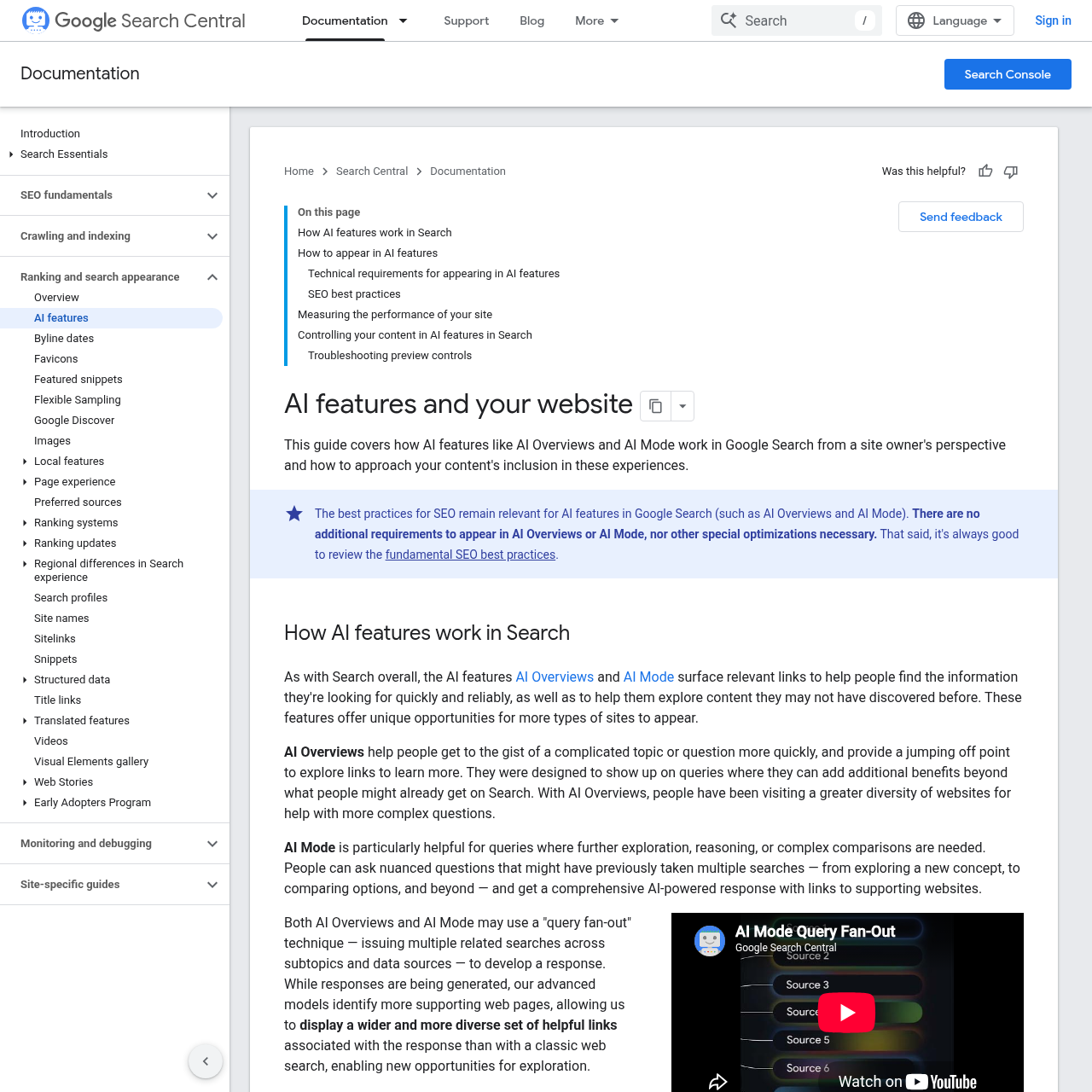
Since December 2025, Google Search Central has maintained a documentation page called AI features and your website (available in Portuguese and other languages) that organizes, from the publisher's point of view, how AI Overviews and AI Mode choose links within Google Search. The document doesn't announce a new feature: it consolidates rules that already applied but were scattered across different help pages. For those working with technical SEO, this changes less what to do and more what to measure.
How AI-generated answers choose links
According to the documentation, both AI Overviews and AI Mode use a technique called "query fan-out": the system triggers several internal searches on subtopics and data sources related to the original question before assembling the final answer. While the text is being generated, Google's models identify the most relevant pages for each of these sub-searches and include them as supporting links. The result is a set of links that, according to the document itself, tends to be more varied than that of a traditional search.
AI Mode is described as more useful for queries that require reasoning, comparing options, or digging deeper into a topic, replacing several sequential searches with a single interaction. AI Overviews, on the other hand, only appears when Google's systems understand that the answer adds something beyond what a traditional search would already show, which is why the text itself acknowledges that it "isn't triggered most of the time." It's an additional layer, not a replacement for the classic SERP.
There's no special optimization, but basic SEO still decides
The most direct point in the documentation is also the easiest to overlook: there's no exclusive technical requirement for appearing in AI Overviews or AI Mode. A link is only eligible as a supporting source if the page is already indexed and can be shown with a snippet in traditional search. In other words, the bar for entry is the same bar as regular search.
Google lists the best practices that still apply, none of which is new to anyone who already does technical SEO:
- Make sure
robots.txtand any CDN or hosting infrastructure allow crawling - Make content easy to discover with internal links
- Offer good page performance for site users
- Make sure essential content is available as text, not only as image or video
- Support text content with good-quality images and videos when it makes sense
- Keep structured data (
schema markup) consistent with the visible text on the page - Keep information up to date in Merchant Center and Business Profile, when applicable
- Verify site ownership in Search Console to quickly detect technical issues
The real controls (and what doesn't exist)
Here's a useful correction for those following GEO discussions on social media: the documentation does not create a noai meta tag. The set of controls Google recognizes to limit what appears with a snippet, including in AI-generated answers, is the same as always: nosnippet, data-nosnippet, max-snippet, and noindex. Anyone applying a made-up tag is simply failing to block anything.
An example of fully blocking a snippet via meta tag:
<meta name="robots" content="nosnippet">To block only a specific excerpt of the text, without removing the entire page from the snippet:
<p>Text that can normally appear.
<span data-nosnippet>Excerpt that should not become a snippet or an AI answer.</span></p>
Separate from that is Google-Extended, a specific user-agent in robots.txt that controls whether content can feed training and grounding for other Google AI systems, outside of Search:
User-agent: Google-Extended
Disallow: /
These are two different layers: nosnippet and friends decide what appears in search, Google-Extended decides whether content feeds AI models outside of search. Blocking one doesn't automatically block the other, and that's the kind of confusion that generates viral but wrong posts about "the tag that removes your site from AI."
How to measure before and after in Search Console
The documentation confirms something that changes how GEO reports are put together: traffic from AI Overviews and AI Mode gets mixed into the "Web" search type in the Search Console performance report, together with traditional search. Today, there's no separate filter for "clicks coming from an AI answer" within the tool.
In practice, this means measuring the specific impact of a schema markup or robots.txt adjustment on AI Overviews requires indirect work: comparing the behavior of queries that historically trigger AI answers before and after the change, instead of looking for an isolated number inside Search Console. It's analyst work, not a ready-made dashboard.
The document also mentions something relevant to justify this effort: clicks coming from pages featured in AI Overviews tend to be of "good quality," with a higher chance that the visitor spends more time on the site. This is measurable in Google Analytics, by looking at session time and conversion for the segment of landing pages that appear as sources for these answers, cross-referenced with the queries identified in Search Console.
When the snippet control isn't respected
For those who applied nosnippet or noindex and still see the content appearing in AI answers, the documentation recommends a verification sequence:
- Confirm that the control is correct and visible to Googlebot, using the URL inspection tool to see the HTML the crawler actually received
- Give Google time to recrawl and process the change, which can take from a few days to several months, depending on how often that type of page is updated
- Request a new crawl of the affected pages, if the change was recent
- If the problem persists even after that, report the case in the Google Search Central support community
What remains open for those publishing in Portuguese
The documentation is the same across all languages, but it doesn't detail the rollout pace of AI Overviews and AI Mode by market. For those publishing in Brazilian Portuguese, the practical approach is to track, query by query, whether their own niche already triggers these answers before investing time in fine-tuning schema markup specifically with generative AI in mind. Without that, GEO work turns into optimization for a scenario that may not yet exist for that specific audience, and the effort should stay focused on what Google itself reinforces: solid technical SEO, without the workaround of a meta tag that doesn't exist.
Translated from the Brazilian Portuguese original · Read the original
Google reinforces in updated guide that structured data and quality content define GEO
Search Central updated the official guide on AI Overviews and AI Mode in December 2025. The core message is uncomfortable for those selling GEO tricks: there is no new technical requirement, just well-executed fundamental SEO.

